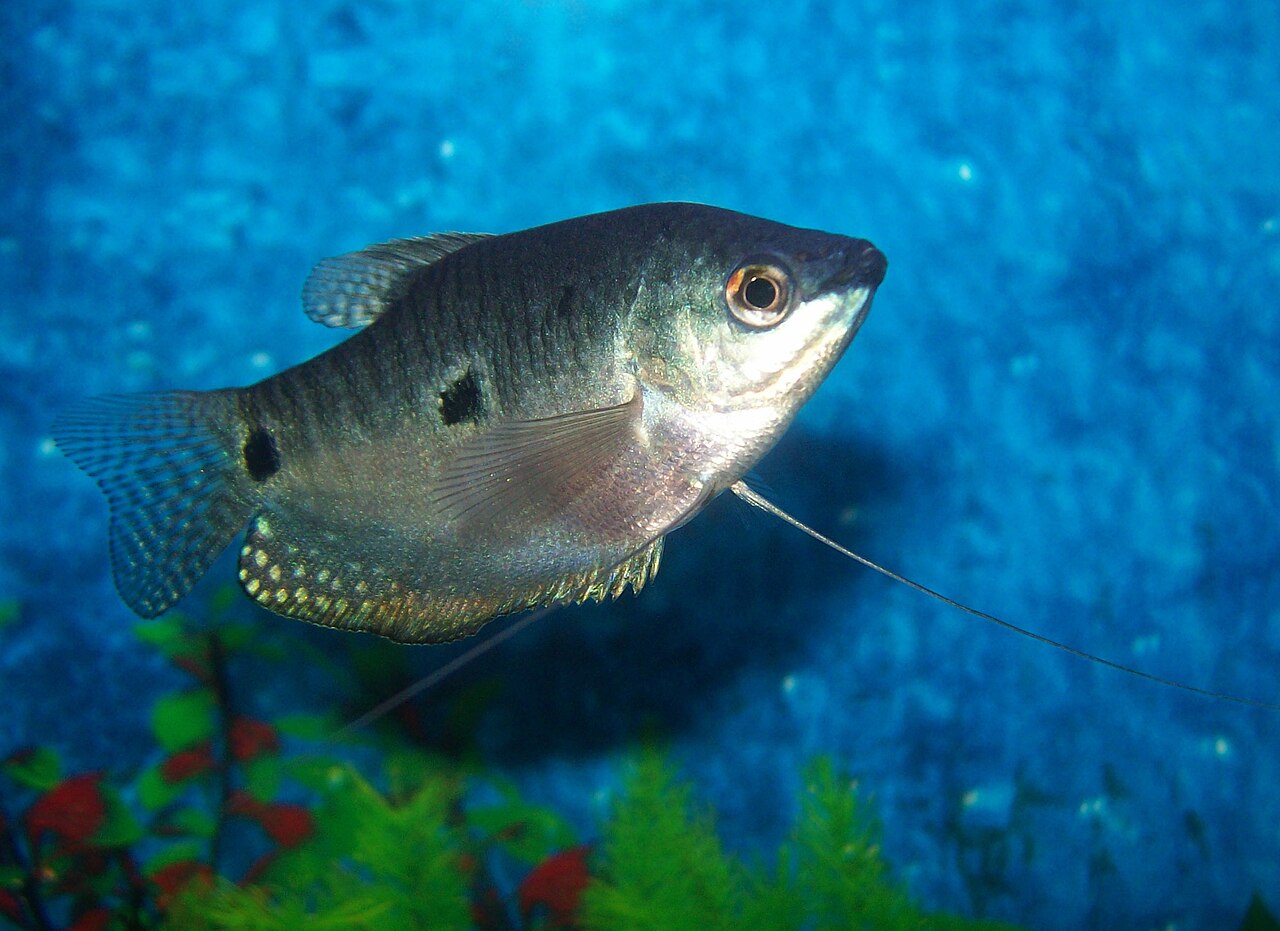
Blue gourami
Trichopodus trichopterus
Origin: Southeast Asia: from Yunnan (China) through mainland Southeast Asia and the Malay Peninsula to Java, Sumatra and Borneo.
Also known as: Sumatran gourami, Trichogaster trichopterus sumatranus
Fact sheet
- Size
- 15 cm
- Lifespan
- 6 years
- Minimum tank size
- 80 L
- Temperature
- 24–28 °C
- pH
- 6–7.8
- Hardness GH
- 4–20 °dH
- Temperament
- Semi-aggressive
- Social behavior
- In pairs
- Group size
- 2+ individuals
- Swimming zone
- Middle, Top
- Diet
- Omnivore
- Jumps out
- Yes
Overview
The blue form of the three spot gourami; Russian Wikipedia also describes it as the subspecies T. t. sumatranus. Care is the same as for the species; it is considered especially hardy and tolerant of lower temperatures.
Appearance
A silvery-blue body without dark bars, on which the two black spots — mid-body and near the tail — stand out clearly. The anal, dorsal and tail fins are bluish with small light spots; the pelvic threads are pale. The photo shows a female with a rounded dorsal fin.
Care
Shared with the species: Gourami
- Tank: from 80 L for several pairs.
- Temperature: 24–28 °C; keeping below 24 °C is not recommended.
- Water: pH 6.0–7.8, general hardness 4–20 °dGH.
- Free access to the surface is essential: gouramis breathe atmospheric air.
- A lid is a must: it stops the fish jumping out and keeps the air above the water warm, as gulping cold air can make them ill.
- Plenty of live plants and several hiding places (driftwood, caves); dark substrate shows off the colours.
- Good filtration without strong flow; aeration is optional.
- Water changes: 1/5 to 1/3 of the volume weekly.
Lifespan in the aquarium, according to Tetra, is 4–6 years on average.
Feeding
Shared with the species: Gourami
The three spot gourami is an omnivore. In the wild it feeds on zooplankton, crustaceans and insect larvae.
In the aquarium, base the diet on quality dry food (flakes, granules), including algae-based food. Add bloodworms, tubifex, brine shrimp, daphnia and mosquito larvae — live, frozen or freeze-dried.
Feed young fish several times a day. Gouramis are greedy, so avoid overfeeding; adults tolerate a week without food without harm.
Compatibility
Shared with the species: Gourami
Gouramis get along with peaceful fish of similar size: platies, swordtails, rainbowfish, tetras, peaceful catfish, angelfish.
Males are territorial and may fight each other, and with age some become aggressive towards other tankmates as well. They often harass fish with long, bright fins, such as male guppies, bettas and goldfish. With several males, provide plenty of cover; keep at least two females per male.
Avoid fin-nippers (e.g. tiger barbs) and large aggressive cichlids. Small fish and fry will be eaten.
Breeding
Shared with the species: Gourami
Gouramis mature at about 8–12 months. Breeding is easy: the male builds a foam nest at the surface from air bubbles stuck together with saliva, often with bits of floating plants.
- Breeding tank: 20–50 L, water level 10–15 cm, floating plants (riccia, hornwort), no strong filter.
- Trigger: raise the temperature to 26–28 °C and replace part of the water with fresh soft water.
- The male wraps around the female under the nest and squeezes out the eggs. According to English Wikipedia and Tetra, a female can lay up to 800 eggs; a typical clutch is about 50–200.
- The eggs float; the male gathers them into the nest and guards them. Remove the female right after spawning.
- Larvae hatch after 24–48 hours and live off the yolk sac for about three more days.
- Once the fry swim freely, remove the male too. First foods: infusoria and fine zooplankton.
The fry's labyrinth organ only develops after 2–3 weeks, so frequent water changes, gentle aeration and stable temperature are important during this time.
Fun facts
Shared with the species: Gourami
- The "three spots" are two spots on the side plus the eye.
- Gouramis breathe atmospheric air and, according to Russian Wikipedia, can survive 6–8 hours out of water if their gills stay moist.
- For a long time the fish died in transit in sealed barrels. Once people noticed that gouramis rise to the surface for air, the barrels were filled only two-thirds and left open — and in 1896 three spot gouramis reached Europe.
- The blue form has been known in Europe since 1934.
- In its native range the species is caught and farmed as a food fish.
- It has been introduced far outside its native range, e.g. to the Philippines, India and Trinidad.
- In the flood season the fish migrate from permanent waters into flooded forests, for example in the Mekong basin.
- Gouramis readily eat freshwater hydra, and according to Tetra they can knock flying insects down with a jet of water.