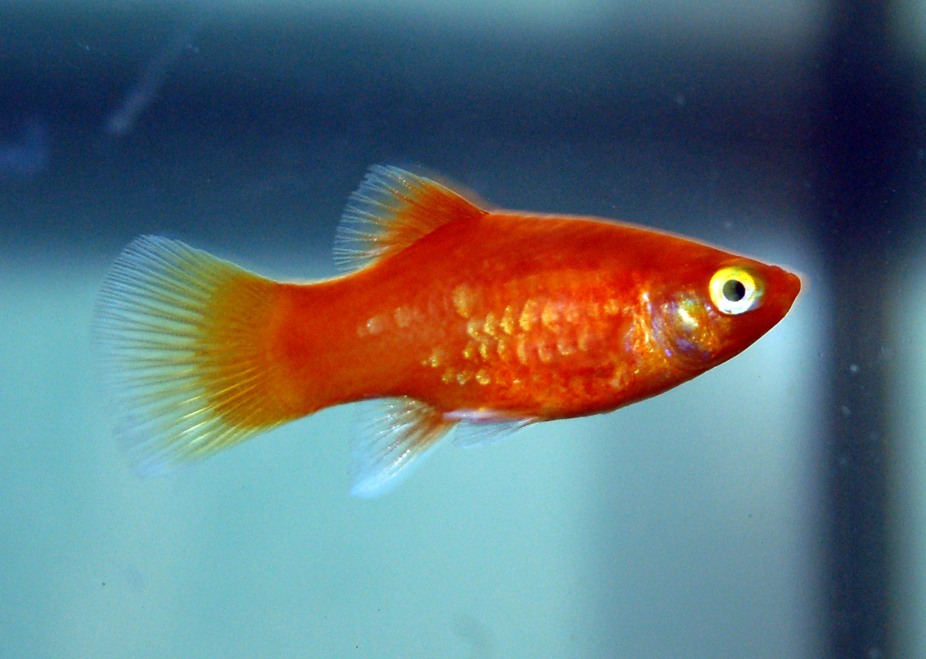
Red platy
Xiphophorus maculatus
Origin: North and Central America: from Veracruz, Mexico, to northern Belize.
Also known as: red coral platy
Fact sheet
- Size
- 6 cm
- Lifespan
- 3 years
- Minimum tank size
- 40 L
- Temperature
- 18–28 °C
- pH
- 6.8–8
- Hardness GH
- 9–28 °dH
- Temperament
- Peaceful
- Social behavior
- Schooling
- Group size
- 6+ individuals
- Swimming zone
- Top, Middle
- Diet
- Omnivore
- Jumps out
- Yes
Overview
A selectively bred form of the platy (Xiphophorus maculatus) with a solid red body. Care is the same as for the common platy.
Appearance
The body is evenly coloured from orange to bright red, with fins matching the body or translucent. Fish with a red body and a black tail belong to a different group. The photo shows a red coral female with yellowish translucent fins.
Care
Shared with the species: Platy
- Volume: at least 15 L per pair, but platies are best kept in groups of 6 or more, so a 40–60 L tank is recommended. Keep more females than males.
- Temperature: 24–27 °C is optimal (Tetra); English Wikipedia gives ranges of 18–25 °C and 22–28 °C.
- Water: pH 7–8 (6.8–8 is also quoted), general hardness from 9–10 up to 20 °dGH (some sources say up to 28). Platies like hard water and get sick more often in very soft water.
- Filtration and aeration are a must, especially in a well-stocked tank. Use a heater — room temperature may not be enough.
- Moderate lighting; a dark, fine substrate (3–6 mm) works well.
- Plants: plenty of them (Cryptocoryne, Echinodorus, Elodea, hornwort), plus Riccia as cover for fry. Leave open swimming space.
- A lid is essential — platies jump.
- Water changes: up to 20% weekly.
- Platies tolerate a little salt, but use salt only as a medication.
Platies live about 3–4 years.
Feeding
Shared with the species: Platy
The platy is an omnivore. In the wild it eats plant matter, algae and small animals — crustaceans, insects and worms.
In the aquarium platies are not fussy and accept any food. They feed in the upper and middle water layers, so flakes and crisps suit them well. Always include food with a plant component (e.g. spirulina) — they need the fibre for good digestion. Bloodworms, daphnia and other live or frozen foods make good occasional treats.
Feed several times a day in small portions that the fish finish within a couple of minutes.
Compatibility
Shared with the species: Platy
Platies are peaceful and get along with their own kind and with other species. The best tank mates are calm, small fish that also like hard water: guppies, mollies, swordtails, some catfish and rainbowfish.
Angelfish, tetras, danios, gouramis and barbs are also fine, as long as the tank has enough hiding places.
Do not keep platies with large aggressive cichlids (oscars, acaras) or with coldwater fish such as goldfish and koi. Keep in mind that adult fish — platies included — eat fry.
Breeding
Shared with the species: Platy
Platies are livebearers: fertilisation is internal, the eggs develop inside the female and she gives birth to fully formed fry. They breed so readily that, as fishkeepers say, it is harder to stop them breeding than to get them started.
- Maturity: 3–4 months according to English Wikipedia, 5–6 months according to Tetra.
- Gestation: 1.5–2 months according to Tetra; English Wikipedia notes that a female may give birth about once a month.
- Brood size: usually 20–40 fry (figures of up to 50 and up to 80 are also given). Birth takes about 5 hours on average.
- Before giving birth, the dark spot near the female's anal fin becomes more visible and she hides more often.
- Females can store the male's sperm for a long time.
- To save the fry, move the female to a separate tank (about 20 L, water from the main tank, filter and aeration, around 25 °C, floating plants and moss). Remove her after the birth.
- Fry are about 7 mm long at birth and start eating right away: fry food, crushed flakes, live and frozen foods all work. Feed 4–6 times a day.
- Fry are easily sucked up by a gravel siphon — cover its opening, for example with fine mesh.
- The sex of the young becomes visible at about one month.
Fun facts
Shared with the species: Platy
- The name "platy" comes from the old genus name Platypoecilus. The "true" Poecilia are a different genus that includes guppies and mollies.
- Platies readily interbreed with green swordtails, and many aquarium strains of both fish come from these hybrids.
- The platy genome was sequenced in 2013.
- Platies have three sex chromosomes — W, X and Y. Together with genes on other chromosomes they create a very complex sex-determination system; for example, WY fish develop as females.
- Released platies have established themselves in several US states and in Puerto Rico. In Hawaii they have been linked to the decline of native damselflies.
- The species was described by Albert Günther in 1866.