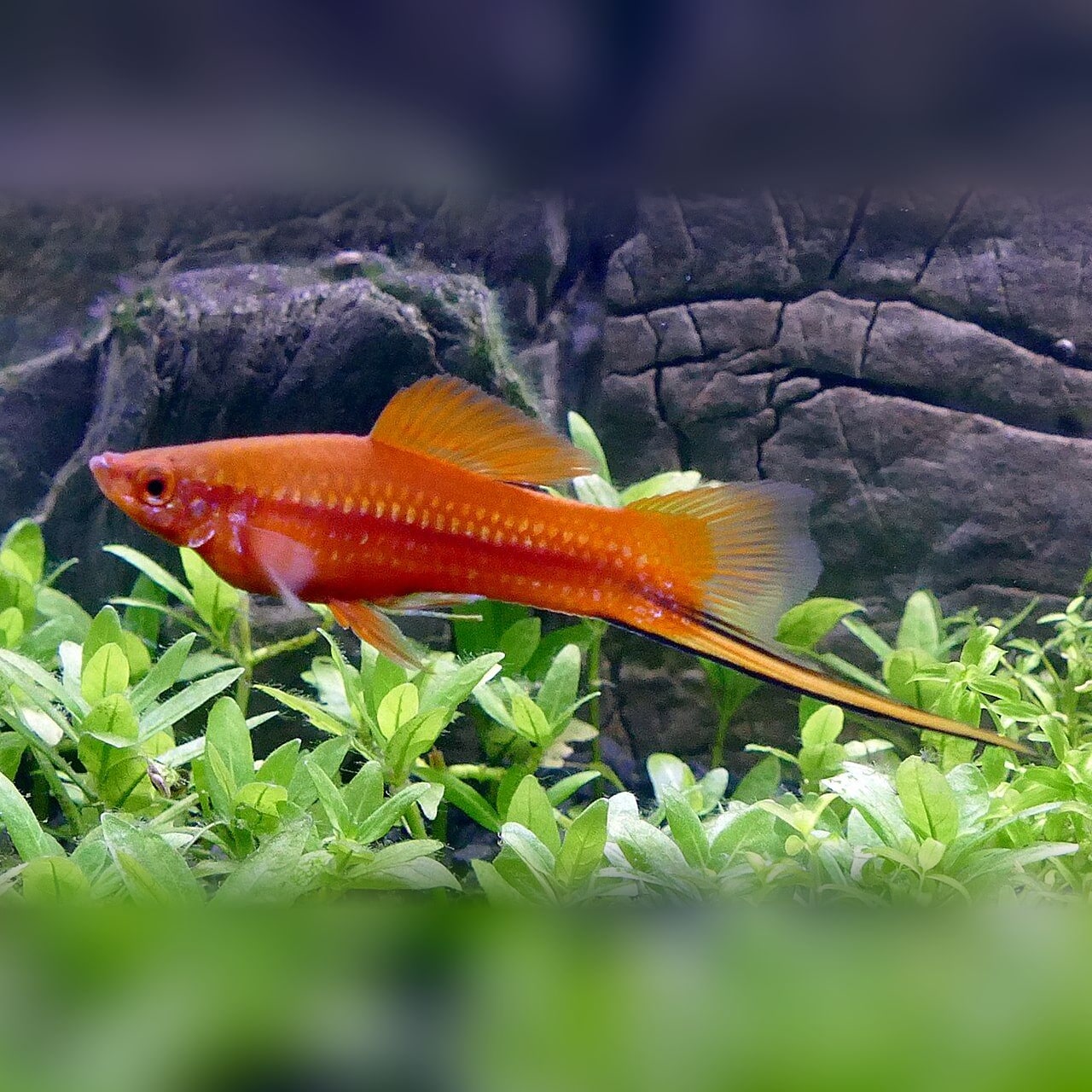
Red swordtail
Xiphophorus hellerii
Origin: Мексика (Веракрус) — Гондурас: быстрые реки и ручьи Центральной Америки
Also known as: Red swordtail, Xiphophorus hellerii var. Red
Fact sheet
- Size
- 16 cm
- Lifespan
- 5 years
- Minimum tank size
- 60 L
- Temperature
- 20–28 °C
- pH
- 7–8
- Hardness GH
- 8–25 °dH
- Temperament
- Peaceful
- Social behavior
- Harem
- Group size
- 6+ individuals
- Swimming zone
- Middle, Top
- Diet
- Omnivore
- Jumps out
- Yes
Overview
A selectively bred color form of the green swordtail that does not occur in nature; the red platy was also involved in its development. Care is the same as for the species.
Appearance
The body and fins are solid bright red or orange. The photo shows a male with a long body-colored sword edged in black below.
Care
Shared with the species: Swordtail
Swordtails are active swimmers and require a tank of at least 75 liters (20 gallons) with a minimum length of 90 cm to give them room to move. They prefer water temperatures of 22–26°C (72–79°F), pH 7.0–8.3, and moderately hard to hard water, which reflects their natural habitat in mineral-rich Central American rivers. They appreciate a mix of open swimming space and planted areas for cover, with a secure lid since they are capable jumpers. Strong filtration and regular water changes maintain the water quality they need.
Feeding
Shared with the species: Swordtail
In nature, swordtails are omnivores that consume algae, plant matter, small crustaceans, insects, annelid worms, and other invertebrates. In the aquarium they readily accept high-quality flake food and pellets as a daily staple, benefiting from regular enrichment with live or frozen foods such as brine shrimp, daphnia, bloodworms, and mosquito larvae. Vegetable matter—spirulina flakes, blanched spinach, cucumber, or zucchini—is also important for their digestive health.
Compatibility
Shared with the species: Swordtail
Swordtails are generally peaceful and suitable for community aquariums with a variety of similarly-sized, non-aggressive species. Good tankmates include other livebearers (platies, mollies, guppies), peaceful tetras, danios, rasboras, corydoras, and other bottom-dwelling catfish. Males can be aggressive toward each other, particularly in smaller tanks, so it is advisable to keep only one male per tank under 150 liters, or maintain groups where females significantly outnumber males.
Breeding
Shared with the species: Swordtail
Swordtails are livebearers (ovoviviparous), with internal fertilization via the male's gonopodium and a gestation period of approximately 28 days. A single brood can range from 20 to over 100 fry, with larger, older females typically producing bigger broods. Females should be moved to a heavily planted separate tank or a birthing box before giving birth, as adults will readily eat fry if they have the opportunity. An intriguing biological phenomenon: females can occasionally undergo spontaneous sex reversal, transforming into functional males later in life.
Fun facts
Shared with the species: Swordtail
Swordtails have been established as invasive species in multiple countries including South Africa, Zimbabwe, Namibia, Madagascar, Puerto Rico, Hawaii, and eastern Australia, where released or escaped aquarium specimens have colonized waterways and displaced native fish. Research has shown that the male's sword is a genuine fitness signal: females respond positively to longer swords during mate selection, and males with more impressive swords inhibit the sexual development of younger rival males in the same group.