Plants
Water hedge (Alternanthera reineckii)
Alternanthera reineckii
Origin: South America
Also known as: Alternanthera cardinalis, Telanthera osiris, Alternanthera rosaefolia, water hedge
Fact sheet
- Height
- 50 cm
- Temperature
- 22–28 °C
- pH
- 6.5–7
- Hardness GH
- 5–20 °dH
- Lighting
- Medium
- CO₂
- Recommended
- Growth rate
- Medium
- Placement
- Midground, Background
Varieties
Photos
Overview
Alternanthera reineckii is a stem plant of the amaranth family (Amaranthaceae), known as water hedge. In nature it grows submerged and semi-submerged in marshes, along stream banks and around ponds. Most members of its genus are terrestrial; only a few can live in an aquarium.
It is probably the best-known red aquarium plant. Aquarists value it for its purple-red foliage, which contrasts strongly with green plants, and several cultivars are grown in aquaria.
Appearance
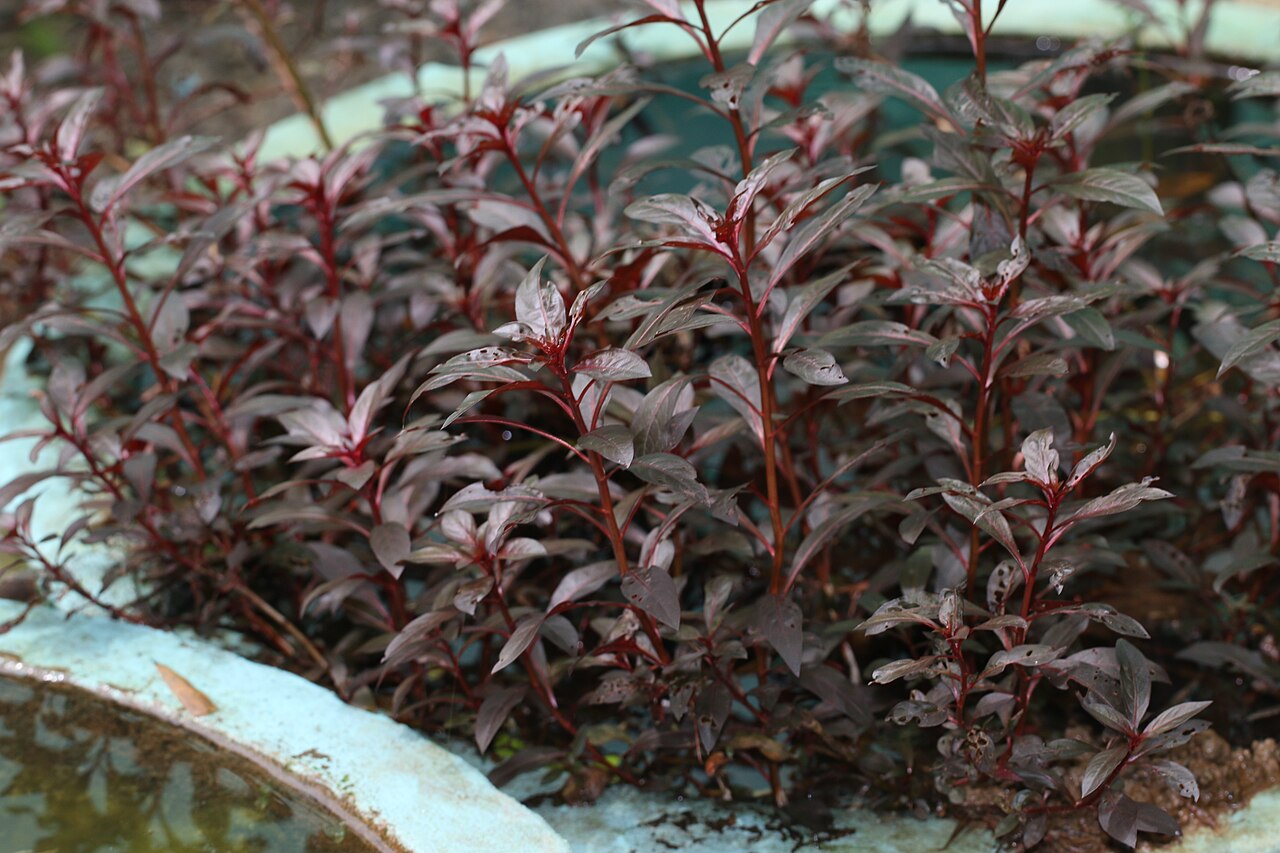
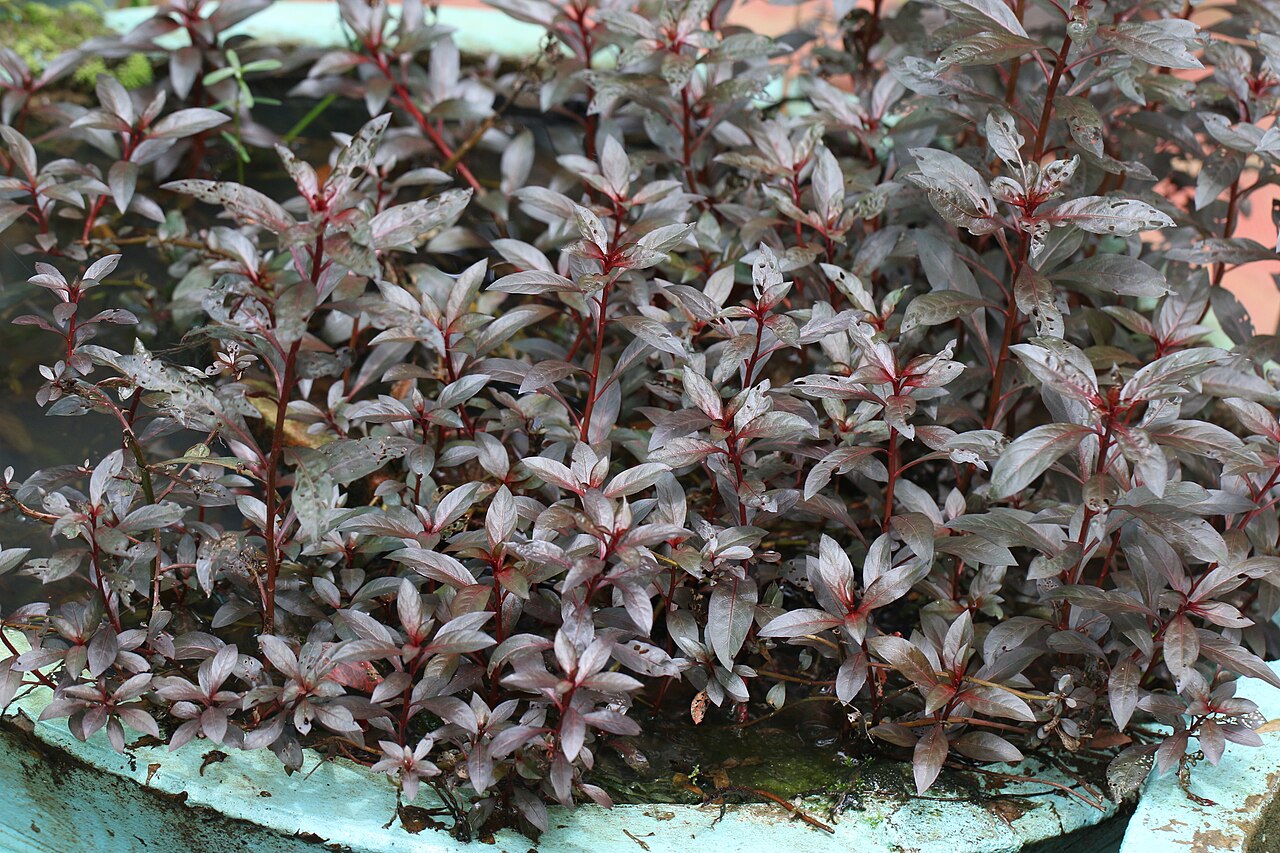
The stem is upright and fairly thick, reaching 20–50 cm in good conditions (English Wikipedia gives up to 30 cm). Aerial roots are easy to see. The leaves are opposite, short-stalked, pointed at the tip and tapering to the base, up to 4 cm long and 1.5 cm wide.
Colour varies: the upper leaf surface is brownish-red, the underside purple or lilac. The red colour comes from anthocyanin, which is produced mainly under strong light; in poor light the plant turns greener. The roots are thin and fibrous. Small white flowers may appear in the leaf axils.
Care
- Placement: midground and background, along the side glass or in the centre of the background; plant in groups of 5–10 stems, but not too close together, as crowded leaves tend to rot.
- Light: Tropica rates its light demand as medium, but strong light is needed for intense colour; a photoperiod of about 9–12 hours is usual, keeping algae in mind.
- CO2: medium demand according to Tropica (6–14 mg/L); with strong light, CO2 injection clearly improves growth.
- Temperature: 22–28 °C.
- pH 6.5–7.0; GH 5–20.
- Substrate: the roots are weak, so use river sand or a light nutrient substrate for plants; avoid frequent replanting.
- Trimming: don't let stems grow above the water surface. Once it reaches the air, the plant sheds its lower submerged leaves. Pinch off the tips regularly, which also makes the plant bushier.
- Change about 20% of the water weekly.
Medium difficulty: Tropica rates it "Medium", and Tetra describes it as fairly demanding.
Fertilizing
It responds well to regular fertilisation. Iron is especially important, because bright colour is impossible without it, and a shortage of micronutrients leads to pale leaves. The plant takes most of its nutrients from the water, so iron-containing liquid fertilisers work best; in densely planted tanks, add complete macro- and micronutrient fertilisers as well.
Breeding
Propagate by cuttings. Nip off the terminal bud and plant it in the substrate; the mother plant then forms more side shoots and becomes bushier. You can also cut an adult stem into pieces with at least four leaf pairs each and let them float. Thin roots appear after about a week, and then the cuttings can be planted.
Fun facts
- The genus name Alternanthera comes from Latin alternus ("alternate") and anthera ("anther").
- In the wild its shoots usually grow above the water, but it can stay fully submerged indefinitely.
- In a humid greenhouse it easily forms dense stands under strong light at air temperatures of 26–30 °C.
- A dwarf form, 'Mini', stays about 5–10 cm tall and can be trimmed into a red-violet carpet.