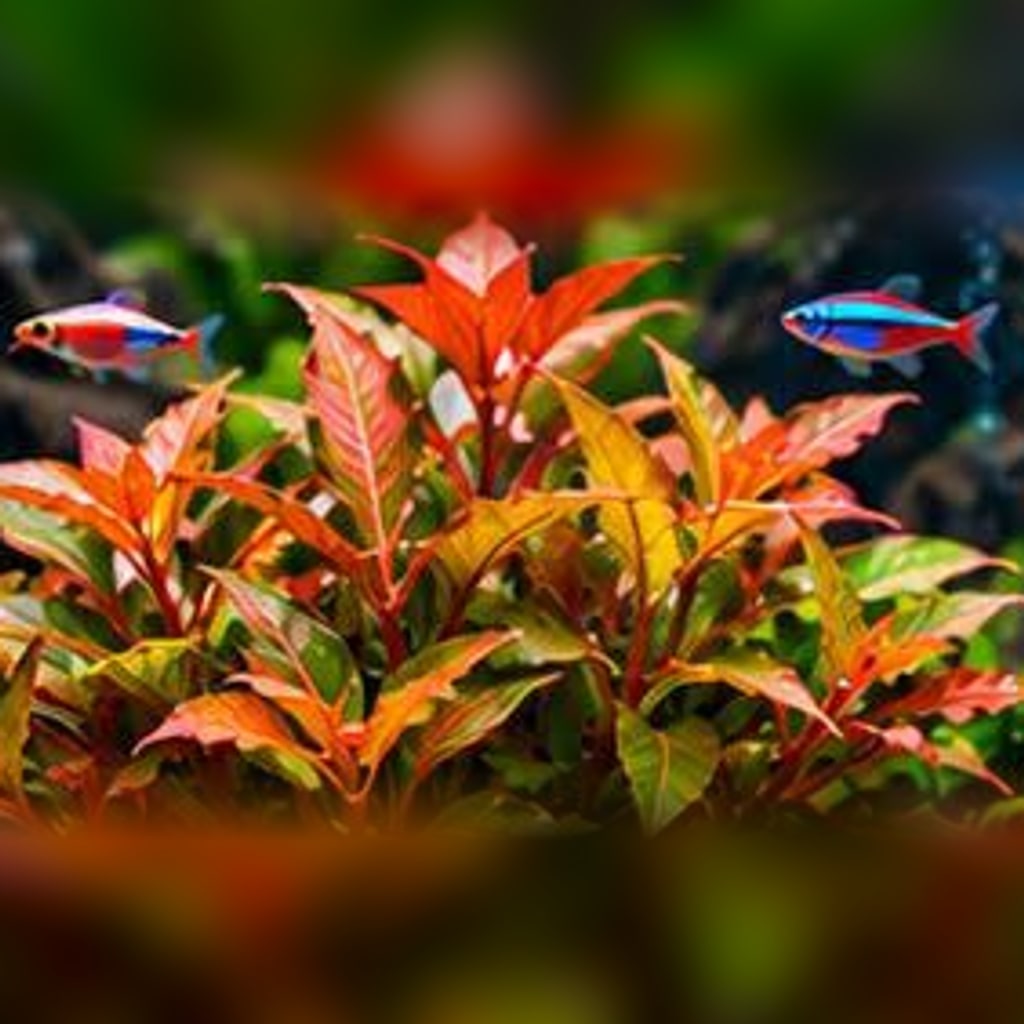
Plants
Ludwigia 'Super Red'
Ludwigia palustris 'Super Red'
Origin: Aquarium form of Ludwigia palustris; the species is near-cosmopolitan — Europe, the Mediterranean, Iran, North and South America, Africa, Asia
Also known as: Ludwigia palustris 'Super Red', marsh seedbox, water purslane, Ludwigia 'Mini Super Red', Ludwigia 'Red'
Fact sheet
- Height
- 30 cm
- Lighting
- Low
- CO₂
- Not needed
- Growth rate
- Medium
- Placement
- Background
Overview
Ludwigia 'Super Red' is an aquarium form of Ludwigia palustris (marsh seedbox, water purslane), an aquatic or semi-aquatic herb of the evening primrose family (Onagraceae). This species is what is sold as Ludwigia 'Super Red', 'Mini Super Red' and 'Red'. It is often confused with its close relative Ludwigia repens, but L. palustris has smaller leaves.
Aquarists love it for its deep red colour, which develops easily, for its willingness to branch and for cuttings that root quickly. Tropica calls it one of the easiest red stem plants; it also suits new tanks, because it grows fast and takes up nutrients, which helps to prevent algae.
Appearance
A compact stem plant: according to Tropica each stalk is 2–4 cm wide and 10–30 cm tall — smaller than Ludwigia repens 'Rubin', and it turns red more easily. The leaves are opposite, narrowly to broadly elliptic, smooth-edged and glossy; submersed plants tend to have elliptic to almost round leaves that are larger than emersed ones.
Colour depends on light: in strong light the plant becomes intensely red and compact; in low light the internodes lengthen, the leaves stay a duller green-red and the lower ones may drop. It can produce aerial roots, which may be left or trimmed off.
Care
- Placement: background; its strong colour makes it a focal point against green plants and dark wood
- Light: Tropica lists a low light demand, but strong light is needed for the best colour and compact growth
- CO2: rated low by Tropica, yet the plant becomes redder and grows better with added CO2
- Substrate: best in a nutrient-rich substrate such as aquarium soil
- Pruning: regular — trimming quickly triggers side shoots and the plant becomes very dense within weeks; eventually remove the lower parts and replant the healthy tops
An easy plant, suitable for beginners.
Fertilizing
Ludwigia palustris is nitrogen-hungry: in high-energy tanks with strong light and CO2 it needs regular dosing of a complete fertiliser. It does best in a nutrient-rich substrate.
Breeding
Propagated by cuttings: tops removed during pruning quickly grow new roots when planted. The trim-and-replant cycle can be repeated indefinitely.
Fun facts
- The epithet palustris is Latin for "of the marsh", after its usual habitat
- Linnaeus first named it Isnardia palustris in 1753; the American botanist Stephen Elliott moved it to Ludwigia in 1817
- It may be the most widespread species of the genus; it has been introduced to Australia and New Zealand and can be invasive there
- The name "water purslane" refers to its leaves and succulent stems, "marsh seedbox" to its unusual cube-shaped, four-angled fruits
- Some sources claim 'Super Red Mini' is not genetically dwarf, its small size being the result of less-than-optimal growing conditions