Fish
Neon tetra
Paracheirodon innesi
Origin: South America: western and northern Amazon basin (southeastern Colombia, eastern Peru, western Brazil).
Also known as: Neon, common neon tetra; obsolete scientific name Hyphessobrycon innesi
Fact sheet
- Size
- 4 cm
- Lifespan
- 3 years
- Minimum tank size
- 50 L
- Temperature
- 22–27 °C
- pH
- 6–7
- Hardness GH
- up to 12 °dH
- Hardness KH
- 1–2 °dH
- Temperament
- Peaceful
- Social behavior
- Schooling
- Group size
- 6+ individuals
- Swimming zone
- Bottom, Middle
- Diet
- Omnivore
- Jumps out
- Yes
- Eats plants
- No
Photos
Overview
The neon tetra is a tiny schooling characin from the Amazon basin and one of the most popular aquarium fish in the world — about 2 million are sold in the US every month.
In the wild it lives in soft, acidic blackwater and clearwater forest streams. Its bright iridescent stripes help the fish see each other in dark water.
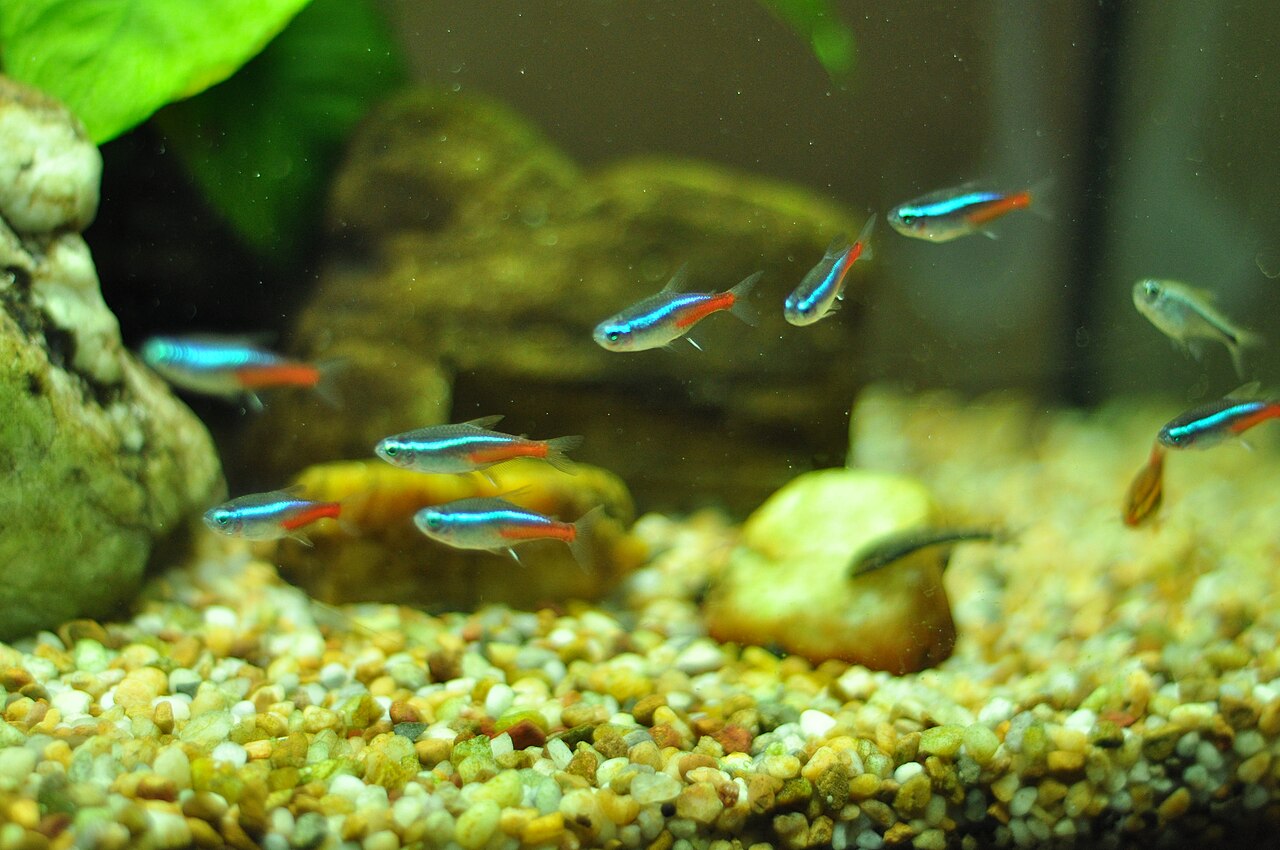
Peaceful and undemanding, the neon looks its best as a school against dense planting.
Appearance
Length is about 4 cm; females reach 4 cm, males are usually 0.5–1 cm smaller.
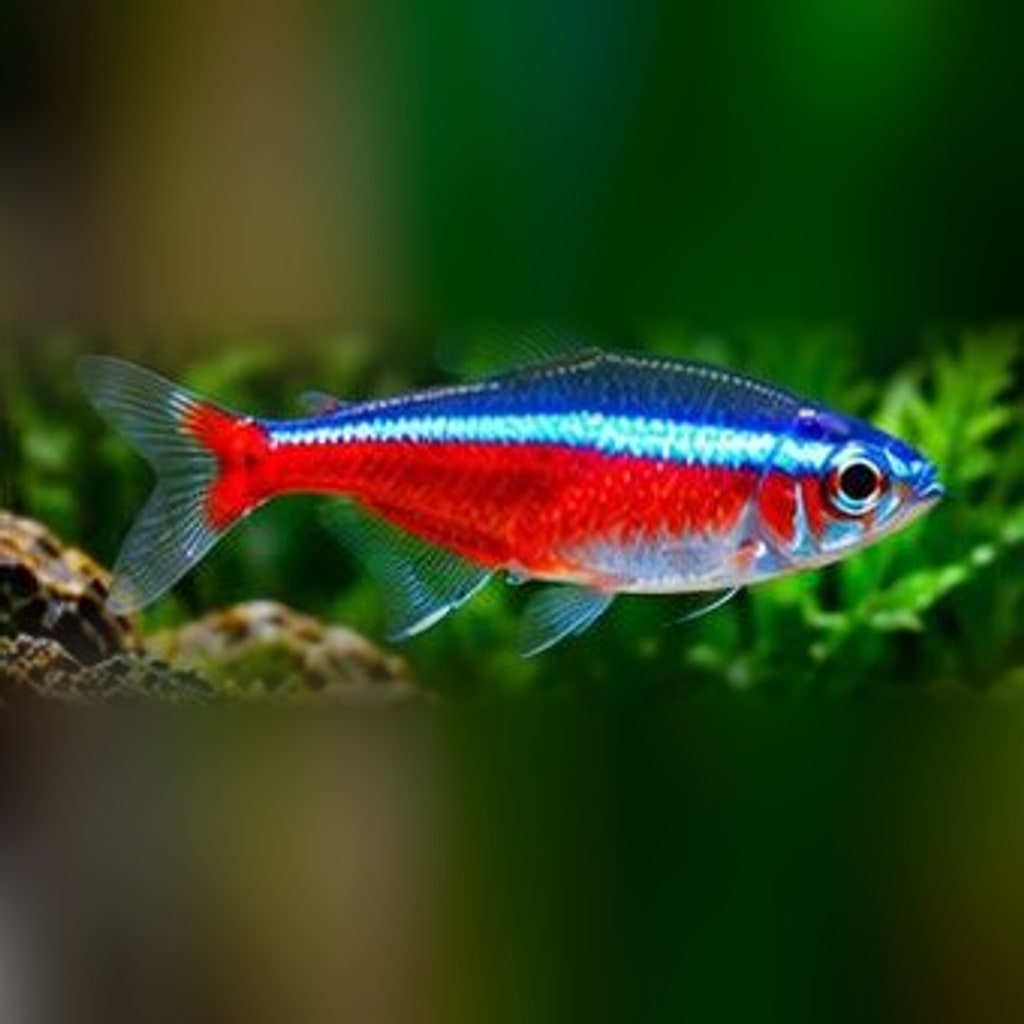
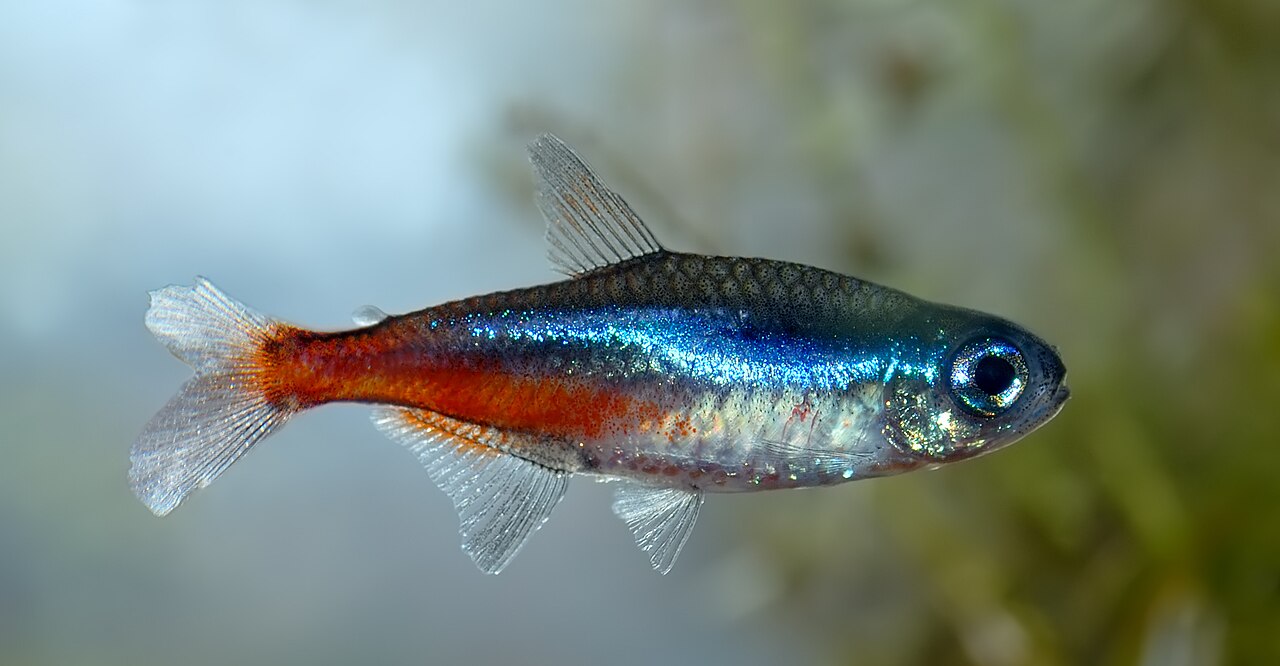
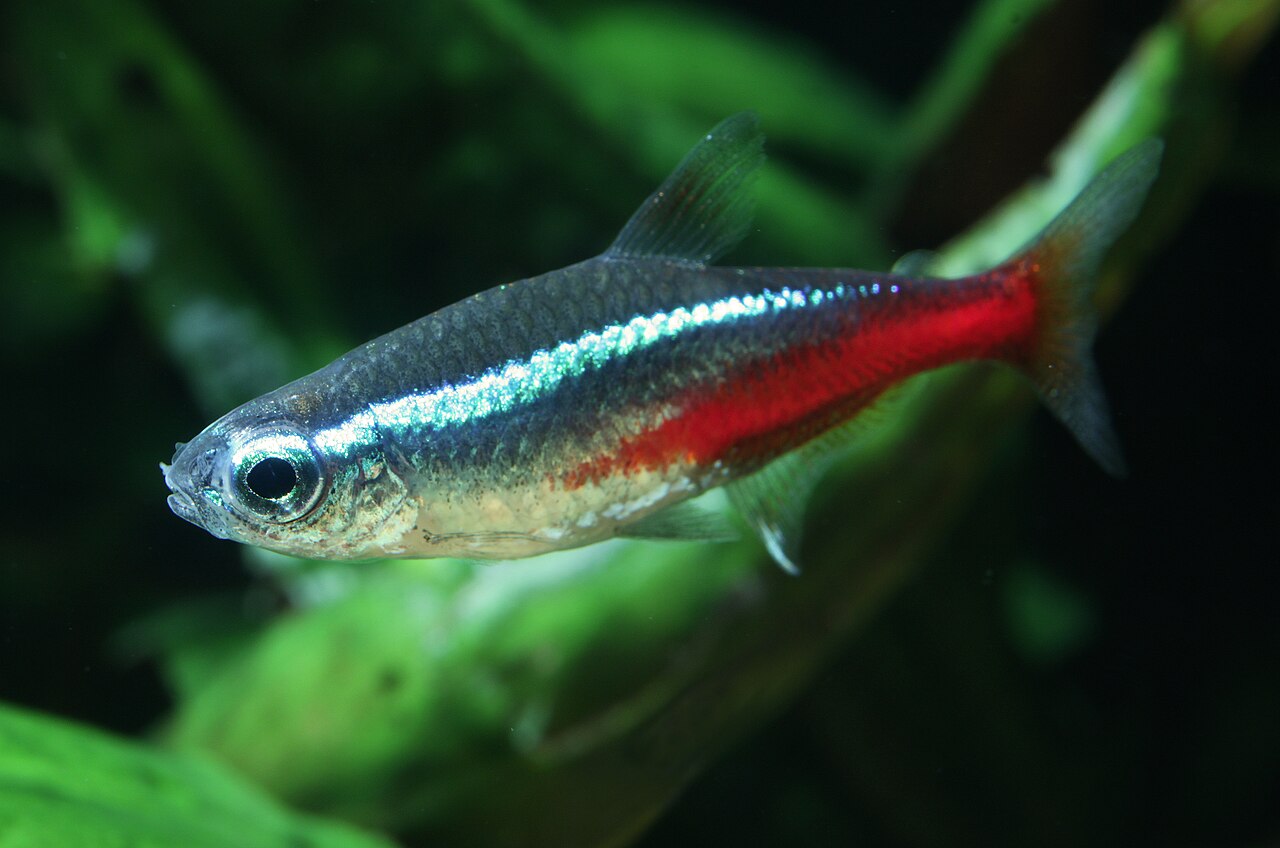
The back is dark olive-grey and the belly silvery. An iridescent turquoise-blue stripe runs from the eye to the adipose fin, and a bright red stripe from mid-body to the base of the tail. The fins are transparent. At night, while resting, the colours fade to grey or black and return in the morning.
Sexual dimorphism is slight: the female is larger and rounder, and her blue stripe is slightly bent in the middle, while the male's is straight.
Care
- Volume: 50 L or more for a school (English Wikipedia gives a minimum of 38 L).
- Group: at least 6 fish, better 10–15 or more — they are more active and look better.
- Temperature: 22–27 °C (English Wikipedia recommends 22–24 °C, the Tetra blog 23–27 °C).
- Water: pH 6.0–7.0, hardness up to 10–12 °dGH, KH 1–2 °dKH, nitrate below 20 ppm.
- Light: moderate.
- Plants: dense planting and a dark substrate, like their native streams.
- Swimming zone: lower and middle water layers.
- Equipment: filter, aeration, heater.
- Lid: essential — neons jump easily.
- Water changes: about 20% weekly.
Neons usually live 3–5 years in an aquarium (English Wikipedia: typically 2–3 years, rarely up to 10).
Feeding
Neon tetras are omnivores. The staple can be good small flakes and micro-pellets; sinking pellets with natural colour enhancers bring out their colours. For variety, offer brine shrimp, daphnia, bloodworms (freeze-dried or frozen) and tubifex.
Feed once a day, as much as they eat in a few minutes. Tubifex and other live foods can carry spores of the "neon tetra disease" parasite, so buy them only from reliable sources.
Compatibility
A peaceful community fish for tanks with similarly calm tankmates: other neons and tetras, cardinals, rasboras, guppies, platies, rainbowfish and cherry barbs. The Tetra blog also lists angelfish as suitable companions.
Large fish, including many cichlids, may treat neons as food. Occasional fights within the group can happen — mostly in a new tank, during spawning or when food is scarce.
Breeding
Breeding neons at home is considered difficult but quite possible.
- Maturity: at 5–8 months (English Wikipedia: from 12 weeks).
- Spawning tank: about 10 L, water depth 10–15 cm, dim light.
- Water: very soft (Russian Wikipedia: 0.5–3 °dH; Tetra blog: GH below 4), pH 5.5–6.5, 22–25 °C, rich in tannins.
- Eggs: a female lays 50–150 eggs.
- Incubation: about a day (20–24 h).
- Fry: live off the yolk sac for the first 4–5 days, then start swimming and feeding.
Fun facts
- The neon tetra was discovered in 1934 by French explorer Auguste Rabaut during an expedition to the Amazon.
- George S. Myers described the species in 1936 and named it after aquarist and publisher William T. Innes.
- The shimmer comes from guanine crystals in skin cells: the stripe looks blue-green in light and indigo in darkness.
- Fewer than 5% of neons sold in the US are wild-caught; the rest are farm-raised, mostly in Southeast Asia.
- A dangerous disease is Pleistophora infection, the "neon tetra disease"; quarantine new fish.
- Bred forms include the long-finned (veil), gold and diamond neon.
- The green neon tetra and the black neon tetra are separate species, not colour varieties of the neon.