Fish
Cardinal tetra
Paracheirodon axelrodi
Origin: South America: upper Orinoco (Colombia, Venezuela) and upper Rio Negro (Brazil).
Also known as: Red neon tetra, cardinal; obsolete scientific names Cheirodon axelrodi, Hyphessobrycon cardinalis
Fact sheet
- Size
- 5 cm
- Lifespan
- 5 years
- Minimum tank size
- 60 L
- Temperature
- 23–27 °C
- pH
- 5.5–7
- Hardness GH
- 1–5 °dH
- Temperament
- Peaceful
- Social behavior
- Schooling
- Group size
- 6+ individuals
- Diet
- Carnivore
- Jumps out
- Yes
- Eats plants
- No
Photos
Overview
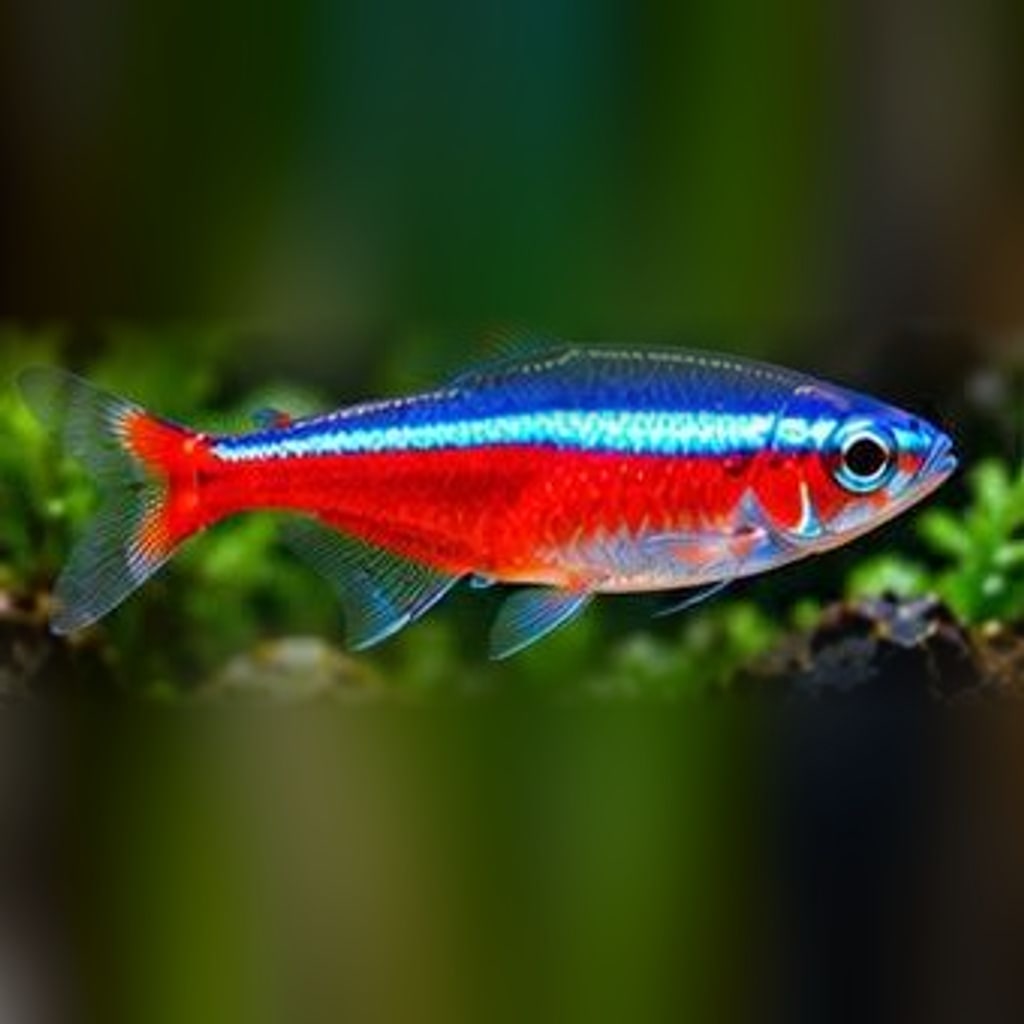
The cardinal tetra is a close relative of the neon tetra and one of the most beautiful aquarium fish. Its name comes from the brilliant red colouring, reminiscent of a cardinal's robes.
In the wild it forages in shallow, slow-moving, plant-rich water. Most cardinals in the trade are still wild-caught: over 92 million were exported from the Brazilian state of Amazonas between 2006 and 2015. The fishery supports thousands of local people and is considered sustainable.
It is a peaceful schooling fish for a calm tank with soft, acidic water and subdued light.
Appearance
Wikipedia gives a length of about 3 cm; according to the Tetra blog, aquarium specimens can reach 5 cm. Cardinals appear to grow larger in captivity than in the wild.
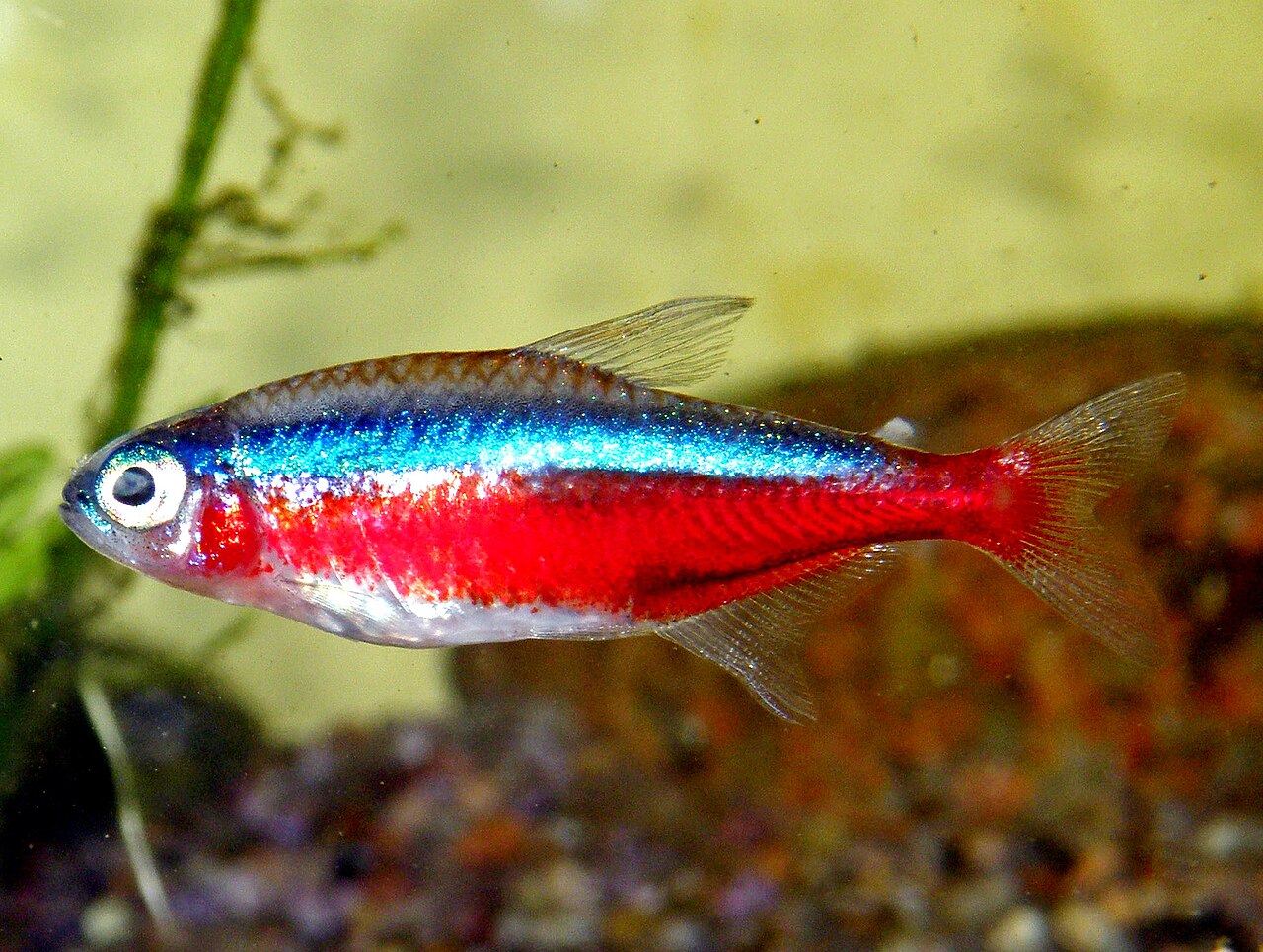
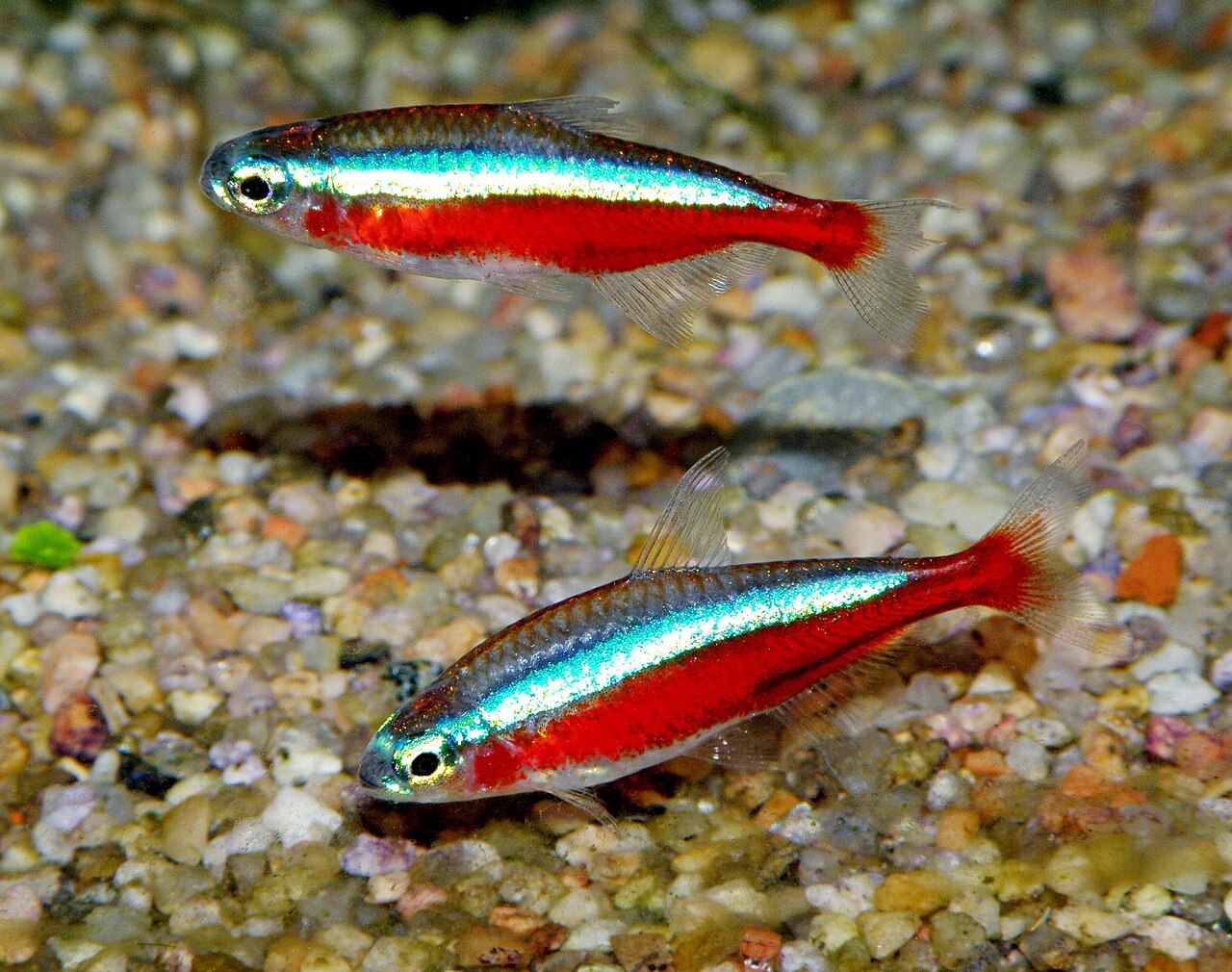
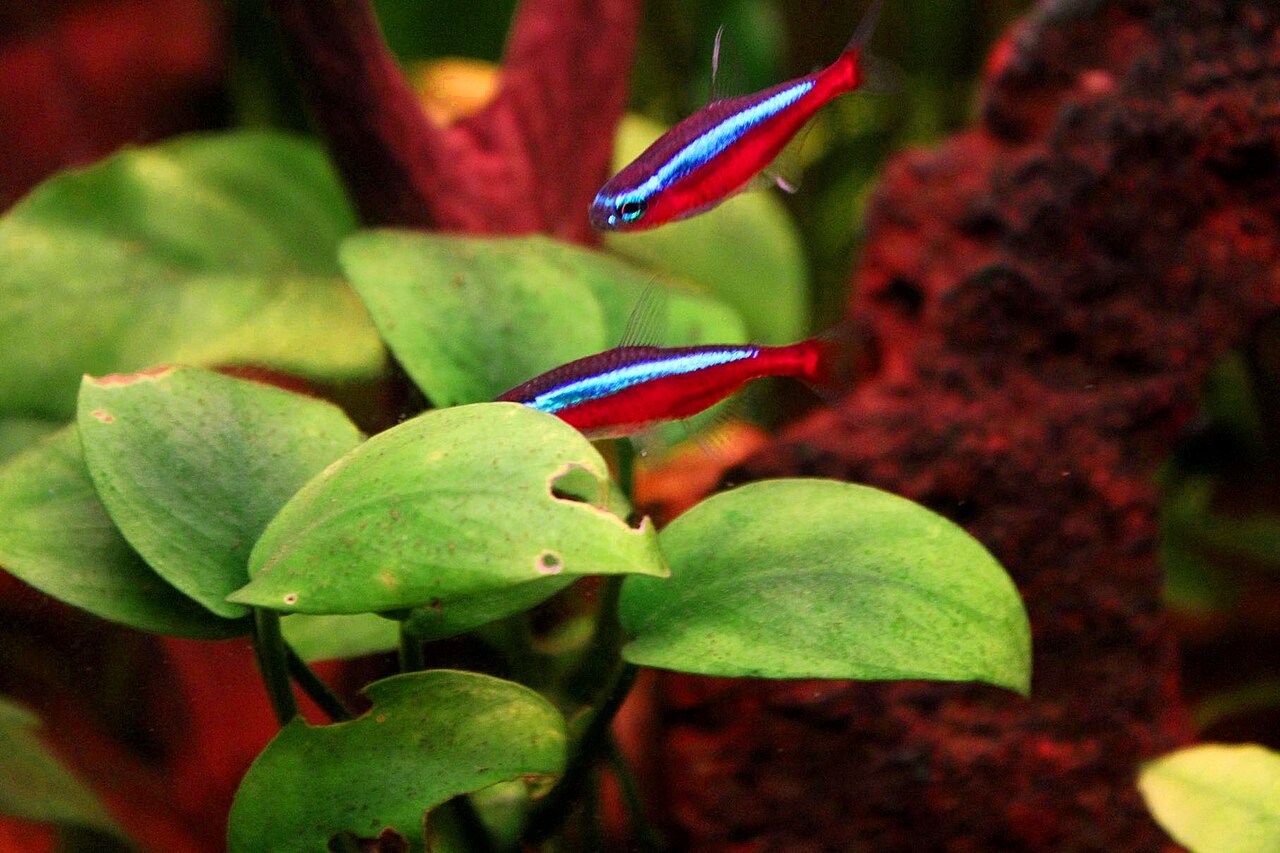
An iridescent blue stripe runs from the eye to the adipose fin, and the whole body below it is vivid red from head to tail. That is the key difference from the neon tetra, whose red covers only the rear half of the body. The back is olive-beige and the belly whitish. The stripe's shade depends on the viewing angle: from below it looks sapphire or even indigo, from above more greenish.
Females are fuller than males; the edge of the anal fin is concave in females and convex in males.
Care
- Volume: 60 L or more for a school.
- Group: at least 6 fish (Russian Wikipedia: from 5).
- Temperature: 23–27 °C (Tetra blog 23–26 °C, Russian Wikipedia 24–27 °C).
- Water: soft and acidic — pH 5.5–7.0, hardness 1–5 °dGH (Russian Wikipedia recommends pH 5.5–6.2 and 1–3 °dH).
- Light: subdued — cardinals dislike bright light.
- Plants: live plants are a must — Vallisneria, Echinodorus, Cryptocoryne, ferns, Java moss, Cabomba, Limnophila; stones and driftwood work as decor.
- Flow: gentle; strong current is undesirable.
- Lid: needed — these active fish jump easily.
- Water changes: about 20% weekly.
Cardinals live 3–5 years in an aquarium; in the wild the species may effectively live only about a year.
Feeding
In the wild the cardinal is predominantly a predator, picking tiny animals from plants, roots and leaf litter: chironomid midge larvae, water fleas and other microcrustaceans, fly larvae, insect eggs and rotifers.
Its mouth is small, so the food must be fine. Feed small portions several times a day.
Compatibility
Good companions are peaceful fish of similar size: other neons and tetras, rasboras, Apistogramma and other small cichlids, gouramis, Corydoras and other peaceful catfish, as well as shrimp.
Do not keep cardinals with fish large enough to swallow them.
Breeding
In the wild, cardinals swim upstream in large numbers into streams shaded by the rainforest canopy and spawn in big aggregations. They were long hard to breed in captivity, but many breeders now produce them.
- Spawning tank: 15–20 L (Russian Wikipedia: 30 × 25 × 25 cm), dim light.
- Spawning: the male chases the female into fine-leaved plants, and the pair release eggs and sperm swimming side by side.
- Eggs: up to 400 small eggs; the eggs are light-sensitive.
- Incubation: 22–30 hours depending on temperature.
- Fry: free-swimming on day 4–5, start feeding on day 5–6.
- Maturity: at 8–10 months.
Fun facts
- Leonard P. Schultz described the species in 1956 and named it after fishkeeping book publisher Herbert R. Axelrod.
- Cardinals were first imported into the USSR in 1961.
- The blue shimmer is a structural colour, produced by light refracting in guanine crystals inside special cells called iridocytes.
- "Gold" and "silver-blonde" forms with less blue in the stripe occur in the Rio Negro drainage, while Orinoco fish differ in the stripe and may be a separate subspecies.
- In a study in Manaus, cardinals died below 19.6 °C or above 33.7 °C, and at pH below 2.9 or above 8.8.
- Wild-caught cardinals can often be recognised by damaged fins.