Fish
Green neon tetra
Paracheirodon simulans
Origin: South America: uppermost tributaries of the Rio Negro (Brazil) and the Orinoco (Venezuela–Colombia border).
Also known as: False neon tetra, simulans tetra; obsolete scientific name Hyphessobrycon simulans
Fact sheet
- Size
- 2.5 cm
- Lifespan
- 5 years
- Minimum tank size
- 30 L
- Temperature
- 23–27 °C
- pH
- 5–7
- Hardness GH
- 1–8 °dH
- Temperament
- Peaceful
- Social behavior
- Schooling
- Group size
- 10+ individuals
Photos
Overview
The green neon tetra is the smallest and least known of the three Paracheirodon species. It is exported far less often than the neon and the cardinal — about 17,000 fish in 2002, for example.
In the wild it lives in the uppermost reaches of rivers and heavily planted wetlands with very soft, acidic, oxygen-poor water that can warm up to 35 °C. The species is remarkably tolerant of such conditions.
It is a peaceful schooling fish for a calm, densely planted aquarium, and needs extra attention during acclimatisation.
Appearance
Sources differ on size: standard length (without the tail fin) 1–2 cm according to English Wikipedia, 1.5–2.5 cm according to the Tetra blog; Russian Wikipedia gives about 3.5 cm.
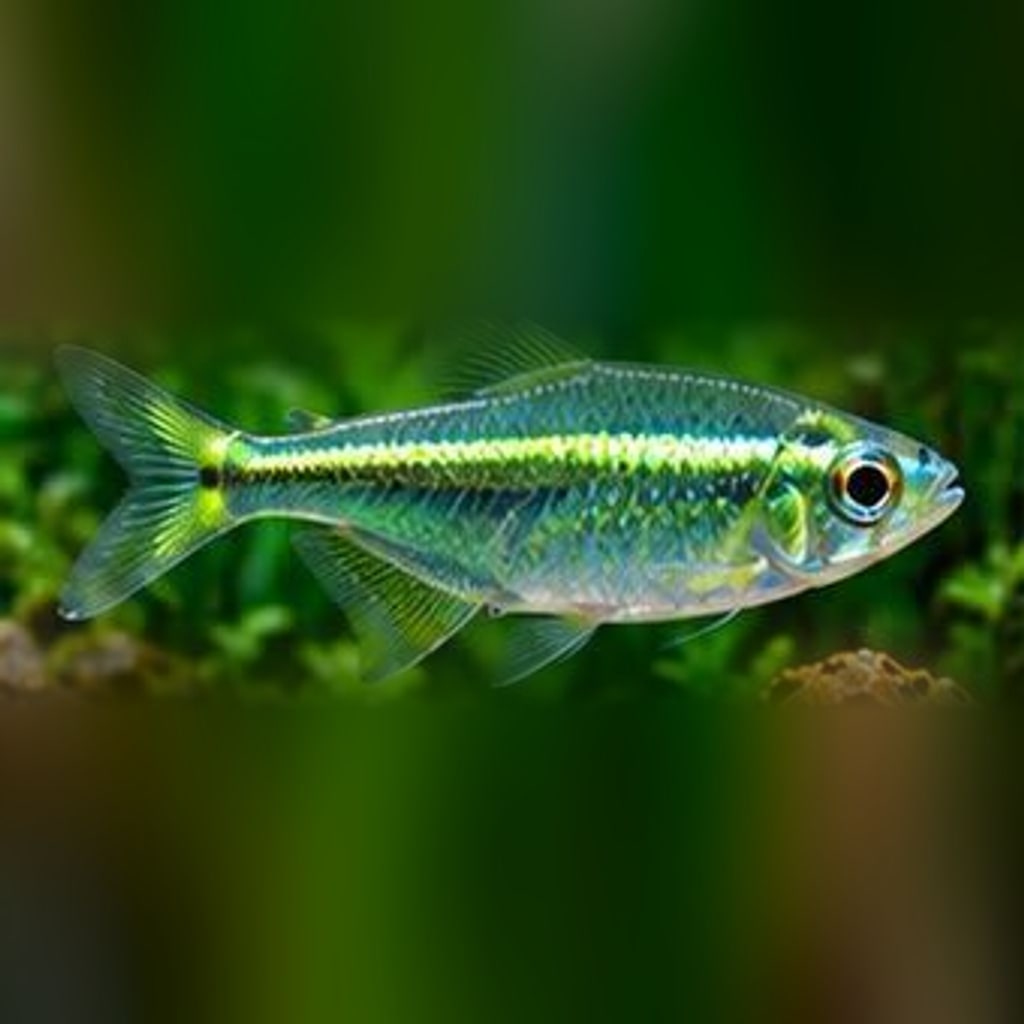
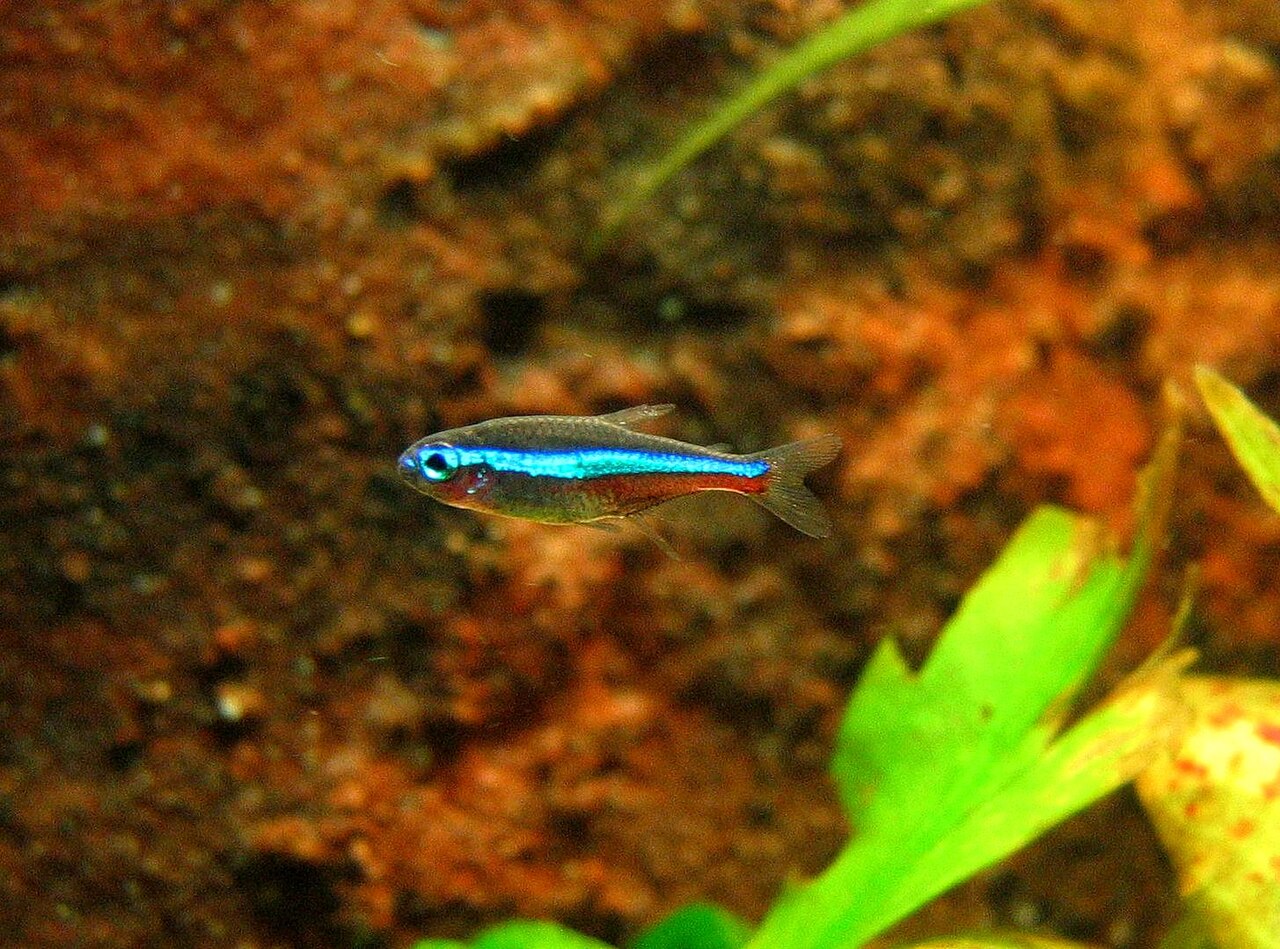
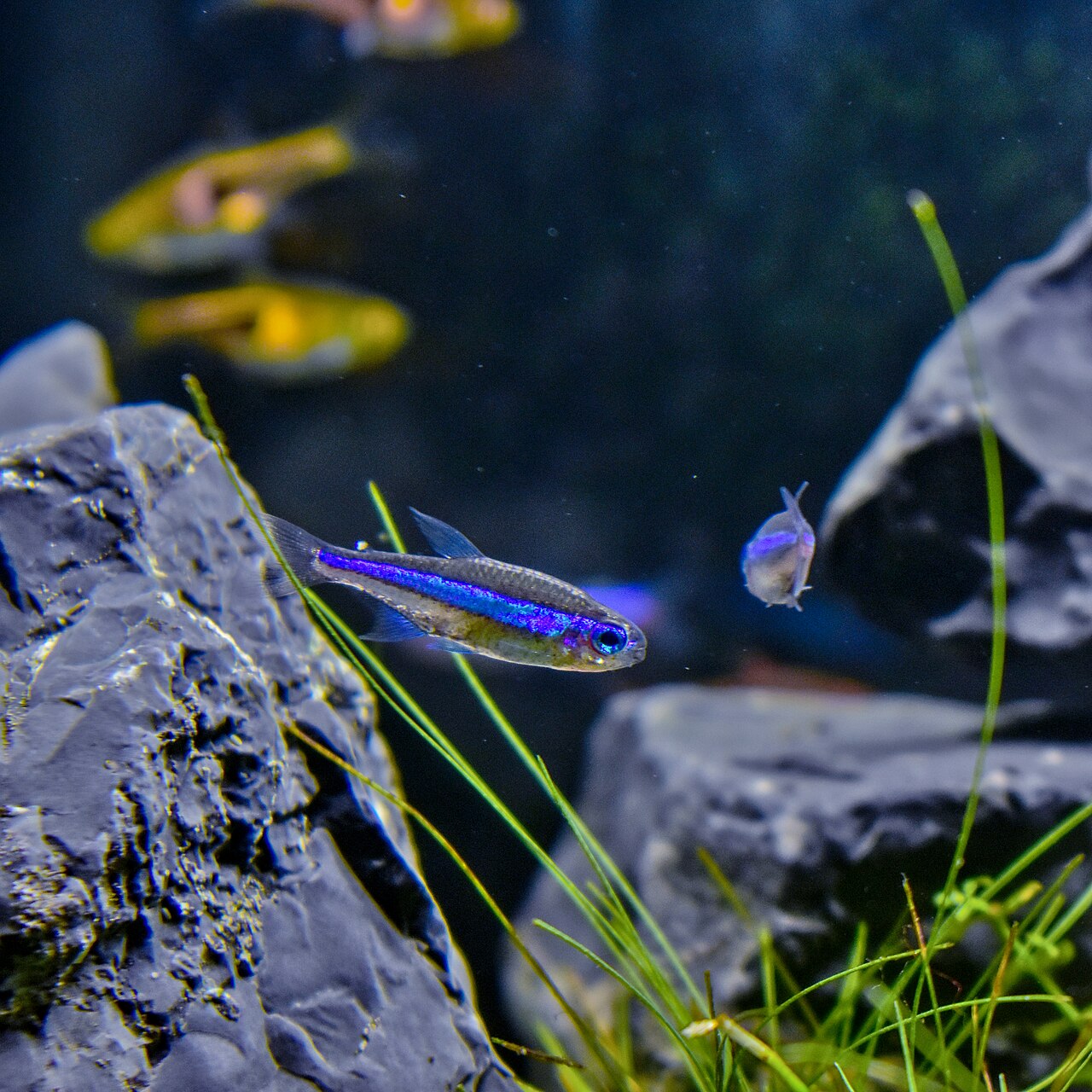
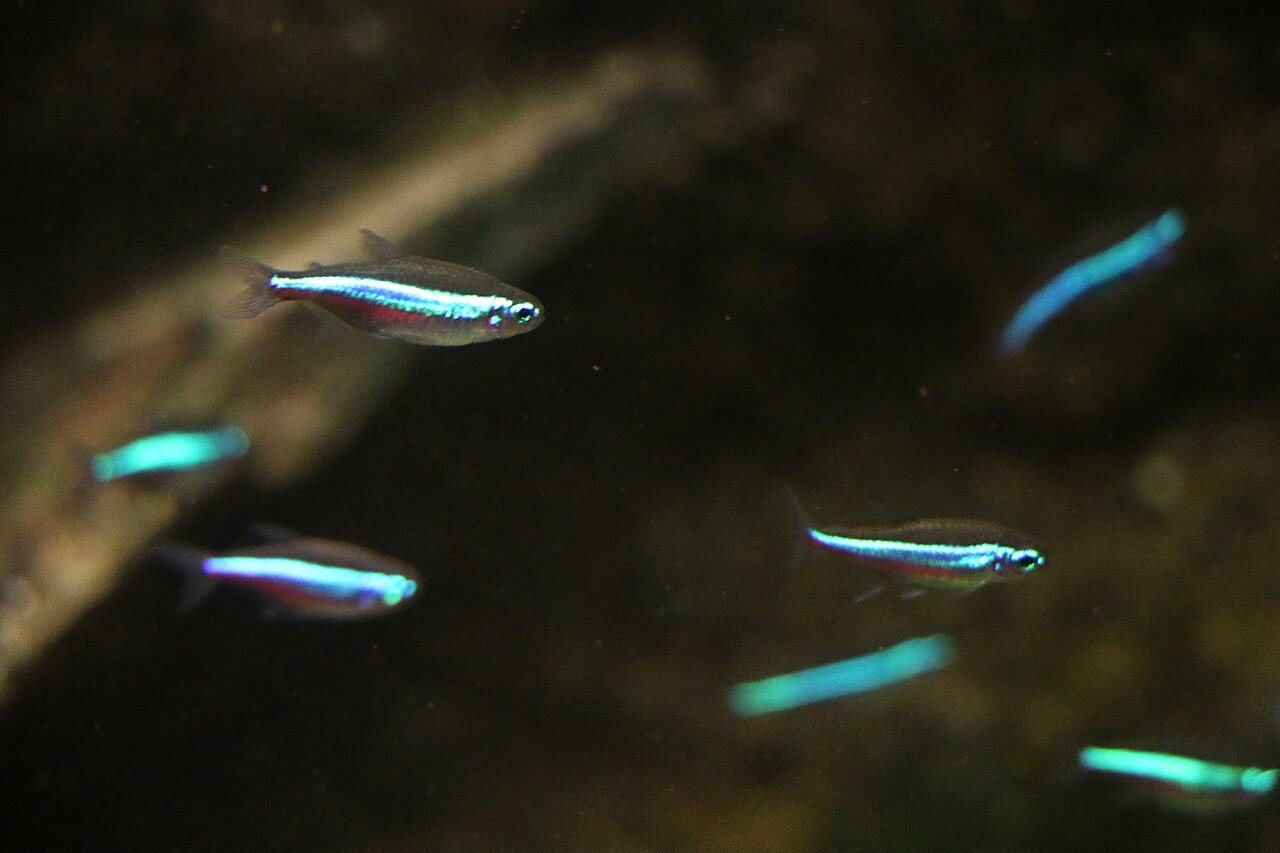
An iridescent blue-green stripe runs along the body. Unlike in the neon and cardinal tetras, it extends all the way to the base of the tail. The red underside is less pronounced than in its relatives, and blue tones dominate. The colours fade when the lights go off and return when they are switched on.
Adult females are usually larger than males, with a rounder belly.
Care
- Volume: 30 L or more (the Tetra blog's overview article says 40 L).
- Group: 10 fish or more (Russian Wikipedia: at least 9).
- Temperature: 23–27 °C.
- Water: soft, slightly acidic — pH 5.0–7.0, hardness 1–8 °dGH.
- Plants: dense, shade-tolerant plants (Anubias, Cryptocoryne, ferns) with enough open swimming space.
- Water changes: about 20% weekly.
- Acclimatisation: watch new fish closely during the first weeks.
Lifespan in an aquarium is 3–5 years (Russian Wikipedia: 5 years).
Feeding
Our sources say little about the diet of this particular species. Neons in general feed in the wild on small worms, crustaceans and insects.
The green neon is one of the tiniest aquarium fish, so its food must be very fine.
Compatibility
A peaceful fish. Good tankmates include neon and cardinal tetras, other small tetras, rasboras and Corydoras.
Avoid large fish — they see neons as prey.
Breeding
For spawning, the water should resemble its natural habitat.
- Water: very soft (GH below 4), pH 5.5–6.5, 25–26 °C; ideally peat-stained with tannins, in subdued light shaded by plants.
- Spawning tank: 10–20 L, water depth no more than 10–15 cm.
- Spawning: in a school, although during the act one female may pair closely with one or more males.
- Eggs: about 130 per female per batch; the eggs are light-sensitive. Remove the parents after spawning.
- Incubation: about 24 hours (Tetra blog: 1.5–2 days).
- Fry: very small; first food is infusoria, then tiny cyclops and fine fry foods.
- Adults can spawn again after a few weeks.
Fun facts
- The species was described in 1963 as Hyphessobrycon simulans and moved to Paracheirodon in 1983 together with the cardinal tetra; molecular studies support this.
- It is the only species in the genus with premaxillary teeth in two separate rows.
- In an experiment, all green neons survived even the most extreme conditions — low oxygen and pH, high CO₂ and temperature — so the species is considered resilient to climate change.
- Collection for the aquarium trade is its only known threat, and not a significant one: the species is abundant in the wild.
- Its range partly overlaps with the cardinal tetra's, but the two species use different habitats.