Fish
Lemon tetra
Hyphessobrycon pulchripinnis
Origin: South America: the Rio Tapajós basin and the adjoining stretch of the Amazon near Santarém, Brazil.
Also known as: Hyphessobrycon pulchripinnis
Fact sheet
- Size
- 5 cm
- Lifespan
- 6 years
- Minimum tank size
- 40 L
- Temperature
- 21–28 °C
- pH
- 6–7.5
- Hardness GH
- 1–12 °dH
- Temperament
- Peaceful
- Social behavior
- Schooling
- Group size
- 6+ individuals
- Swimming zone
- Middle
- Eats plants
- No
Photos
Overview
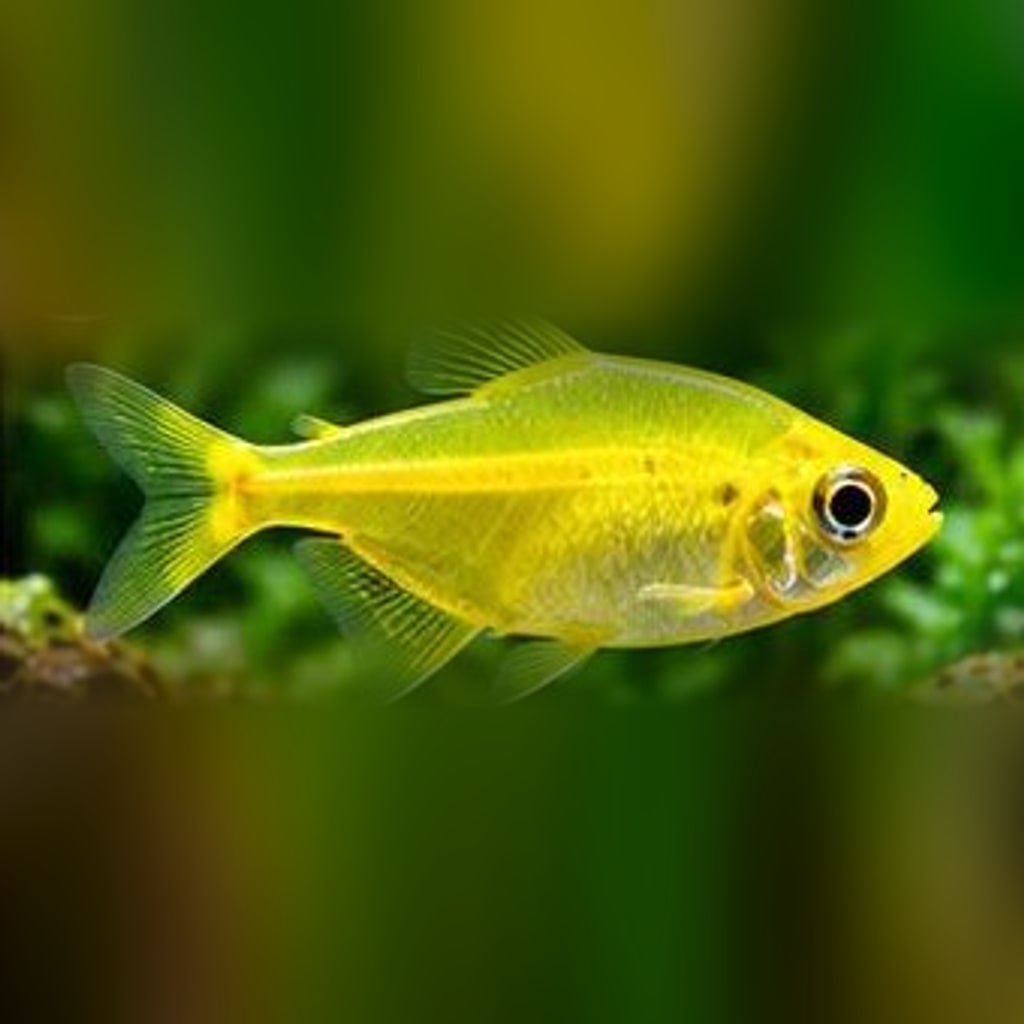
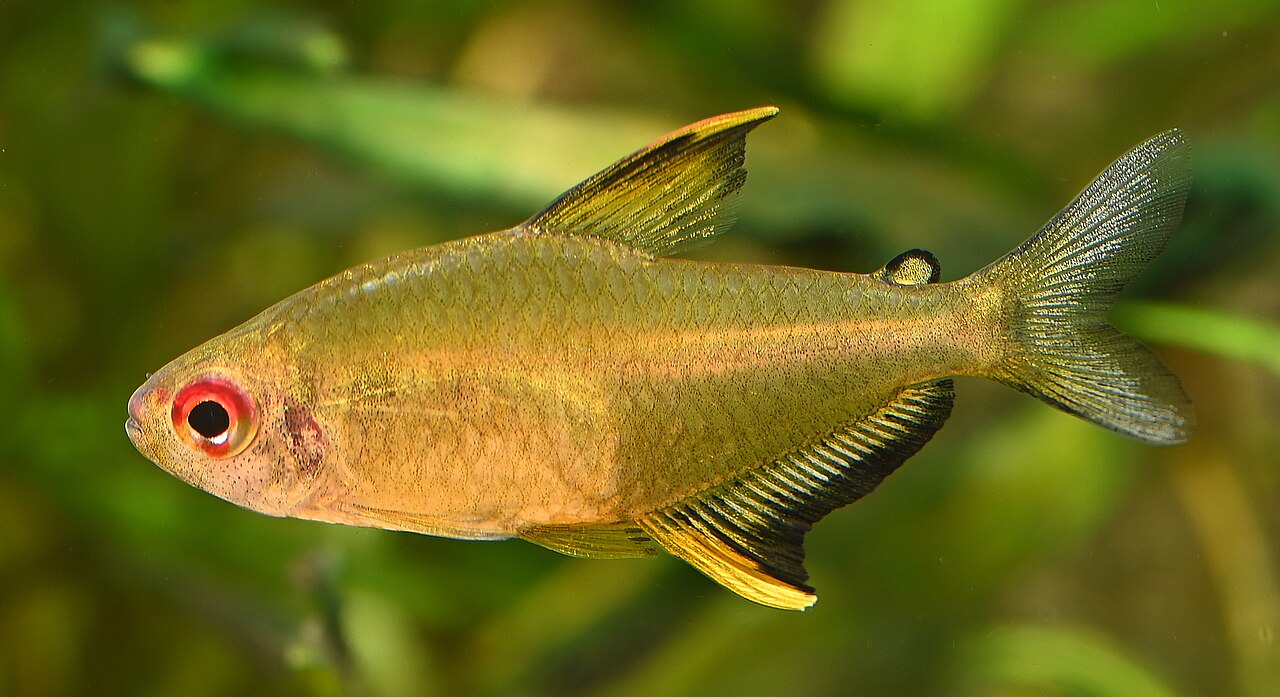
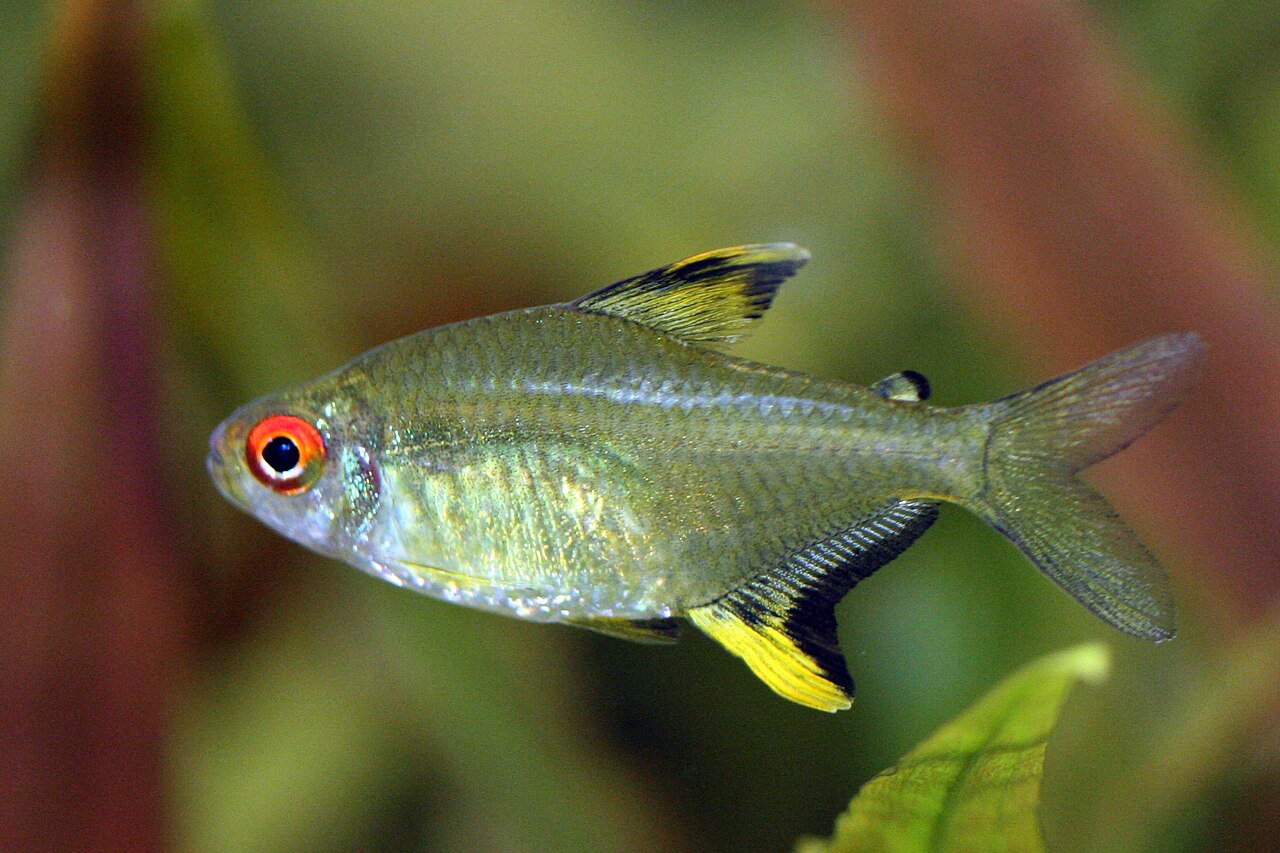
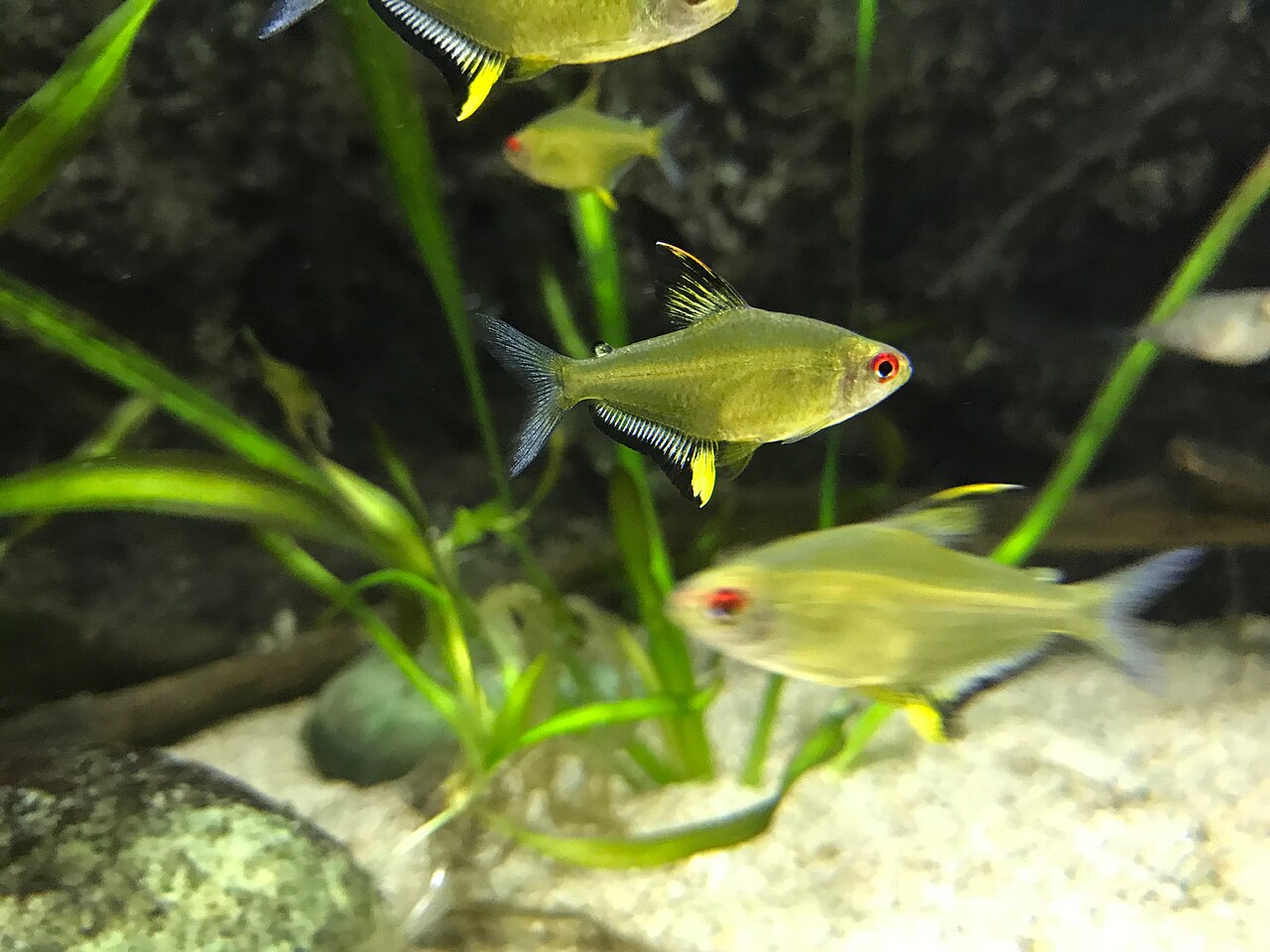
The lemon tetra is a small schooling characin with a diamond-shaped body, translucent yellow colouring and a bright red upper iris. It entered the aquarium hobby back in the 1930s and has been a favourite ever since.
It is hardy and adapts to a wide range of conditions, but it only shows its true lemon colour in a group and in a well-planted tank. Young fish in bare dealer tanks usually look washed out and greyish.
In the wild lemon tetras gather in huge shoals of up to several thousand fish near plant thickets, in clear, slightly acidic water with a gentle to moderate current.
Appearance
Length up to 5 cm according to Wikipedia (the Tetra blog gives a maximum of 4 cm). The body is deep, laterally compressed and lozenge-shaped.
Adults are translucent yellow with a pearly sheen on the scales. The dorsal fin is black with a yellow central patch; the anal fin is clear with a black edge and intense lemon-yellow front rays. The tail is mostly clear, with a gunmetal-blue lustre in the best males. The upper half of the iris is bright red; if it fades or turns grey, the fish is seriously ill. An adipose fin is present.
The only reliable way to sex adults is the black edge of the anal fin: a fine pencil line in females, a much broader band in males that can cover up to a third of the fin when breeding. Ripe females are fuller-bodied, especially seen from above. A tall pointed dorsal fin also occurs in some females, so it is not a reliable sign. Juveniles are almost impossible to sex.
Care
- Tank: from 40 L for a small school.
- Group: at least 6 fish, more is better — they are calmer and more colourful in a school.
- Temperature: 21–28 °C (the Tetra blog gives 20–28 °C); with good aeration they tolerate up to 32 °C.
- Water: prefers soft (below 8 °dGH), slightly acidic water around pH 6.6; tolerates pH 6.0–7.5 and GH 1–12. Avoid pH 8.0 and above and very hard water.
- Light: diffused, chosen to suit the plants; floating plants are welcome.
- Plants: dense thickets along the sides with open swimming space; the fish do not eat plants.
- Equipment: filter, aeration and heater.
- Water changes: about 20% weekly.
Typical aquarium lifespan is about 6 years, sometimes up to 8 (Wikipedia; the Tetra blog gives 3–5 years).
Feeding
Easy to feed: lemon tetras eagerly take all fish foods — flakes, crisps and freeze-dried foods. Live foods such as Daphnia are especially useful for conditioning before spawning, and bloodworms are a firm favourite. Offer small portions suited to their small mouths.
Compatibility
A peaceful community fish. Good tankmates include other tetras (neons, cardinals, rummy-noses, serpae), small barbs, danios and rasboras, Corydoras, bristlenose and Otocinclus catfish, and in larger tanks Apistogramma and angelfish.
Do not keep them with large cichlids or with long-finned fish — lemon tetras tend to nip fins.
Breeding
Breeding is fairly easy; fry sometimes even appear in a community tank. As they mature, males hold harmless ritual "jousts" and court females by flashing their yellow fins.
- Spawning tank: about 20 L, soft slightly acidic water, dim light, fine-leaved plants (Java moss, Cabomba) and a mesh or other egg trap.
- Raise the temperature slowly over a few days to 28 °C and condition the pair with plenty of live food.
- Two males to one female often works best; spawning usually happens at dawn, and morning sunlight is a known trigger.
- The eggs are non-adhesive and fall to the bottom; a large female can lay up to 300. The parents eat eggs, so remove them after spawning.
- Eggs hatch in about 72 hours at 28 °C; the larvae live off the yolk sac for another 24–48 hours.
- First foods are infusoria or egg-layer fry food, then newly hatched brine shrimp after a week. Change about 10% of the water every 1–2 days.
- Sexual maturity comes at 8–9 months.
Fun facts
- The species name pulchripinnis means "beautiful fins", after the yellow-and-black dorsal and anal fins.
- The red upper iris is a health indicator: if the red fades or turns grey, the fish is seriously ill.
- In the wild tens of thousands of pairs spawn together and eat their neighbours' eggs — which is why they eat their own eggs in aquaria.
- Ritual contests between evenly matched males can last 30 minutes or more without any injuries.