Fish
Rosy tetra
Megalamphodus rosaceus
Origin: Northern South America: Guyana and Suriname (Essequibo, Courantyne and Suriname river drainages).
Also known as: Hyphessobrycon rosaceus, Megalamphodus rosaceus
Fact sheet
- Size
- 3.4 cm
- Minimum tank size
- 60 L
- Temperature
- 23–28 °C
- pH
- 6–7.5
- Hardness GH
- 5–18 °dH
- Temperament
- Peaceful
- Social behavior
- Schooling
- Group size
- 6+ individuals
Photos

Overview
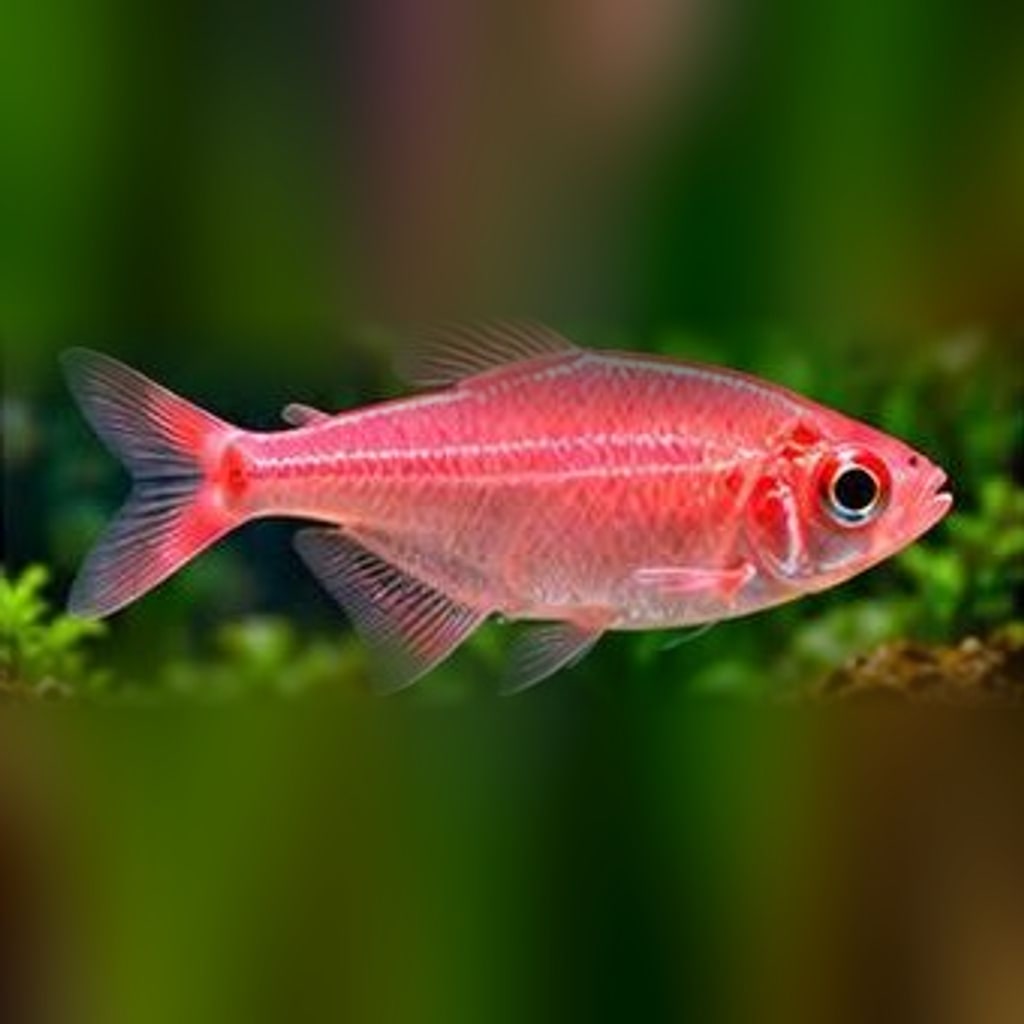
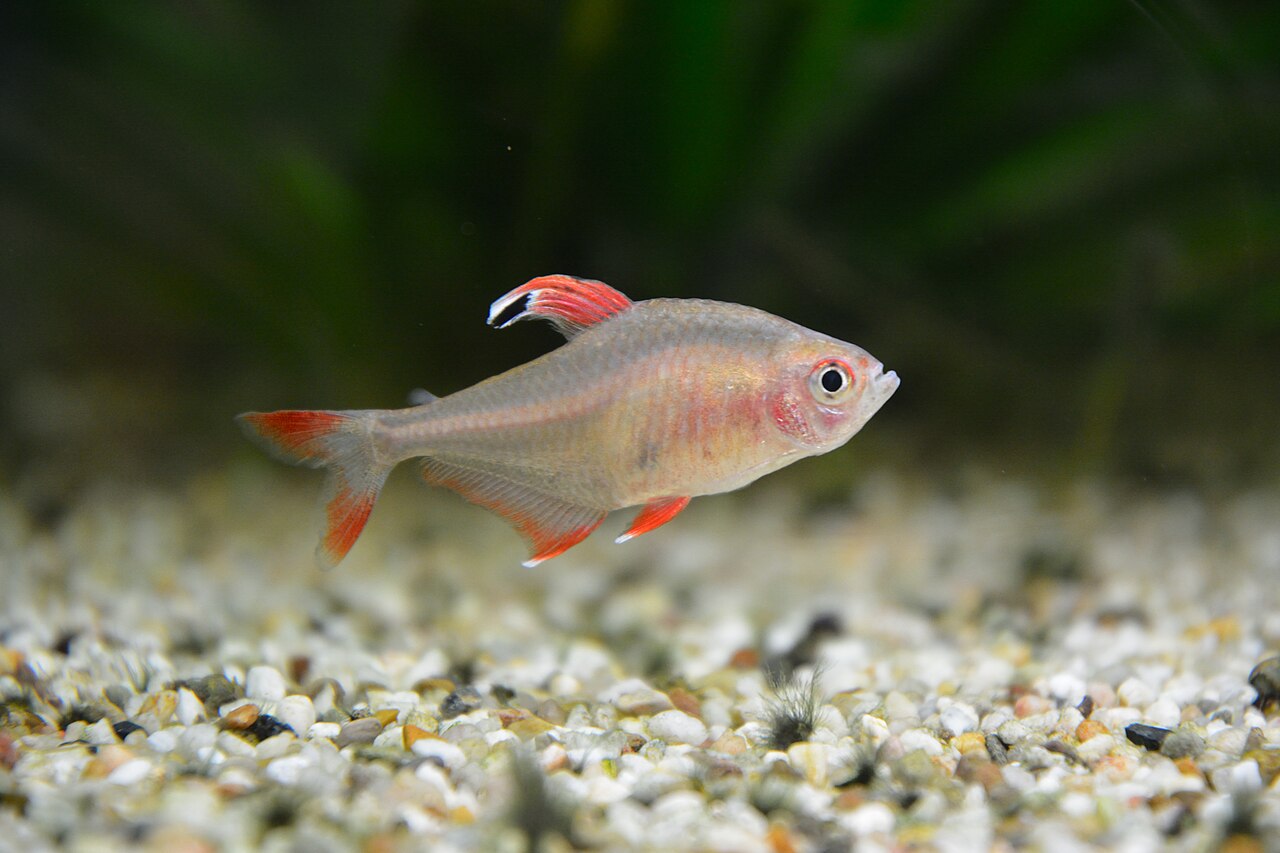
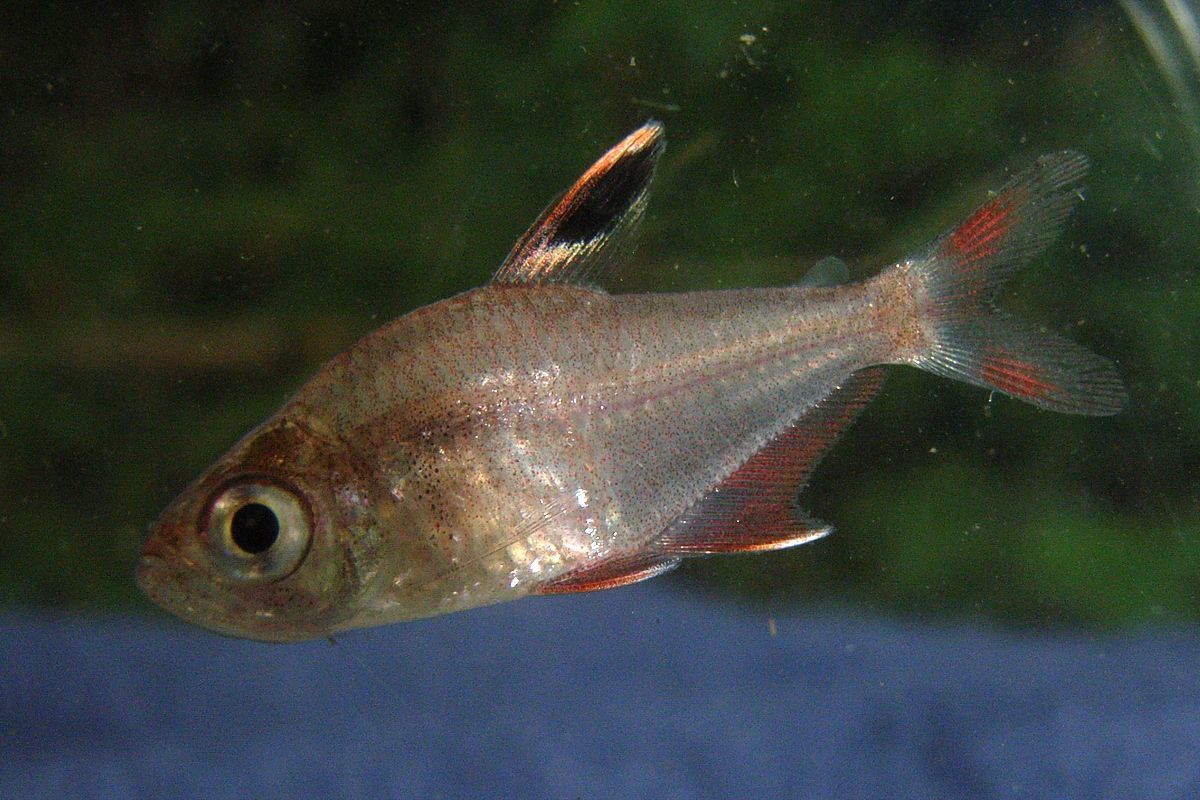
The rosy tetra is a small schooling characin from the group aquarists call ornate tetras or "phantoms". Its body is deep, strongly compressed and translucent, with a soft pink tint, black markings and white tips on the fins.
For a long time it was placed in Hyphessobrycon; in 2024 it was moved to the genus Megalamphodus, so its current scientific name is Megalamphodus rosaceus. In the trade it is often confused with the very similar ornate tetra (Megalamphodus / Hyphessobrycon bentosi).
In the wild it lives in clear streams with slow currents and plenty of aquatic plants. It is a calm, undemanding fish for a planted community tank.
Appearance
Maximum standard length (without the tail fin) is 3.4 cm according to English Wikipedia.
The body is deep, laterally compressed and translucent with a pinkish tint, especially on the lower flanks — hence the name rosaceus, "rose-coloured". The fins carry black markings with white tips. Some males have an almost entirely black dorsal fin.
The key difference from the ornate tetra (M. bentosi) is the dark humeral spot behind the gill cover: bentosi has it, the rosy tetra does not.
Males develop elongated fins as they mature and are more intensely coloured, larger and slimmer than females.
Care
- Tank: from 60 L with dense planting.
- Group: at least 6 fish, ideally 8–10.
- Temperature: 23–28 °C.
- Water: pH 6.0–7.5, hardness 5–18 °dGH; peat extract is beneficial.
- Light: subdued, dimmed with floating plants.
- Plants: along the sides with open swimming space in the middle; sand or fine gravel, driftwood and stones.
- Flow: good filtration but no strong current; also aeration and a heater.
- Water changes: up to 20% weekly.
According to the Tetra blog, ornate tetras live 3–5 years.
Feeding
They readily take quality dry foods — flakes, mini-granules and slow-sinking micro crisps; foods with natural carotenoids help keep the red tones. The mouth is small, so food must be fine. Daphnia and bloodworm make good treats. Avoid overfeeding: a portion should be eaten within a few minutes.
Compatibility
A very peaceful fish; minor squabbles within the school are harmless. Good tankmates include neons, black skirt tetras, rummy-noses and other characins, Apistogramma and angelfish, danios, rasboras and microrasboras, dwarf and other gouramis, platies, swordtails and mollies.
Be careful with bettas — active rosy tetras may nip their fins. Keep them away from large predatory cichlids.
Breeding
The Tetra blog gives breeding details for ornate tetras as a group; they are easy to breed.
- Spawning tank: 20 L or more, water about 15 cm deep, a mesh or plenty of fine-leaved plants on the bottom.
- Water a couple of degrees warmer, softer and more acidic than in the main tank; separate and heavily feed the breeders for a couple of weeks beforehand.
- Courtship lasts up to 3 days, then the female scatters 100–400 eggs that fall to the bottom.
- Return the parents to the main tank afterwards, shade the spawning tank and keep gentle aeration.
- Eggs hatch in 36–48 hours; the larvae live off the yolk sac for 3–4 days, after which the fry are fed every 2–3 hours.
- Sexual maturity comes at 8–10 months.
Fun facts
- The Latin name rosaceus means "made of roses", i.e. rose-coloured, after the pink tint of the lower flank scales.
- The species was described in 1909; its type locality is Gluck Island in the Essequibo River, Guyana.
- In 2024 it was moved from Hyphessobrycon to Megalamphodus, the "red tetras"; Hyphessobrycon ornatus Ahl, 1934 is a synonym.
- Ornate tetras are also called "phantoms": their flat, translucent body helps them blend in and hide from predators.
- The IUCN lists the species as Least Concern.