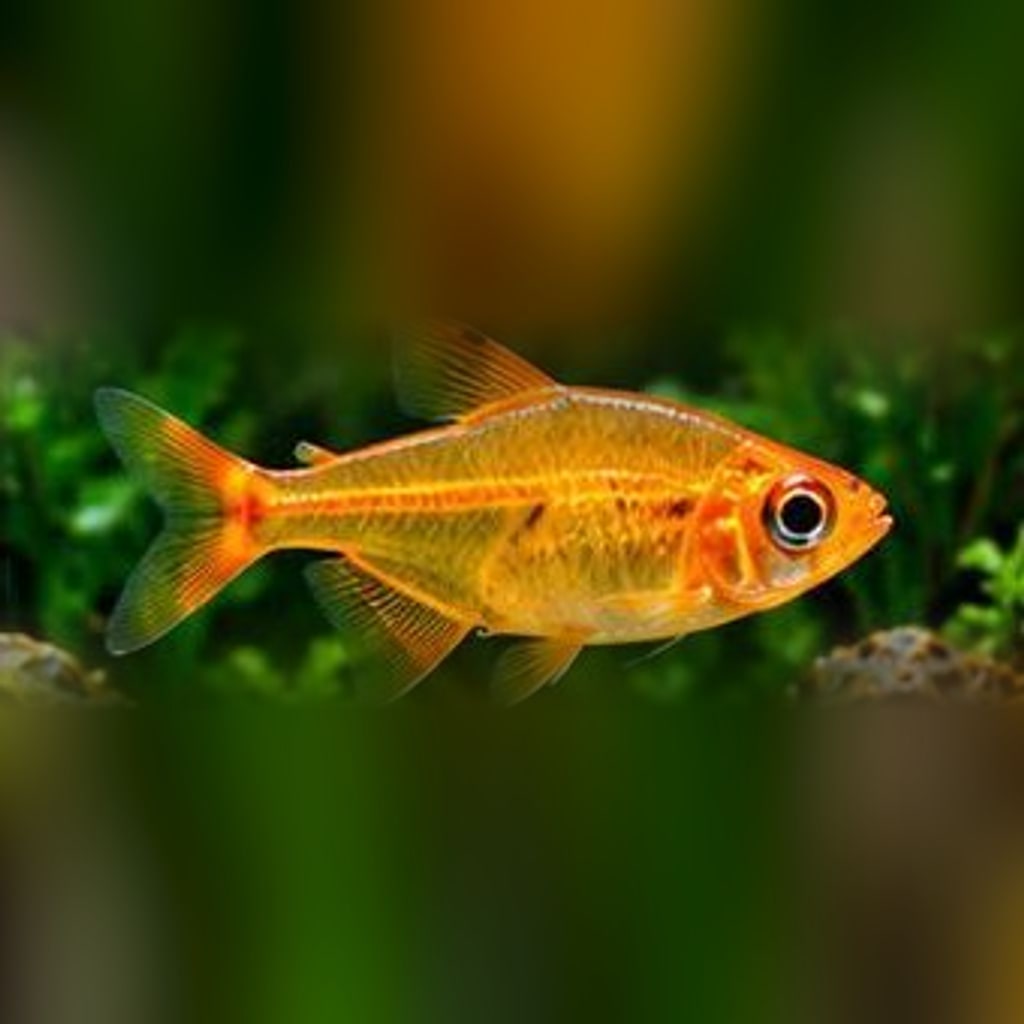
Fish
Ember tetra
Hyphessobrycon amandae
Origin: Central Brazil: Araguaia and Tocantins river basins (Mato Grosso, Tocantins, Pará).
Also known as: Hyphessobrycon amandae
Fact sheet
- Size
- 3 cm
- Lifespan
- 3 years
- Minimum tank size
- 40 L
- Temperature
- 22–29 °C
- pH
- 5–7
- Hardness GH
- 1–10 °dH
- Temperament
- Peaceful
- Social behavior
- Schooling
- Group size
- 8+ individuals
- Swimming zone
- Middle
- Diet
- Omnivore
- Jumps out
- Yes
Photos
Overview
The ember tetra is a tiny red-orange characin from central Brazil. It was discovered in 1987 and named after Amanda Bleher, the mother of the fish explorer Heiko Bleher.
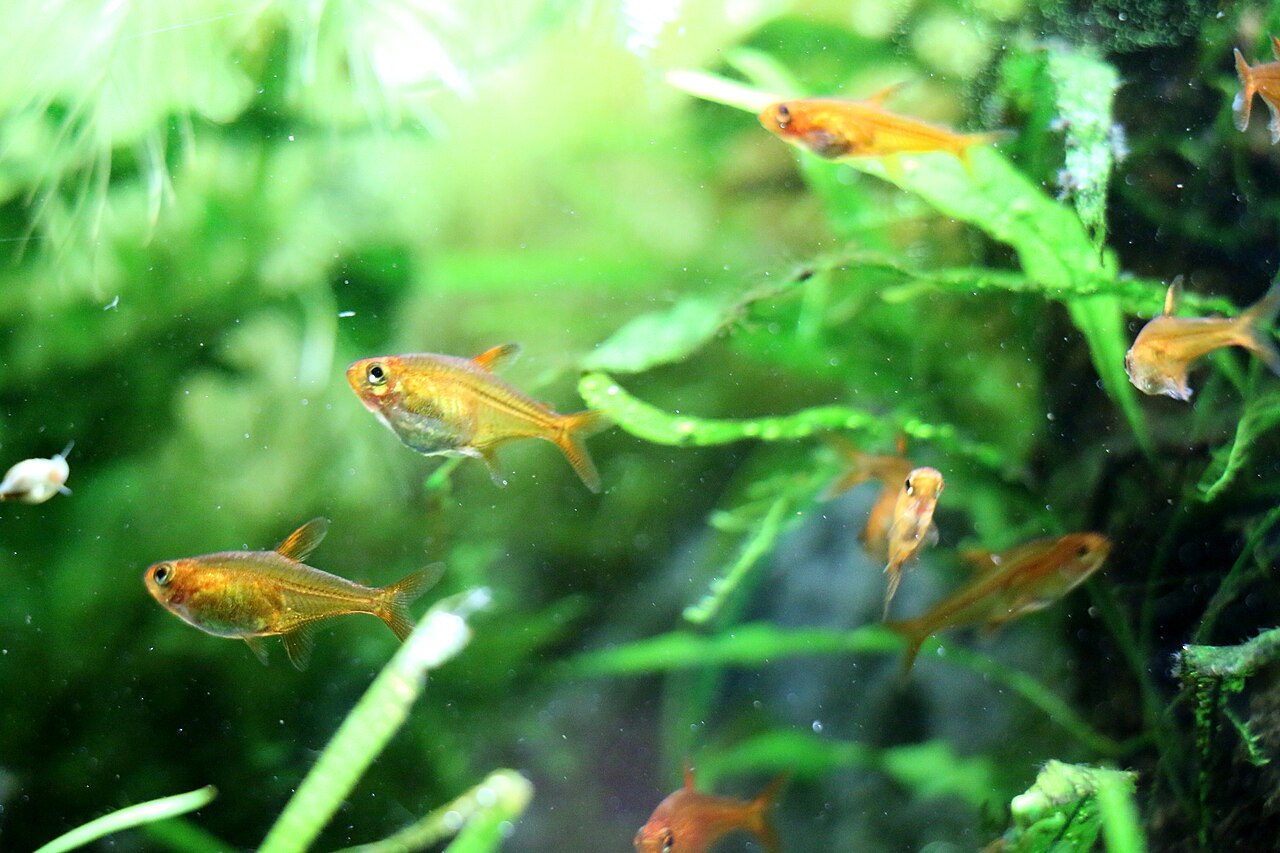
It is a calm schooling fish that is undemanding to keep and a great choice for nano tanks and natural aquascapes: a school of embers looks striking against dense green plants and a dark substrate.
In the wild it lives in slow rivers, streams and lakes under the forest canopy, where fallen leaves make the water soft, slightly acidic and tea-coloured.
Appearance
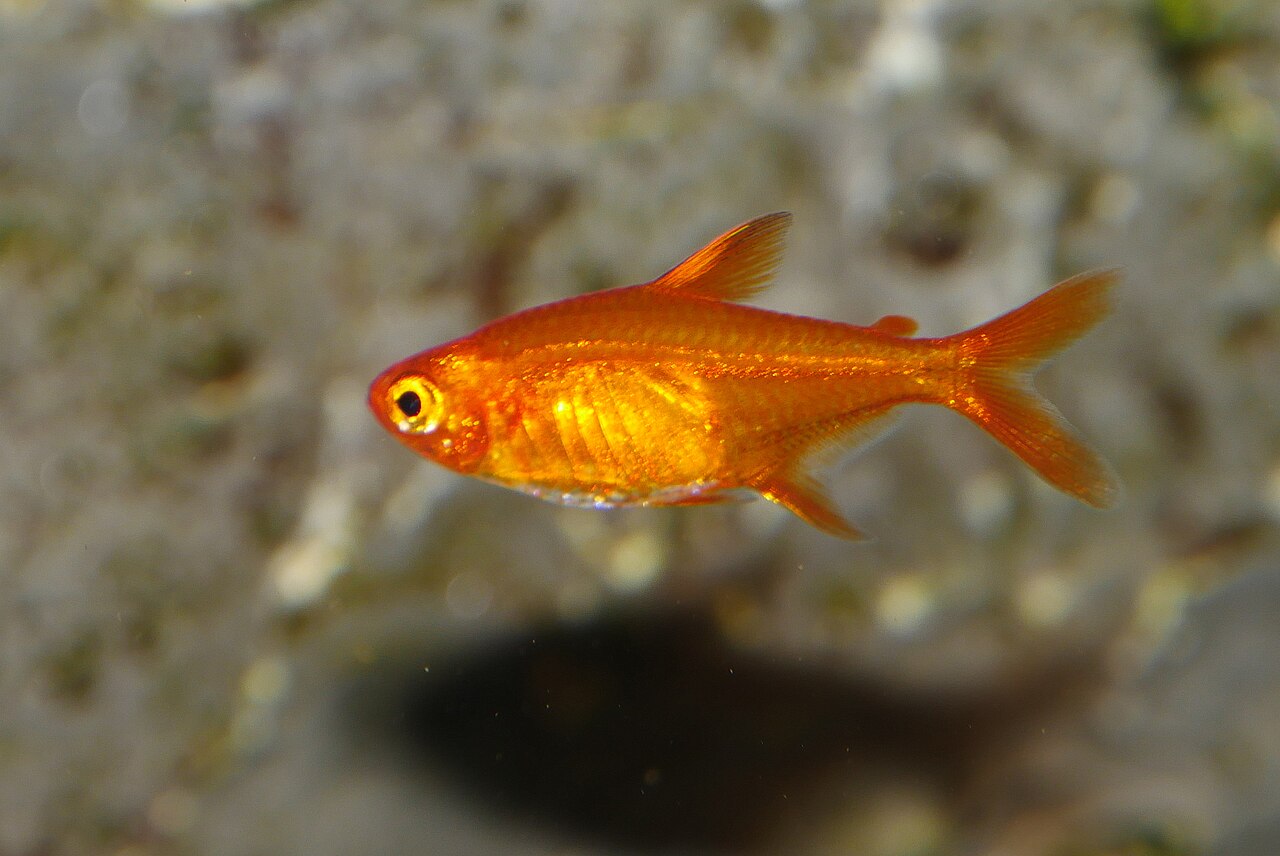
The body has the typical tetra shape: slightly elongated and a little compressed from the sides. Adults are about 2 cm long (many stay even smaller); English Wikipedia gives a maximum length of 2–3 cm.
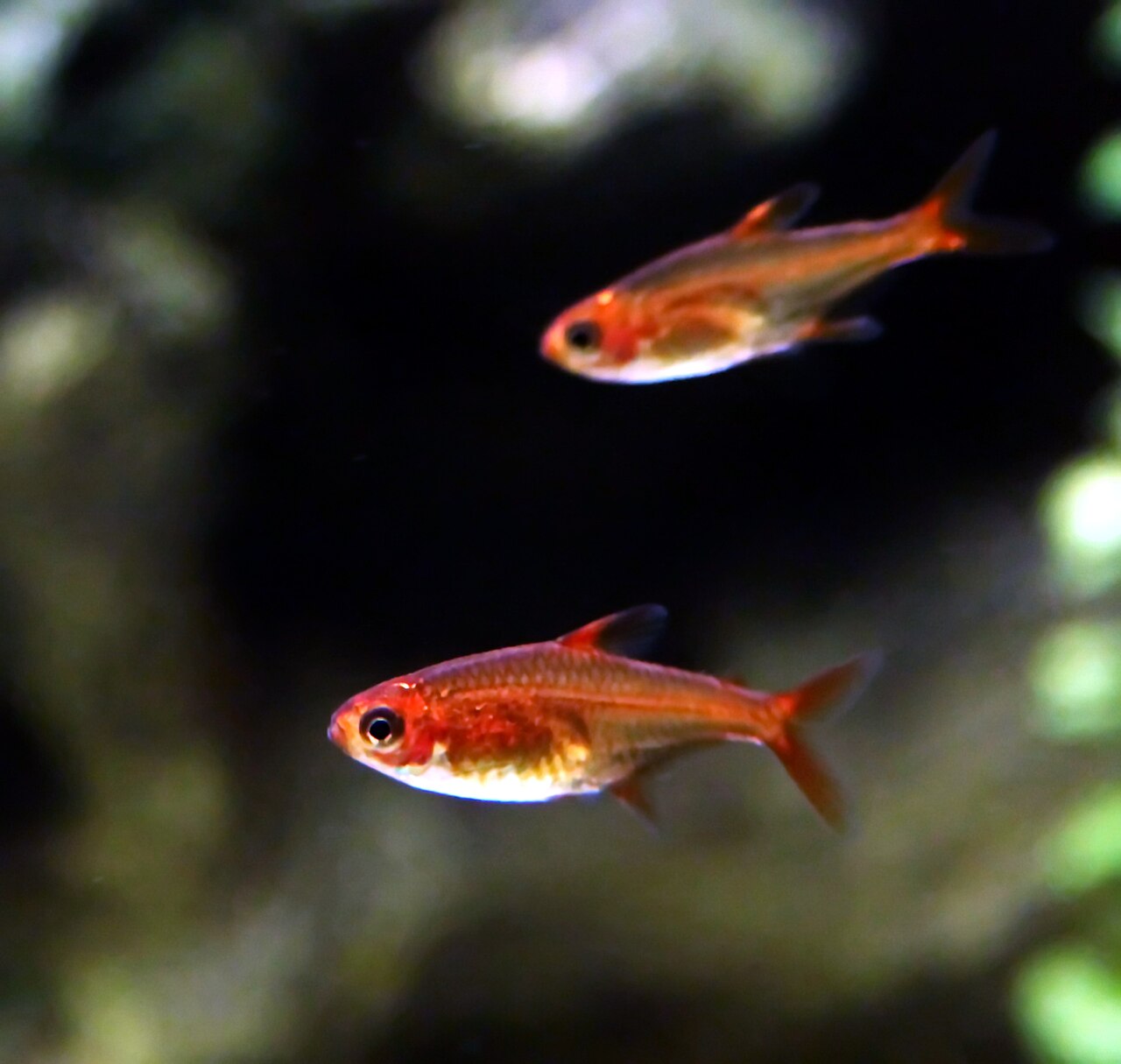
The colour is a rich red-orange, and its intensity depends on conditions: stressed fish, for example right after being moved, turn pale. The unpaired fins have a golden tint and a clear edge, the tail is forked and there is a small adipose fin. The eye is red, outlined in black.
Sexual dimorphism is weak: males are smaller and brighter, females have a rounder belly.
Care
- Tank: from 40 L for a school (English Wikipedia gives a minimum of about 10 gallons / 38 L).
- Group: at least 8 fish; English Wikipedia says at least 6, ideally 9–10.
- Temperature: 22–29 °C, ideally 24–26 °C.
- Water: pH 5.0–7.0 (ideally around 6.6), hardness 1–10 °dGH; according to English Wikipedia they adapt to 5–17 °dGH.
- Light: subdued; floating plants and shaded spots make the fish bolder.
- Plants: dense planting, dark substrate, driftwood, plus open swimming space.
- Flow: good filtration without a strong current.
- Lid: needed, the fish can jump out.
- Water changes: up to 20% weekly.
Russian-language sources give a lifespan of about 3 years, while English Wikipedia reports that embers can live 10 years or more in a well-kept planted tank.
Feeding
In the wild embers eat small invertebrates, zooplankton and insects, plus some plant matter.
In the aquarium they take flakes, frozen and freeze-dried foods; English Wikipedia also recommends small live foods (worms, brine shrimp) to bring out their colour. The Tetra blog, on the other hand, recommends quality dry foods and advises against live and frozen food because of the infection risk. The mouth is small, so food must be fine; foods with carotenoids enhance the colour.
Embers feed in mid-water and do not pick food from the bottom, so bottom dwellers such as pygmy corydoras are useful for eating leftovers.
Compatibility
A peaceful fish for community tanks with similar-sized companions: other tetras (embers will even school with neon tetras), danios, rasboras, small rainbowfish, livebearers, Apistogramma, corydoras, otocinclus and Ancistrus. They leave shrimp alone.
Avoid large, aggressive or very boisterous fish: embers either become food or live in constant stress and lose their colour.
Breeding
Breeding the ember tetra is not difficult.
- Broodstock: pick the brightest, most active fish; a week before spawning keep males and females apart and feed them generously.
- Spawning tank: from 20 L, dim and shaded, with a separator grid and fine-leaved plants such as Java moss on the bottom and a small air-driven sponge filter.
- Water: soft, acidic and a couple of degrees warmer than the main tank.
- Spawning: in pairs or groups. The fish are put together in the evening, and by morning there are several hundred tiny eggs; remove the parents right away.
- Eggs: incubation takes 24–36 hours.
- Fry: free-swimming after 3–4 days and stay among plants; feed them brine shrimp and daphnia 2–3 times a day.
- Juveniles: colour appears at about one month, sexual maturity at 4–6 months.
Fun facts
- The species was described only in 1987 and named after Amanda Bleher, mother of explorer Heiko Bleher.
- Its colour is a well-being indicator: embers turn noticeably pale when stressed or after transfer.
- Embers swim in the middle layer and do not feed from the bottom, so they are often kept with small bottom-dwelling catfish.
- The fish is a frequent resident of professional aquascapes.
- According to English Wikipedia, embers may live ten years or more in a well-maintained aquarium.