Fish
Glowlight tetra
Hemigrammus erythrozonus
Origin: South America: Essequibo and Courantyne rivers (Guyana and Suriname).
Also known as: Hemigrammus erythrozonus
Fact sheet
- Size
- 5 cm
- Lifespan
- 4 years
- Minimum tank size
- 60 L
- Temperature
- 22–28 °C
- pH
- 6–7.5
- Hardness GH
- 2–15 °dH
- Temperament
- Peaceful
- Social behavior
- Schooling
- Group size
- 6+ individuals
- Diet
- Omnivore
- Eats plants
- No
Photos
Overview
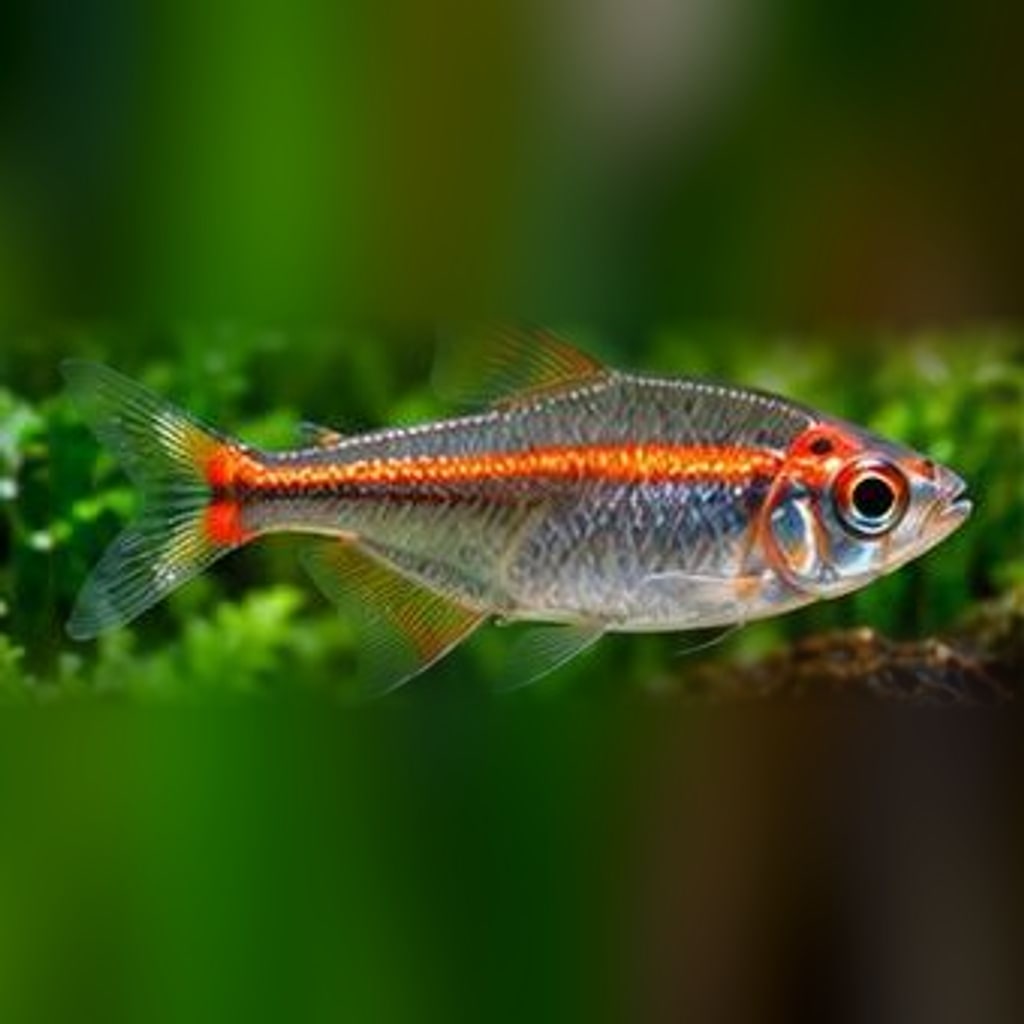
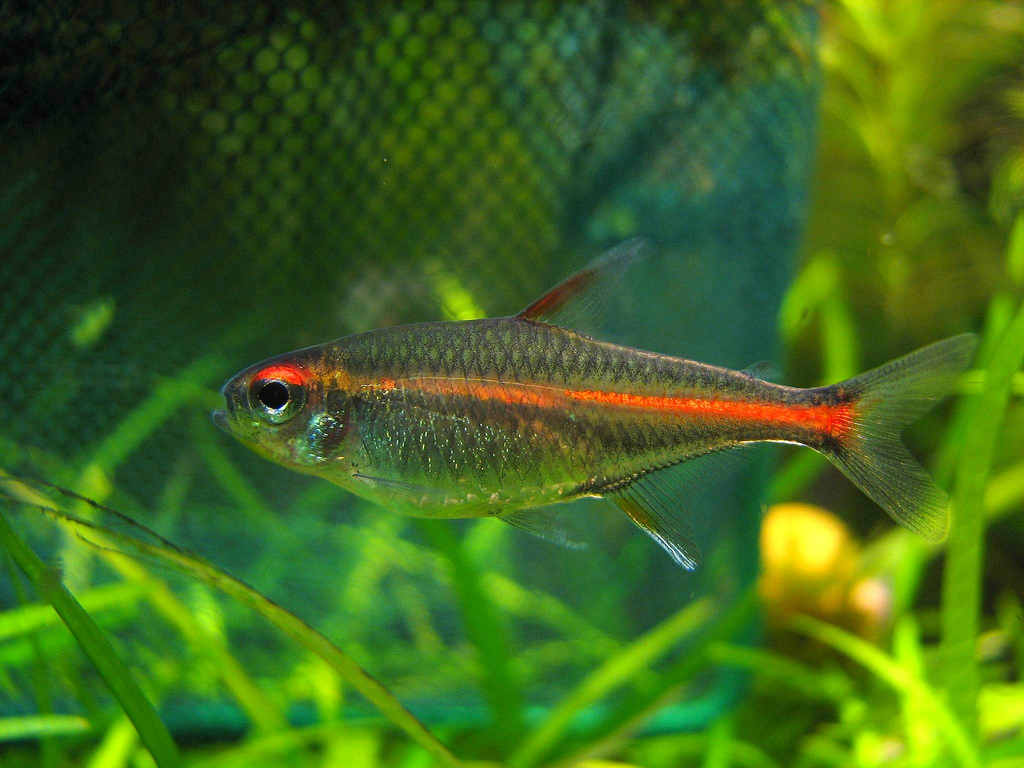
The glowlight tetra is a small characin with a bright orange-red stripe along its body. The species was described in 1909, and about thirty years later it reached European aquarists.
It is hardy, peaceful and usually inexpensive, so it is often recommended to beginners — both as a first schooling fish and as a first breeding project. Juveniles are plain, and the full colour develops with age.
In the wild glowlights live in schools in shallow pools and streams under the rainforest canopy, where the water is acidic and stained dark by humic substances.
Appearance
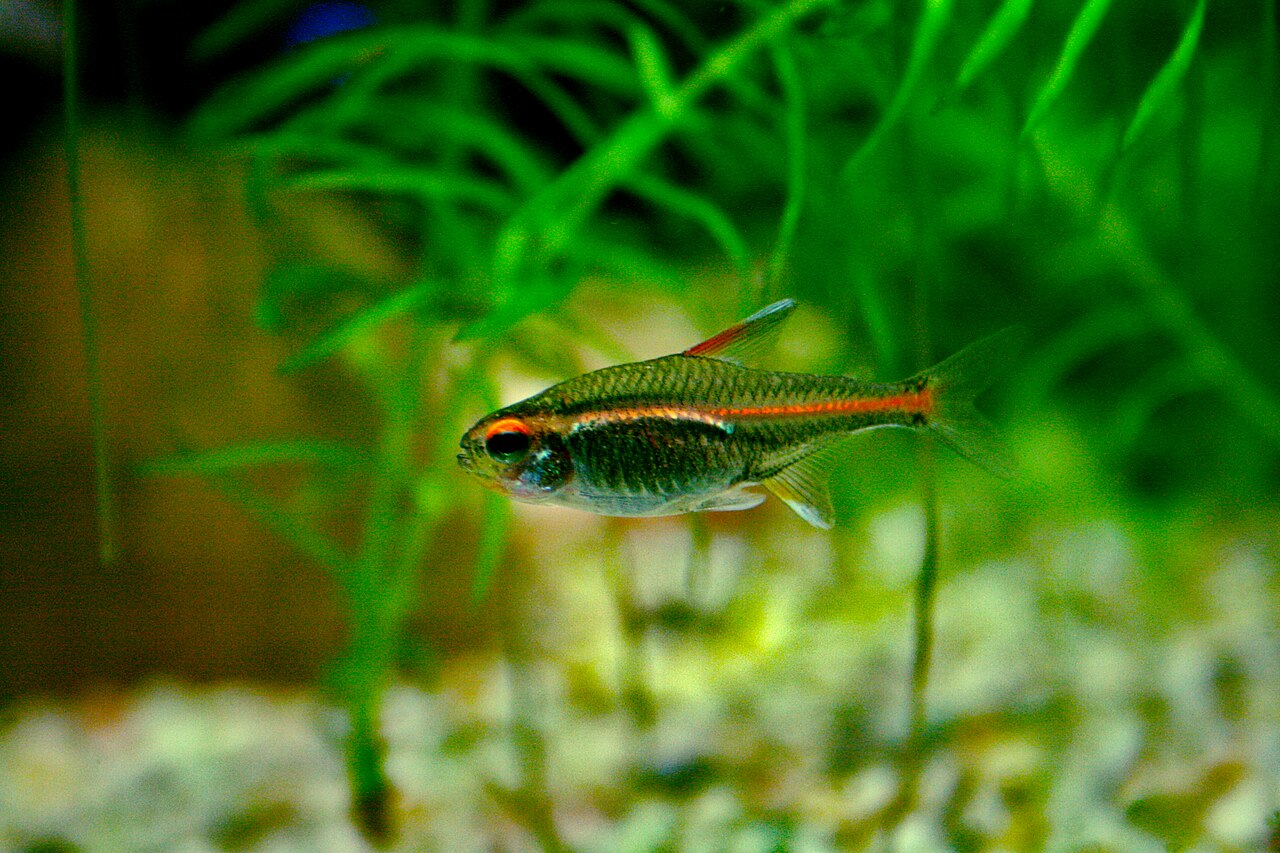
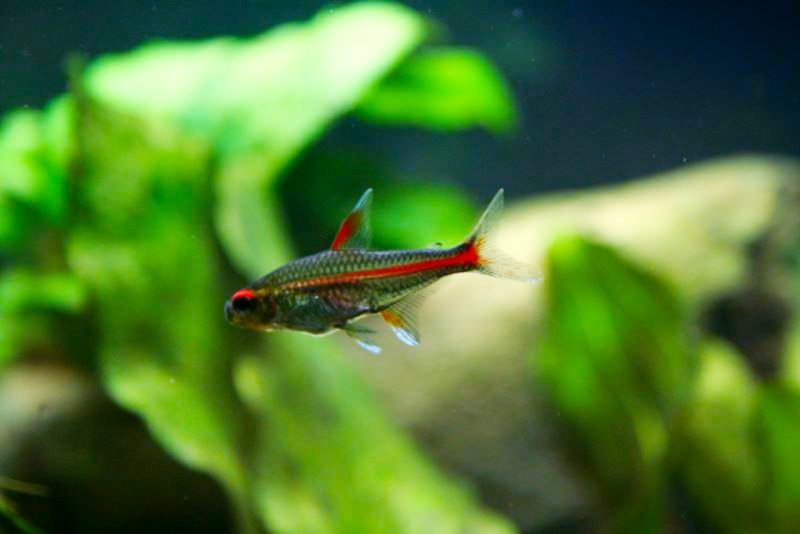
Glowlights grow to 4–5 cm, noticeably larger than neon and cardinal tetras. The body is semi-transparent and silvery with a peach sheen. An iridescent orange-red stripe runs from the snout to the base of the tail and seems to "glow" in reflected light; it gets brighter with age.
The front of the dorsal fin matches the stripe, the other fins are silvery to transparent (with white tips, according to the Tetra blog). There is an adipose fin and a forked tail.
Females are larger, deeper-bodied and slightly paler; sexing is reliable only in mature fish, when females fill with eggs.
Care
- Tank: from 60 L; a long tank (60 cm or more) is better than a tall one.
- Group: 6 or more; English Wikipedia says at least 4, with 8+ making them feel secure.
- Temperature: 22–28 °C, ideally about 25 °C.
- Water: pH 6.0–7.5 (ideally around 6.8), hardness 2–15 °dGH; they adapt easily to harder water, but soft water is needed for breeding.
- Light: subdued, floating plants help; they look best over a dark substrate.
- Plants: plenty of cover plus open swimming space; glowlights leave plants alone.
- Filtration: efficient filtration and aeration.
- Water changes: about 20% weekly.
In good conditions glowlights live 2–4 years.
Feeding
In the wild they eat aquatic insect larvae. In the aquarium they are hungry omnivores and take small live, frozen and dry foods, flakes and small crisps. Adding some vegetable matter varies the diet.
The mouth is small, so choose fine food. Feed small portions several times a day that are eaten within a couple of minutes — these tetras tend to overeat.
Compatibility
A calm tetra for community tanks with peaceful, similar-sized fish: any neons (neon, cardinal, black neon), rasboras and microrasboras, danios, guppies, serpae tetras, rummy-nose tetras, Apistogramma and pencilfish. It also gets on with corydoras, Ancistrus and shrimp (cherry, Amano).
Glowlights usually school on their own but sometimes swim together with cardinals. Do not keep them with large or aggressive fish, which will see them as food.
Breeding
Glowlights are fairly easy to breed, although English Wikipedia rates the difficulty as moderate. They are egg-scatterers.
- Spawning tank: 30–40 L, soft water (up to 6–8 °dGH, KH no higher than 2), pH about 6.5, 26–28 °C; peat helps soften and acidify the water.
- Setup: dim light or darkness, fine-leaved plants (Java moss, Fontinalis) or a spawning mop; a grid or glass beads on the bottom protect the eggs.
- Conditioning: keep the sexes apart and feed them well and varied for at least a week, ideally a few weeks.
- Spawning: move the fish in the late afternoon or evening; spawning usually follows next morning. The male circles the female, the pair rolls over and the female releases the eggs. If nothing happens within three days, condition again. Group spawning at a 1:1 ratio gives the best results.
- Eggs: usually 120–150 (Russian Wikipedia gives 50–500 per female). Remove the parents at once or they eat the eggs. The eggs are light-sensitive, so keep the tank dark; methylene blue helps against fungus.
- Fry: hatch after 20–25 hours. Once the yolk sac is used up, feed infusoria, rotifers and crushed flakes; from day 4 add small amounts of newly hatched brine shrimp, later microworms.
- Growth: the orange stripe appears at three weeks (about 1 cm), about 2 cm at two months; sexual maturity at 6–8 months.
Fun facts
- Hemigrammus gracilis is considered a senior synonym of the species.
- The similar-looking red-line rasbora (Rasbora pauciperforata) from Malaysia and Indonesia is a cyprinid, not a relative.
- Aquarists often buy glowlights to play "second fiddle" to neon tetras.
- Golden and albino forms are also sold.
- When a predator is present the school tightens; when relaxed, the fish swim freely.