Fish
Rummy-nose tetra
Petitella bleheri
Origin: South America: middle Rio Negro and the Orinoco basin (Brazil, Colombia, Venezuela).
Also known as: Firehead tetra, brilliant rummy-nose tetra, rednose tetra, Hemigrammus bleheri
Fact sheet
- Size
- 5 cm
- Lifespan
- 5 years
- Minimum tank size
- 60 L
- Temperature
- 24–28 °C
- pH
- 5.6–7.4
- Hardness GH
- 2–6 °dH
- Temperament
- Peaceful
- Social behavior
- Schooling
- Group size
- 6+ individuals
- Swimming zone
- Middle, Bottom
- Diet
- Omnivore
- Eats plants
- No
Photos

Overview
Three very similar species are sold as "rummy-nose tetras": Petitella rhodostoma (formerly Hemigrammus rhodostomus) from the lower Amazon, Petitella bleheri (Hemigrammus bleheri) from the Rio Negro and Orinoco, and the false rummy-nose tetra, Petitella georgiae, from the western Amazon. Since 2020 all three are placed in the genus Petitella, and their care is practically identical.
Of the three, P. bleheri is the common one in shops: according to English Wikipedia, 7,178,906 of these tetras were exported from the Brazilian state of Amazonas in 2006–2015 alone — about 5% of all ornamental fish exported from there. P. georgiae is traded much less often. This entry therefore covers P. bleheri.
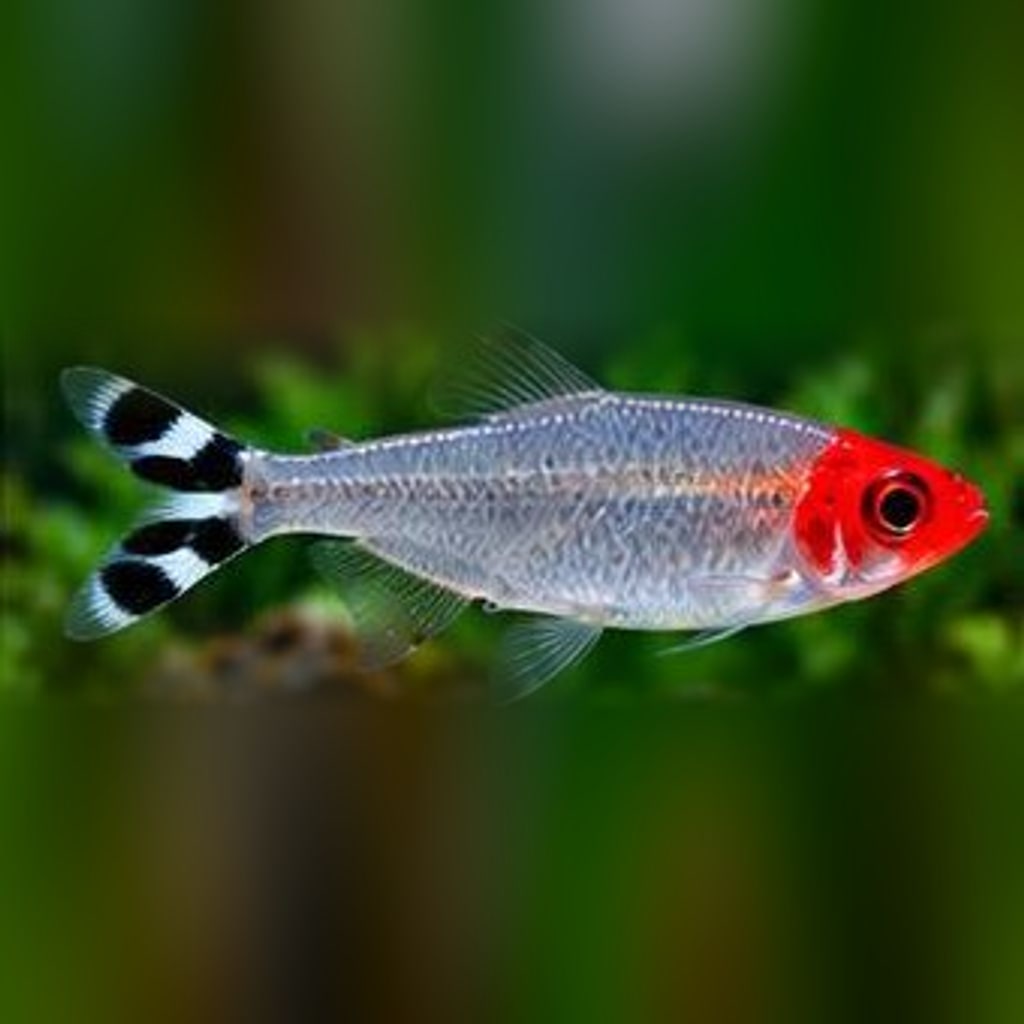
It is a calm schooling fish with a silvery body, a striped tail and a bright red head. Aquascapers love it: a school looks striking without drawing attention away from the plants, and it does not harm them. In return it needs clean, soft water and stable conditions.
Appearance
The body is slender, spindle-shaped and laterally compressed. The maximum standard length of P. bleheri (without the tail) is 3.6 cm; aquarium sources give up to 5 cm for rummy-nose tetras.
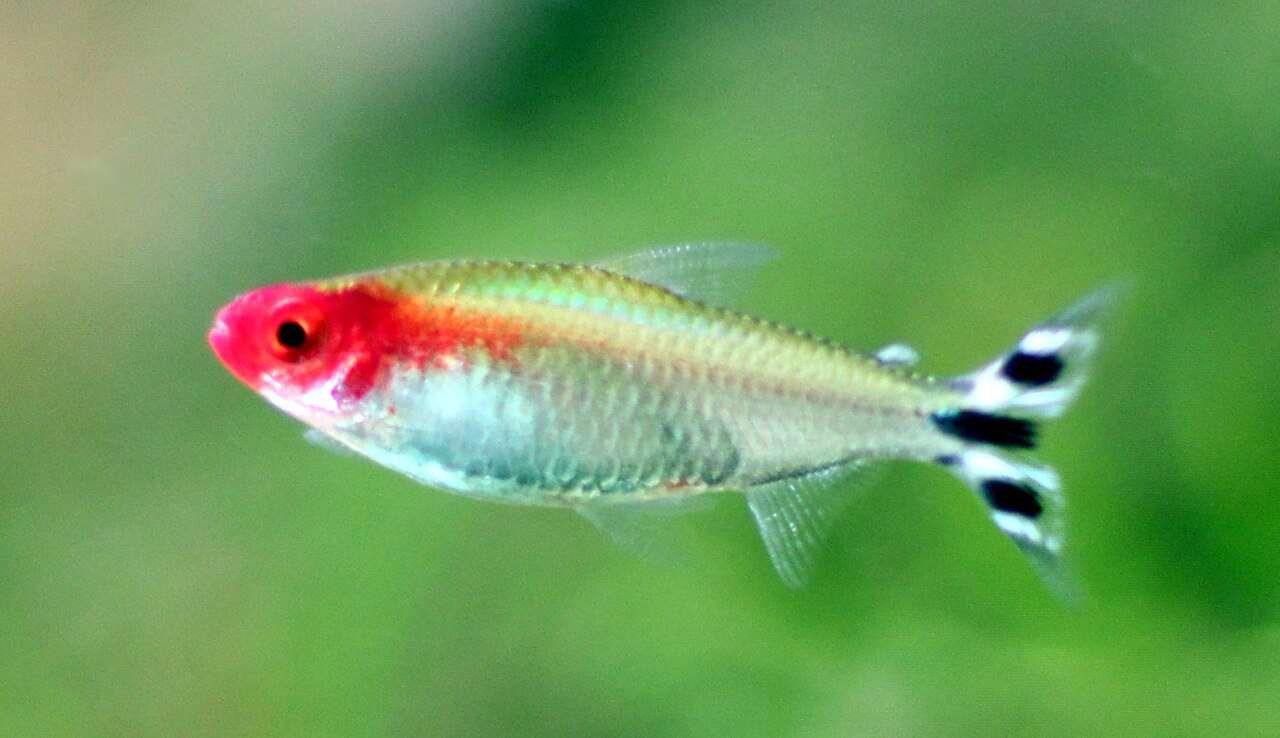
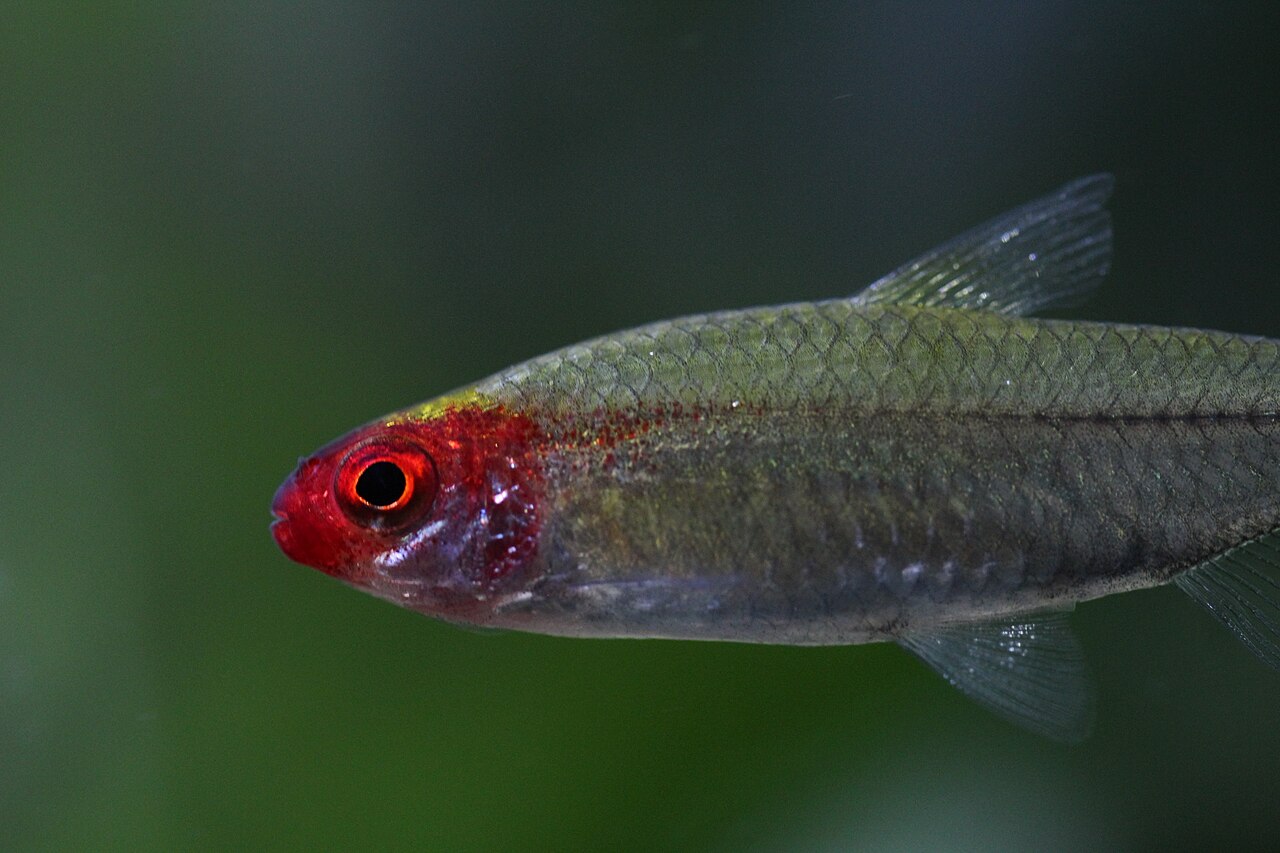
The body is translucent silver, sometimes with a greenish tint, and the fins are clear. The tail has black and white horizontal stripes — usually five black ones (one in the centre and two on each lobe). The head is an iridescent deep red that extends into the iris. P. bleheri differs from the other rummy-noses by a more intense and widespread red reaching the area behind the gill cover, a short black bar on the caudal peduncle and a clear anal fin without a black bar.
Males and females look almost the same; ripe females are just fuller.
Care
- Tank: from 60 L for 6–8 fish; Wikipedia says they prefer about 80 L.
- Group: at least 6, the more the better; they school very tightly.
- Temperature: 24–28 °C; Wikipedia allows 24–31 °C. Not suitable with cool-water fish.
- Water: pH 5.6–7.4 (preferably 6.4–7.0; the Tetra blog gives 5.0–7.0). Hardness no higher than 6 °dH according to Wikipedia; the Tetra blog allows 2–15 °dH.
- Water quality: very sensitive to ammonia and nitrite — efficient filtration and aeration are essential.
- Light: subdued.
- Decor: live plants, especially fine-leaved ones (Cabomba, Myriophyllum), coarse river sand and driftwood; the fish do not damage plants.
- Location: a quiet spot away from traffic — they are shy.
- Water changes: 15–20% weekly; acclimate carefully — after abrupt changes the fish may even lie on their side for a while.
With good care they live 5–6 years, some more than 8 years.
Feeding
In the wild P. bleheri feeds on algae and zooplankton; fish from the Rio Negro have had plant matter and detritus in their guts.
In the aquarium rummy-noses eagerly take both prepared and live foods, especially bloodworms and daphnia. If the diet is based on flakes or pellets, offer a treat once or twice a week. They feed in the middle and lower water layers, so slowly sinking small foods work well. Their stomach is small — feed small portions.
Compatibility
A very peaceful fish. Good companions are neons, black widow tetras and other tetras, danios, barbs, small gouramis, rainbowfish and catfish such as Ancistrus; it also lives with calm South American cichlids like angelfish and discus. It ignores shrimp.
Do not keep it with large aggressive cichlids, with fish that need very different water (e.g. African cichlids) or with cool-water species (e.g. panda corydoras).
Breeding
Breeding is a real challenge even for experienced aquarists.
- Broodstock: sexes can only be told apart by the rounded belly of a gravid female. Keep the fish in soft, acidic water all their lives — in hard, calcium-rich water they become sterile.
- Spawning tank: from 20 L, sterilised beforehand, with an air-driven sponge filter, a heater and clumps of Java moss (or a nylon spawning mop); filter over peat or use a blackwater additive.
- Conditioning: move the pair in about a week before spawning, feed heavily with live food, keep the light dim and the room quiet.
- Spawning: slowly raise the temperature to 30–32 °C (sometimes up to 33 °C), hardness no higher than 5 °dH. Spawning happens in dim light and is hard to observe.
- Eggs: remove the parents and add an antifungal — the eggs are very prone to fungus and bacteria. Keep the tank dim until hatching.
- Hatching: after 72–96 hours at 32 °C; the larvae live on the yolk sac for another 24–48 hours.
- Fry: first food is infusoria or special egg-layer fry food; change about 10% of the water every 24–48 hours.
- Growth: the fry are among the slowest-growing characins — they need micro-foods for 3 to 12 weeks and up to 6 months to reach a size where they eat daphnia; keep them above 30 °C for the first 3 months.
Fun facts
- The red head works as a water-quality indicator: it turns pale when ammonia, nitrite or nitrate rise, and fades briefly after a water change before reddening again in clean water.
- The species is named after its discoverer, the German explorer and fish trader Heiko Bleher.
- P. bleheri was described in 1986 as Hemigrammus bleheri and moved to Petitella in 2020 based on a molecular phylogenetic study.
- Its mitochondrial genome was fully sequenced in 2015 and is 17,021 base pairs long.
- In 2006–2015 P. bleheri made up about 5% of all ornamental fish exported from the state of Amazonas.