Fish
Black neon tetra
Hyphessobrycon herbertaxelrodi
Origin: South America: Paraguay River basin in southern Brazil (the Tetra blog also lists Paraguay and Bolivia).
Also known as: Hyphessobrycon herbertaxelrodi
Fact sheet
- Size
- 4 cm
- Lifespan
- 5 years
- Minimum tank size
- 60 L
- Temperature
- 24–28 °C
- pH
- 5.5–7.5
- Temperament
- Peaceful
- Social behavior
- Schooling
- Group size
- 10+ individuals
- Swimming zone
- Top, Middle
- Diet
- Omnivore
- Jumps out
- Yes
- Eats plants
- No
Photos
Overview
The black neon tetra is a slender characin with a striking two-tone pattern: a bright shining stripe above a broad black one. It was described in 1961 and reached Europe the same year, where it quickly became popular. It is named after the pet-book publisher Herbert R. Axelrod, whose Tropical Fish Hobbyist magazine published the description.
It is a calm schooling fish for community tropical tanks. Black neons do not harm plants, so they are common in designer aquariums; a school looks best over a dark substrate among dense greenery.
Today black neons are bred in large numbers on fish farms and are no longer collected from the wild. Wild fish live in forest streams, small rivers, flooded forest and near sandbanks, in soft acidic water stained by tannins.
Appearance
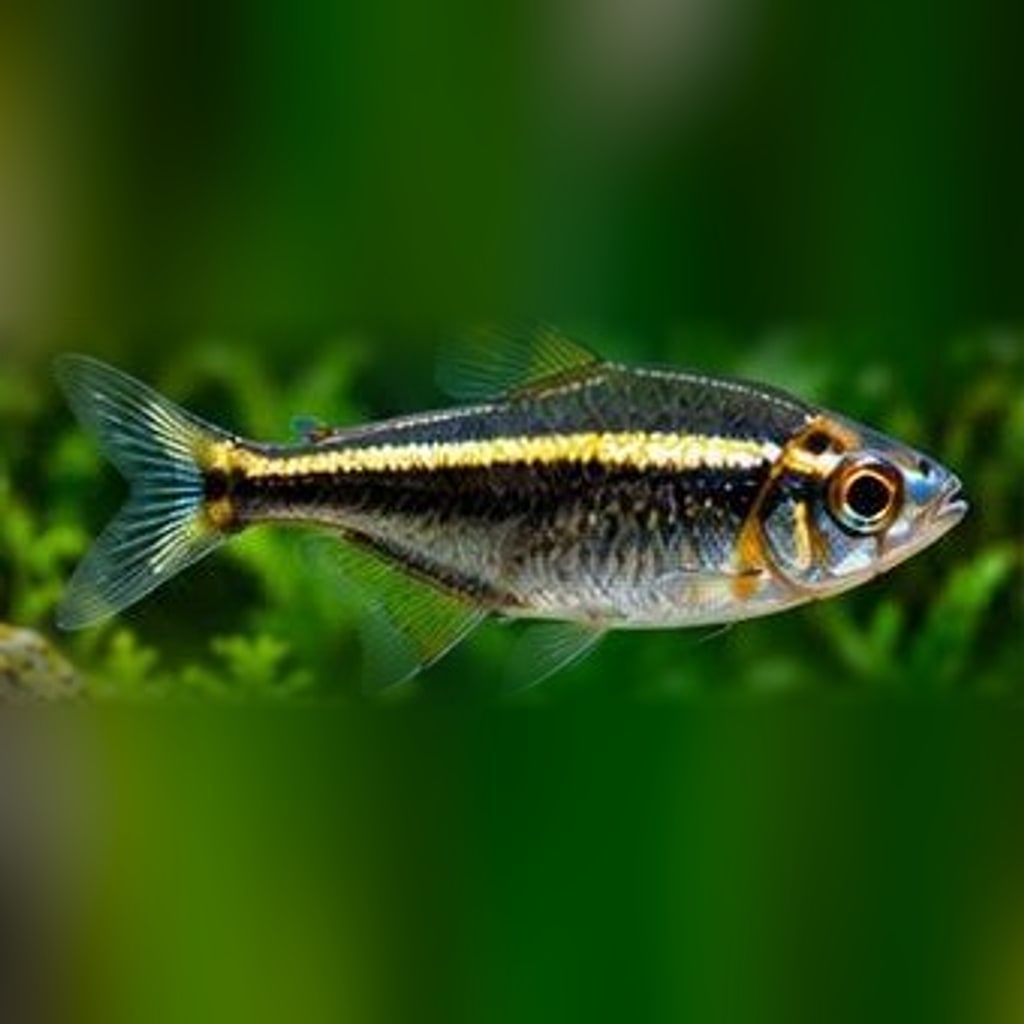
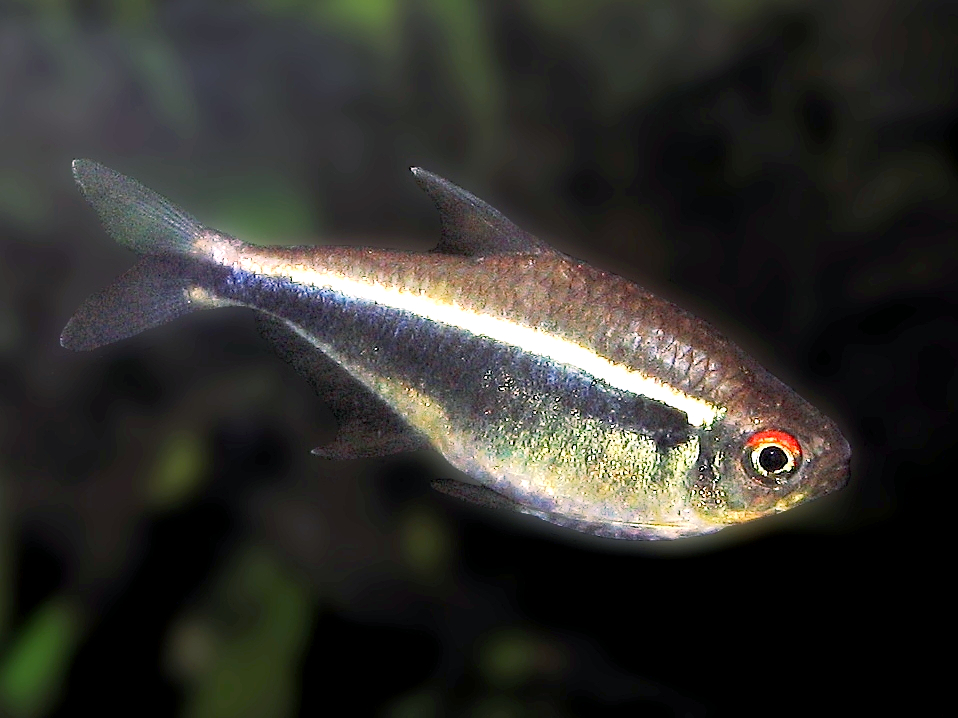
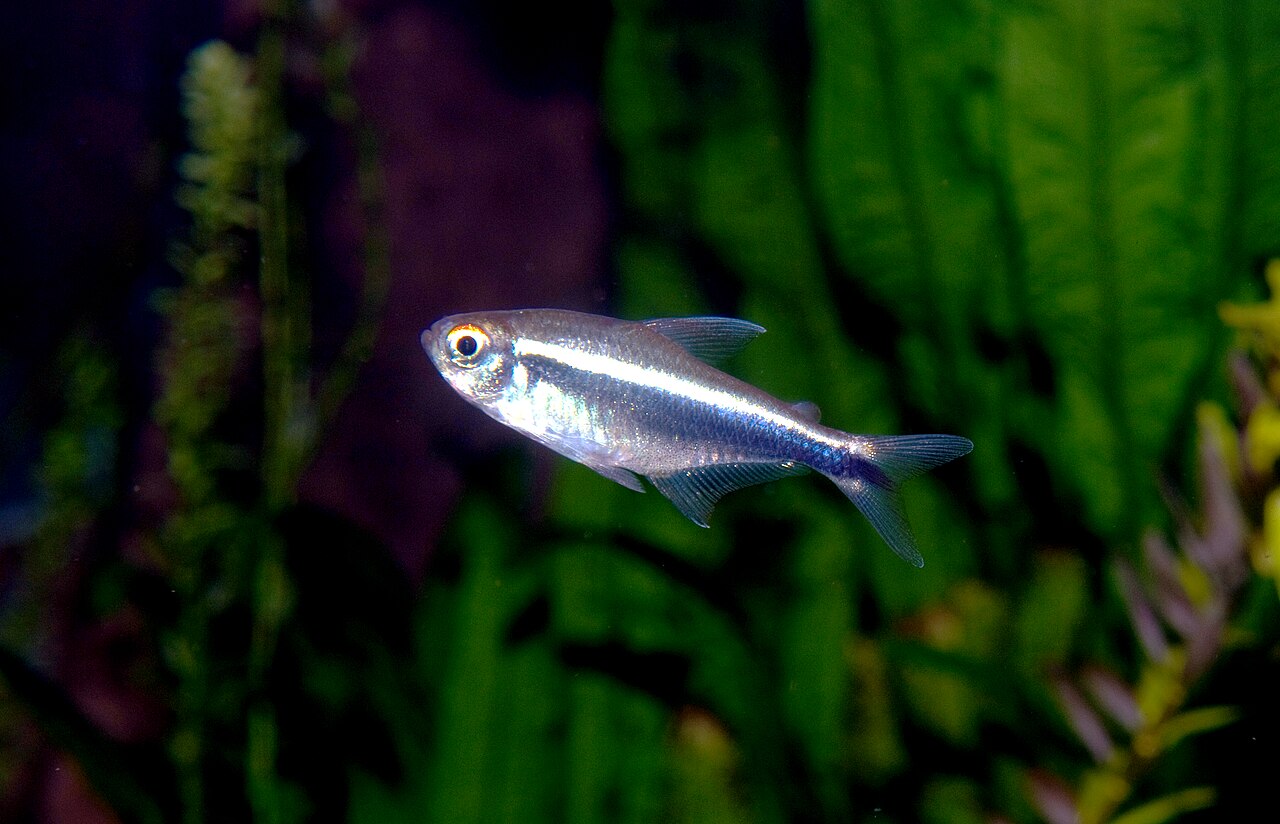
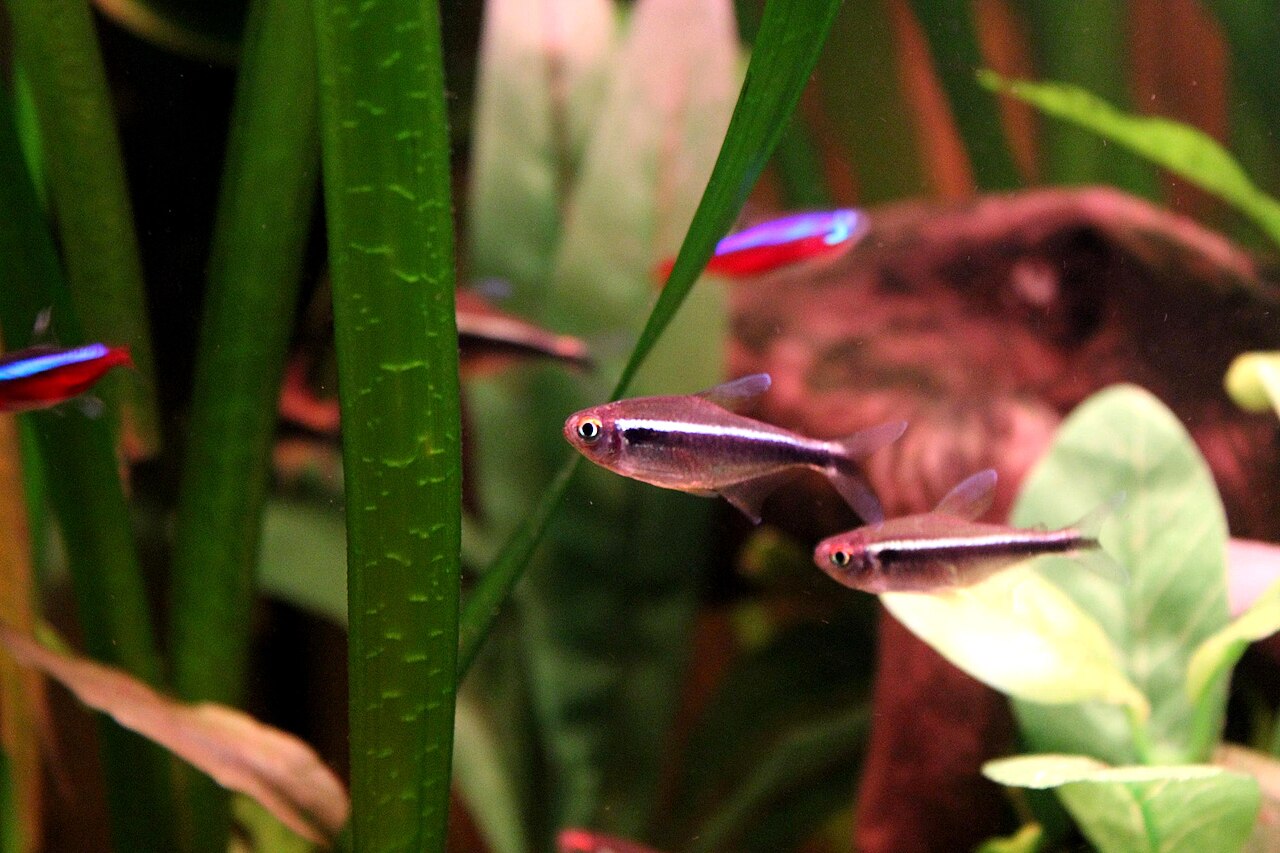
The body is elongated, fairly low and slightly compressed; length up to 4 cm. The back is olive, the belly silvery. Two stripes run from the gill cover to the tail: a narrow shining white one on top (with a bluish or greenish sheen) and a broad velvety black one below with a blurred lower edge. The light stripe contains highly reflective pigment cells, so it "flashes" in reflected light.
The fins are clear or yellowish, and there is an adipose fin. The upper part of the iris is red — English Wikipedia describes two thin bands across the top of the eye, red above yellow.
Females are larger and noticeably plumper than males, especially before spawning.
Care
- Tank: from 60 L for a school of 10.
- Group: ideally 10 or more.
- Temperature: 24–28 °C.
- Water: pH 6.5–7.5 (English Wikipedia says captive-bred fish do well in mature tap water with pH 5.5–7.5). Hardness: the Tetra blog and Russian Wikipedia give 10–20, while English Wikipedia recommends soft, acidic water.
- Light: subdued; floating plants (water lettuce, Riccia) help.
- Plants: plenty of live plants (Echinodorus, Cryptocoryne), dark substrate, driftwood and stones, with enough open swimming space.
- Flow: moderate, with efficient filtration and aeration.
- Lid: essential — they jump easily.
- Setup: avoid new, unstable tanks — add them a few months after start-up.
- Water changes: regular, up to 25–30%.
Black neons live up to 5 years; the Tetra blog gives 5–10 years.
Feeding
In the wild black neons eat small crustaceans, insects and mosquito larvae, as well as some plant matter.
In the aquarium they take flakes, crisps, small granules, frozen and freeze-dried foods, and stay healthiest on a balanced, varied diet. They feed at the surface and in mid-water.
Compatibility
An excellent choice for community tanks with peaceful tropical fish: danios, rasboras, gouramis, dwarf gouramis, corydoras, Ancistrus and other tetras. In a school they are active and harmless, although English Wikipedia notes that they school more loosely in aquaria than many tetras.
With shrimp it varies: sometimes the fish ignore them, sometimes they attack the young. Do not keep them with large or predatory fish (for example big cichlids) — black neons become food.
Breeding
Black neons spawn rather easily if the water is right, though some experience helps.
- Broodstock: healthy fish about one year old. The female is much rounder and plumper than the males. Use 1 female with 2–3 males; Russian Wikipedia also suggests a group of 1–2 males with several females.
- Conditioning: separate the fish for a week and feed generously with live food (brine shrimp, bloodworms).
- Spawning tank: 10–30 L with about 20 cm of water, dark substrate, dim light, a grid on the bottom and fine-leaved plants, a gentle air-driven filter.
- Water: soft and acidic — no more than 4 °dGH, pH 5.5–6.5; about 24 °C, raised to 26 °C after a few days.
- Spawning: on day 1–3, usually early in the morning. The female scatters up to 200 (per Wikipedia, several hundred) sticky eggs over plants and substrate.
- Eggs: remove the parents at once or they eat eggs and fry. Shade the tank on three sides — the eggs are light-sensitive.
- Hatching: after 22–36 hours; fry swim freely on day 3–5.
- Fry: first food is infusoria, then daphnia, brine shrimp or fine flakes; change water more often.
- Growth: fast — stripes appear by the third week; sexual maturity at 8–11 months.
Fun facts
- The black and white stripes help the school keep together in turbid water.
- A "Diamond" or "Brilliant" variety lacks the white stripe and instead shows more reflective scales around the head.
- Thanks to the aquarium trade, a feral population has become established in the Paraíba do Sul river basin in Brazil.
- The name "black tetra" properly belongs to a different species, Gymnocorymbus ternetzi, and the true neon tetra belongs to another genus, Paracheirodon.