Shrimp
Bamboo shrimp
Atyopsis moluccensis
Origin: Southeast Asia. The genus Atyopsis is found on volcanic islands from Sri Lanka to the Samoan Islands and north to Okinawa, and on the mainland from the Malay Peninsula to India. According to Tetra, the shrimp live in large groups in slow-flowing rivers with rocky bottoms and few plants.
Also known as: Filter shrimp, Atyopsis moluccensis
Fact sheet
- Size
- 10 cm
- Lifespan
- 2 years
- Minimum tank size
- 60 L
- Temperature
- 22–28 °C
- pH
- 6–7.5
- Hardness GH
- 4–8 °dH
- Temperament
- Peaceful
- Diet
- Omnivore
- Eats plants
- No
Photos
Overview
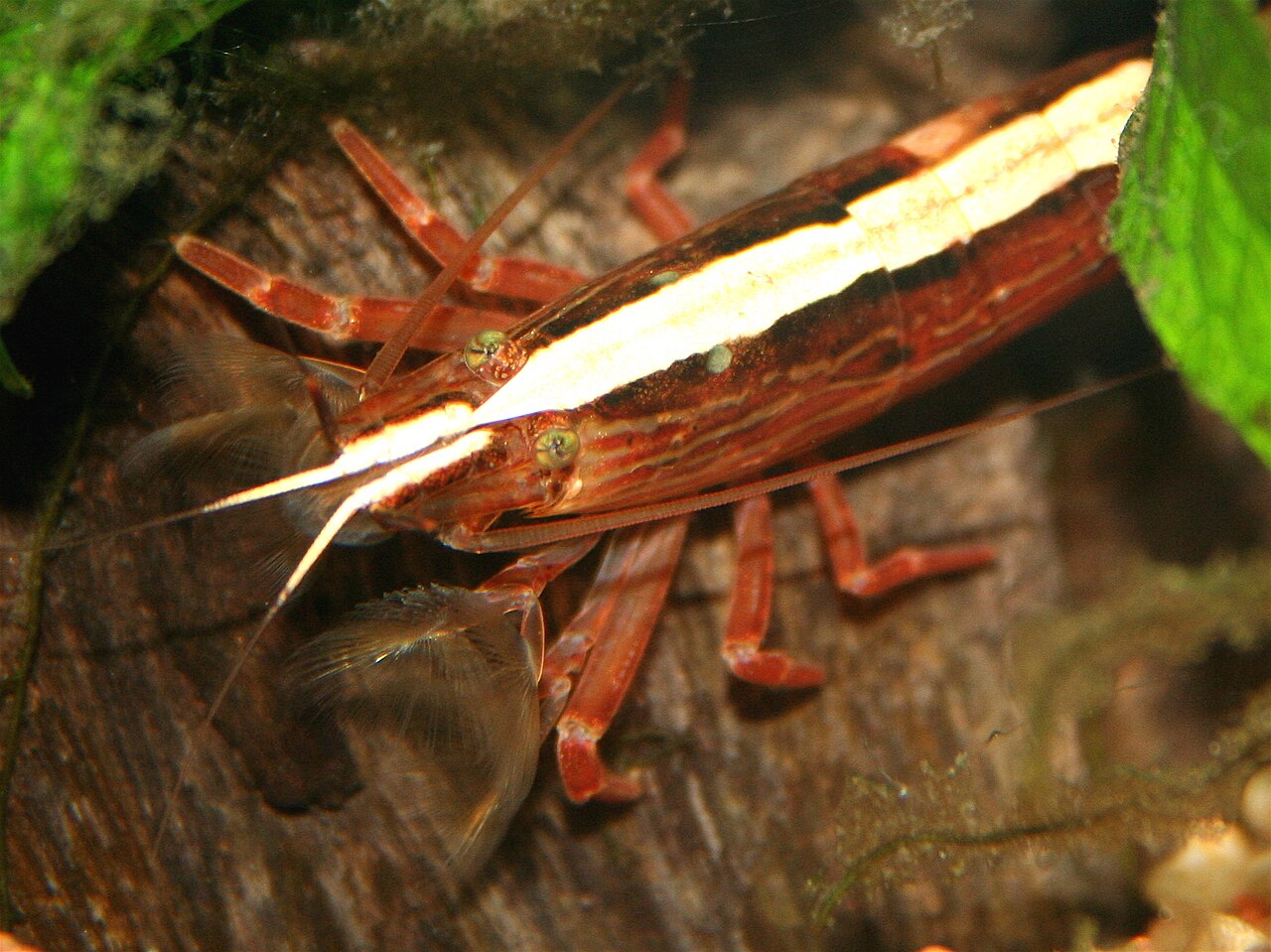
The bamboo shrimp (Atyopsis moluccensis) is a large freshwater shrimp of the family Atyidae. It is sold under several names, including filter shrimp and Atyopsis.
Its defining feature is the way it feeds: the first two pairs of legs carry fans of dense bristles that strain food particles out of the water. The shrimp picks a spot in the current and waits for food to drift into its fans.
It is one of the largest shrimp kept in aquariums, and it is peaceful and gets along with most calm tropical fish.
Appearance
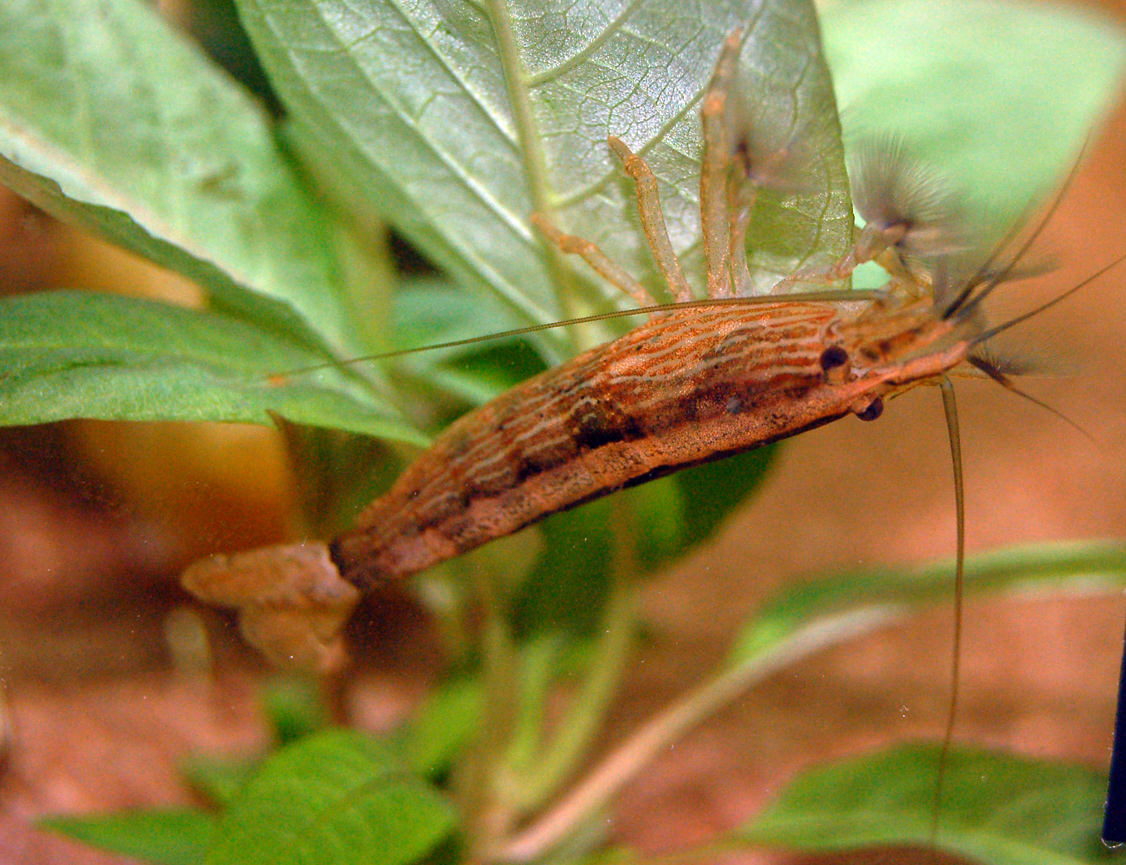
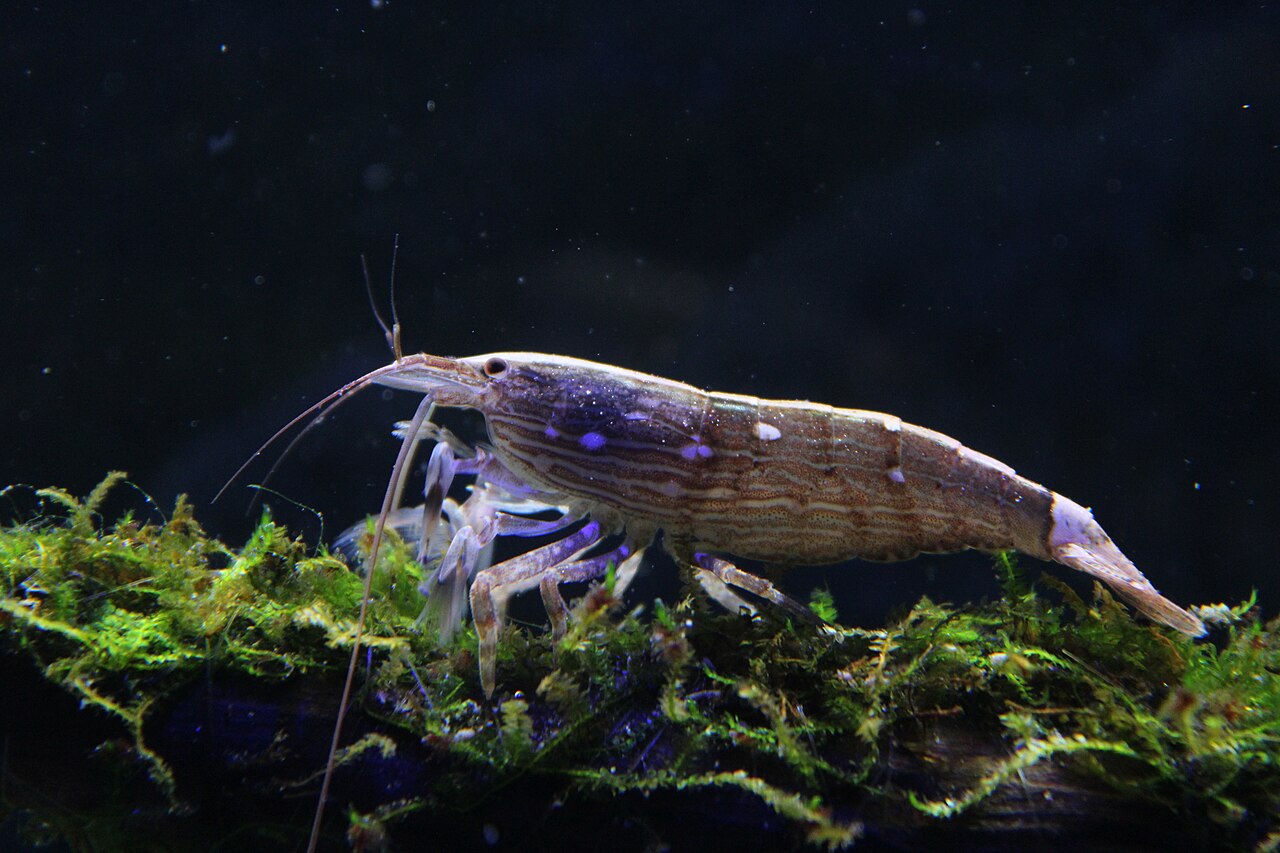
The body is elongated and banana-shaped. Adults reach 6–10 cm, and females are larger than males.
Colour varies a lot: sandy, brown, greenish or yellowish, depending on where the shrimp was caught, its diet and the tank decor, so it is hard to predict. A white or pale yellow stripe runs along the back.
The feeding limbs are made of two halves with dense bristles that open like fans. Small particles get caught in the bristles and are carried to the mouth. The limbs work in turns: one catches while the other feeds. Males of the genus Atyopsis have a "massive spur" on the third pair of walking legs. It differs from its close relative Atyopsis spinipes in the number of teeth on the underside of the rostrum: 7–16 versus 2–6.
Care
- Tank size: from 60 L for a small group.
- Temperature: 22–28 °C.
- pH: 6.0–7.5.
- Hardness: GH 4–8.
- Flow: needs moderate current from a suitably powerful filter, plus aeration.
- Layout: place large plants, stones and driftwood along the filter outflow, where the shrimp line up to catch food. Broad-leaved plants such as Anubias, Echinodorus and Cryptocoryne work well.
- Substrate: any suitable neutral substrate.
- Hiding places: the shrimp is very vulnerable while moulting, so provide small caves and dense plants.
- Water quality: very sensitive to nitrogen compounds, so regular water changes of up to 20% are needed. Do not add the shrimp to a newly set-up tank, as it needs stable conditions.
- Mostly active at night.
Lifespan in the aquarium is 1–2 years.
Feeding
The fans strain detritus, microorganisms and algae from the water, and the diet is mainly plant and algae particles. A tank rarely has enough suspended food, so the shrimp need extra feeding.
Most sinking shrimp foods are unsuitable. Tetra recommends soaking flake food in a little water and releasing the mash near the filter outlet, and finely ground fry food also works. When food is scarce, the shrimp forages through the substrate.
Compatibility
A peaceful species that suits almost any calm community. Good tankmates include guppies, danios, neons, tetras, Ancistrus and other shrimp such as Amano and cherry shrimp.
It does not damage live plants, so it suits planted tanks. It should not be kept with large cichlids, barbs or pufferfish (Tetraodon).
Breeding
- Very difficult to breed at home.
- Sexual maturity comes at a length of 3–4 cm.
- The eggs develop for about a month on the female's swimming legs.
- The larvae that hatch are no more than 1 mm long. In the wild the current carries them to river mouths, where they develop in brackish water, and the young then return to fresh water.
- The larvae need salt water, but adults cannot tolerate higher salinity. For this reason, most shrimp in the trade are wild-caught.
Fun facts
- The genus Atyopsis was created in 1983 by Fenner A. Chace, Jr. for two species previously placed in Atya.
- The genus has only two species: Atyopsis moluccensis and Atyopsis spinipes (the dwarf bamboo shrimp).
- No fossil members of the genus are known.
- A related African filter shrimp, Atya gabonensis, grows to 15 cm.