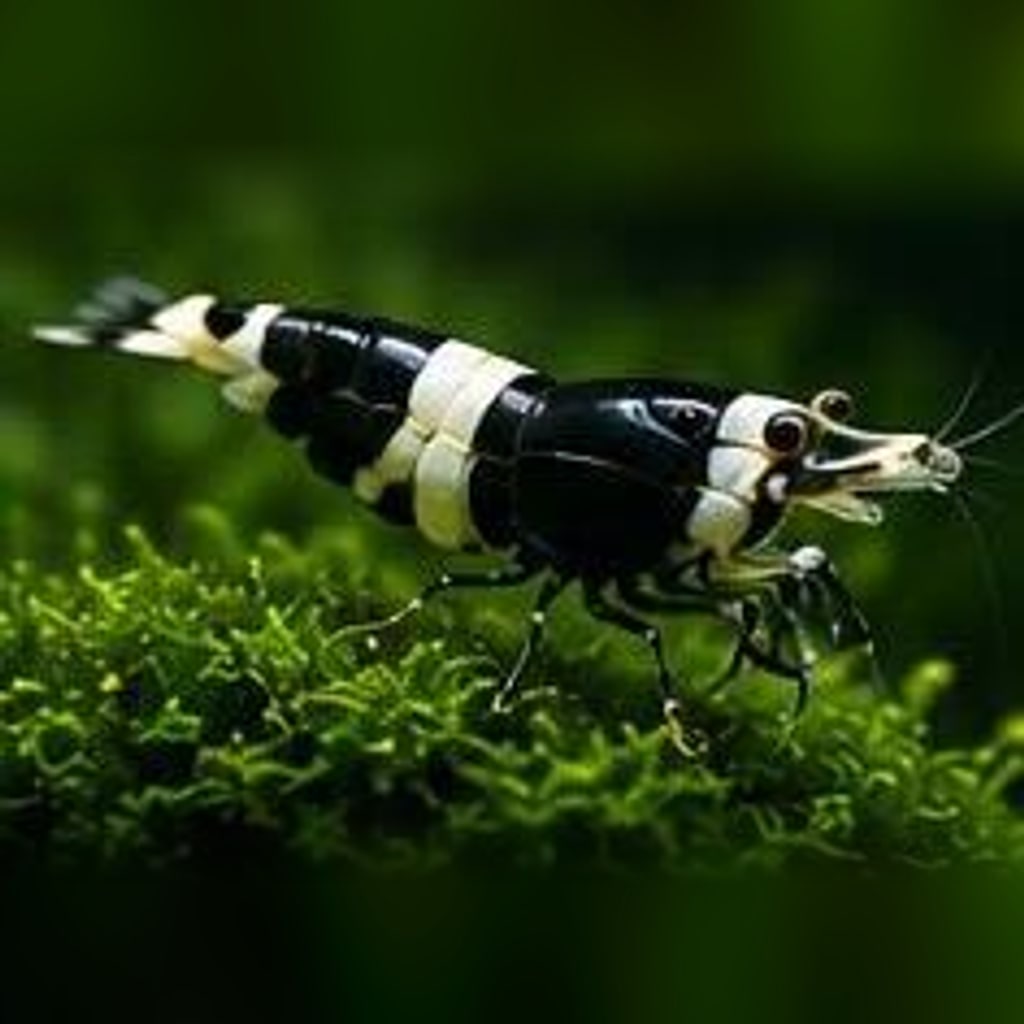
Crystal Black
Caridina cantonensis 'Crystal Black'
Origin: Southern China and Hong Kong, possibly northern Vietnam. According to Tetra, wild shrimp are found on Nan'ao Island, in Guangzhou and Yangjiang (Guangdong Province) and in Hong Kong. They live in clear, oxygen-rich mountain streams and in small, slow waters made acidic by fallen leaves. Tetra also mentions Taiwan and Japan.
Also known as: Black Bee, Black Crystal, Crystal Bee
Fact sheet
- Size
- 3 cm
- Lifespan
- 1.5 years
- Minimum tank size
- 10 L
- Temperature
- 21–26 °C
- pH
- 6.5–7.5
- Hardness GH
- 4–6 °dH
- Temperament
- Peaceful
- Diet
- Omnivore
- Eats plants
- No
- Copper sensitive
- Yes
Photos
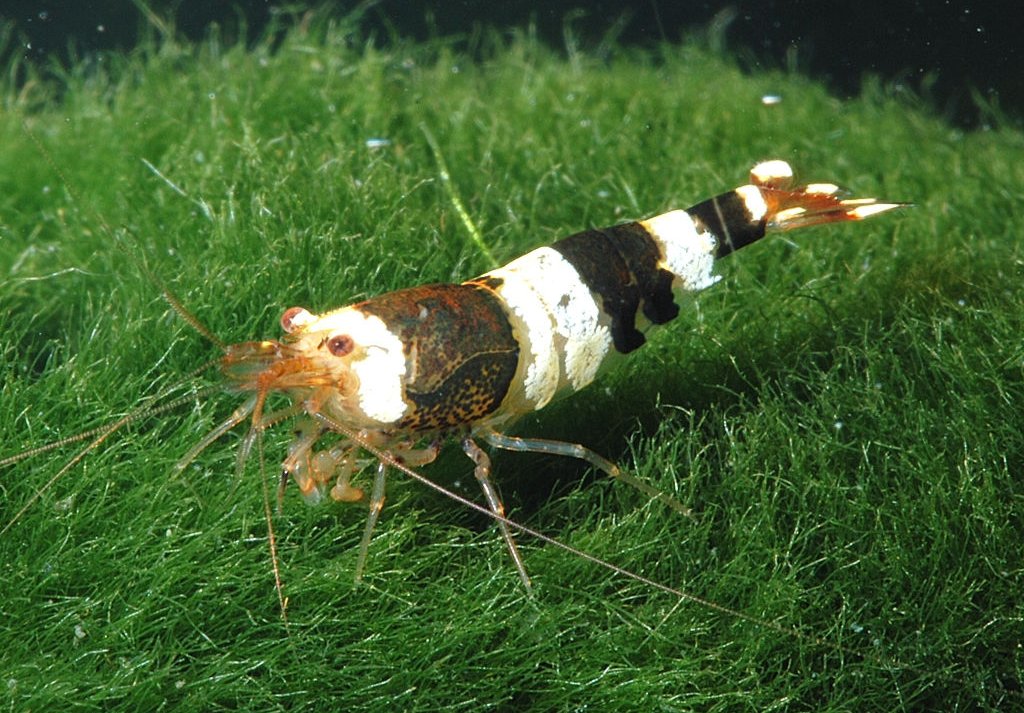
Overview
The black-and-white form of the bee shrimp and its most common variety; other forms, including Crystal Red, were bred from it. Care is the same as for the species. The name "crystal" officially belongs to the red form and was carried over to the black one by habit, so Russian Wikipedia considers "bee shrimp" the correct name.
Appearance
Black bands instead of red ones, alternating with white. In lower grades the black areas are pale.
Care
Shared with the species: Bee shrimp
- Tank size: from 10 L, with as much floor area as possible.
- Temperature: 21–26 °C; the strongest colours develop at 24–25 °C. Long periods of high temperature raise juvenile and adult mortality and reduce egg survival.
- pH: 6.5–7.5.
- Hardness: GH 4–6. For Crystal Red, another Tetra article gives GH 6–9. The shrimp's health depends on soft water.
- Equipment: a filter without strong flow, aeration and a heater.
- Plants: mosses, ferns, carpeting plants and other low plants. Trim Anubias rhizomes and leaves outside the shrimp tank, as cutting them inside may kill shrimp.
- Substrate: fine neutral gravel or special shrimp soil.
- Copper: according to Tetra (article on the Blue Bolt form), this species cannot tolerate even traces of copper, so take care with medications and additives.
- Water changes: up to 20% once a week, with nitrate no higher than 20 mg/L. Condition tap water before use. The shrimp are very sensitive to swings in water parameters.
Lifespan is about 18 months (English Wikipedia). Tetra gives 15–16 months in one article and 2–4 years in another.
Feeding
Shared with the species: Bee shrimp
A scavenger that eats small pieces of decaying plants and algae. The diet is based on algae and biofilm, which the shrimp constantly pick from stones and leaves.
Limit protein food, including most live and frozen foods, because the shrimp digest it poorly. A poor diet turns the white parts of the colouring greyish-yellow or transparent, so quality dry shrimp food is best. Food should be eaten within 30–60 minutes, and a fasting day every 1–2 weeks is useful. Tetra also suggests oak and Indian almond leaves and blanched vegetables.
Compatibility
Shared with the species: Bee shrimp
A species-only tank is best. Different colour forms (for example red and black crystals) and different grades should not be kept together, because they interbreed and the offspring have unpredictable colours.
They live well with cherry shrimp, Amano shrimp and bamboo shrimp. Only small peaceful fish are suitable, such as microrasboras, neons and small tetras, and even then juveniles and freshly moulted shrimp are at risk. Cichlids, even angelfish, are not recommended.
Breeding
Shared with the species: Bee shrimp
- A female ready to mate releases pheromones into the water, and the males search for her actively.
- She carries 10–30 eggs (about 20 on average) under her abdomen, fans them with her swimming legs and removes dead ones.
- The eggs take 3–4 weeks to develop, or about 28 days at 22 °C.
- There is no larval stage: the young hatch as miniature adults.
- Sexual maturity comes at about six months. In warmer water shrimp mature earlier but at a smaller size.
- A drop in temperature of a couple of degrees stimulates breeding.
Fun facts
Shared with the species: Bee shrimp
- The species is listed as Least Concern (LC) on the IUCN Red List.
- The red form was found in the 1990s by the Japanese breeder Hisayasu Suzuki among his black bee shrimp. Tetra says he noticed it in 1993 and published in 1996; English Wikipedia gives 1996.
- Crystal shrimp are graded into lower classes A, B and C and higher classes S, S+, SS and SSS. Rare specimens can sell for several thousand dollars.
- Shrimp farms in Taiwan and other regions breed bee shrimp for the trade.
- A 2020 phylogenetic analysis found the species' closest relative to be Caridina mariae (the tiger shrimp).