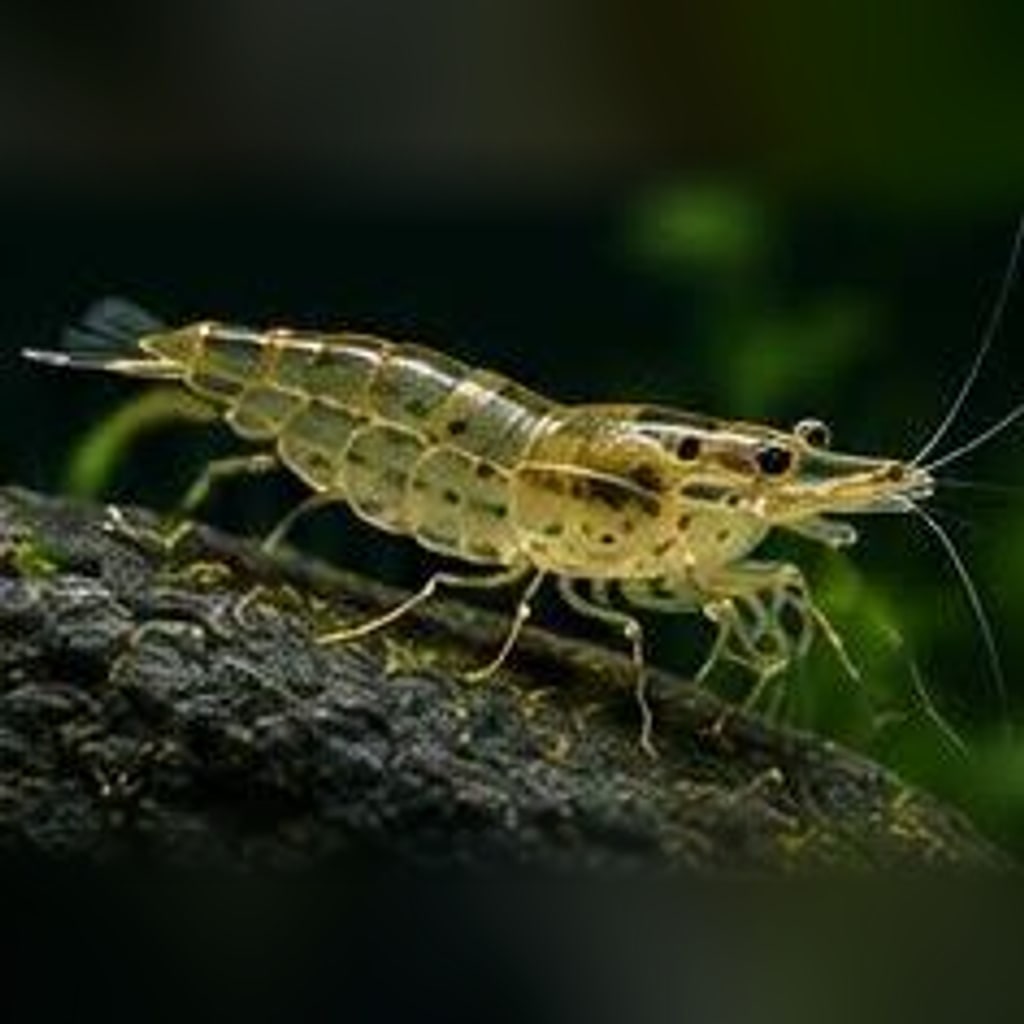
Shrimp
Amano shrimp
Caridina multidentata
Origin: Japan (mainly the southwest and centre), Taiwan and parts of Korea; introduced to Madagascar and Fiji. Lives in rivers with rocky beds and fast-flowing water.
Also known as: Caridina multidentata, Yamato shrimp, Japanese shrimp, algae shrimp; formerly Caridina japonica
Fact sheet
- Size
- 5 cm
- Lifespan
- 4 years
- Minimum tank size
- 30 L
- Temperature
- 22–27 °C
- pH
- 6.5–7.5
- Hardness GH
- 5–20 °dH
- Temperament
- Peaceful
- Group size
- 10+ individuals
- Diet
- Omnivore
- Copper sensitive
- Yes
Photos
Overview
Caridina multidentata is a freshwater shrimp of the family Atyidae, known to aquarists as the Amano shrimp. The Japanese aquascaper Takashi Amano introduced it to the hobby in the early 1980s to control algae.
A group can quickly clear an aquarium of hair algae and other soft algae, which makes the species popular in planted tanks. It is peaceful, active and large enough for a community tank with peaceful fish.
The main difficulty is breeding: the larvae develop in brackish and sea water, so offspring do not survive in a freshwater tank.
Appearance
Length is 2.5–3.5 cm according to English Wikipedia; Russian Wikipedia gives up to 5 cm for females and 3.5 cm for males; Tetra says females are almost twice the size of males and reach 7 cm.
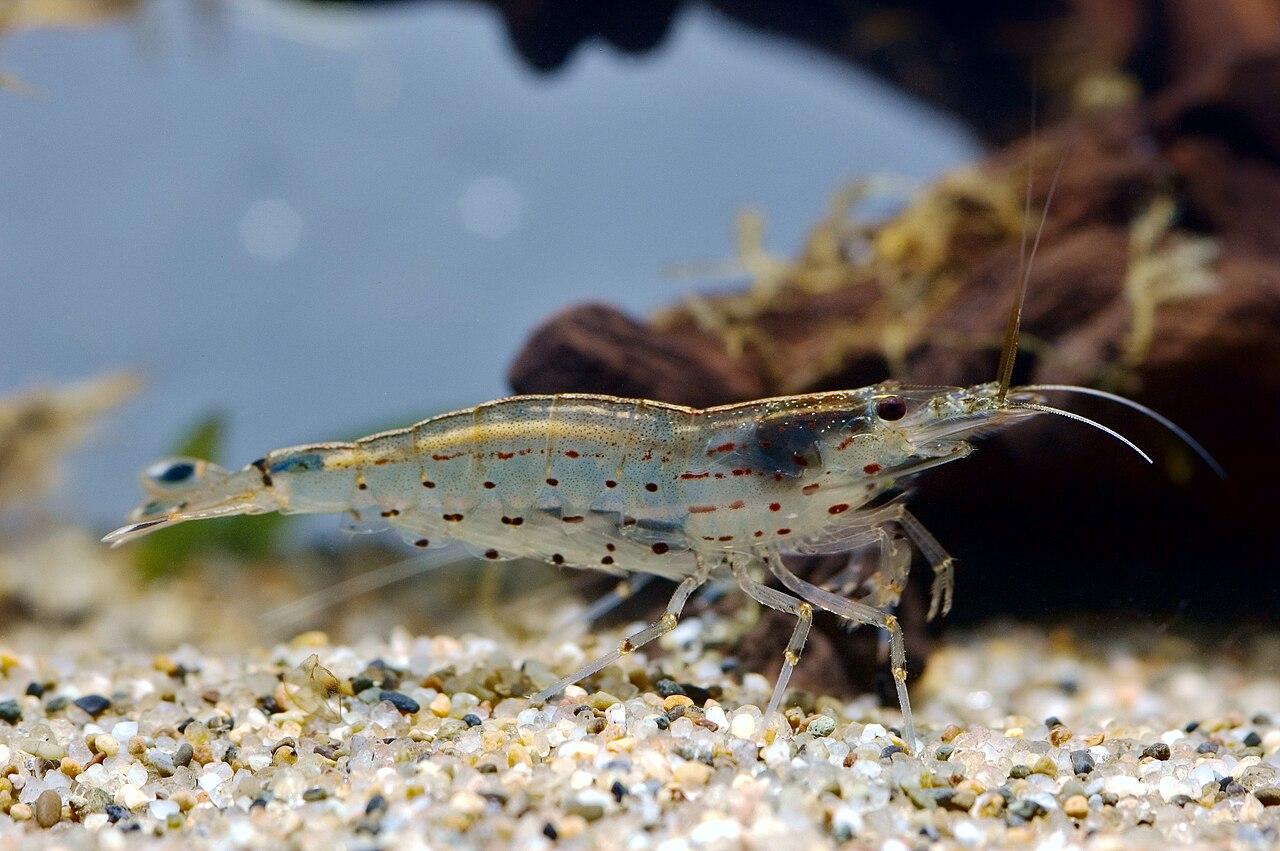
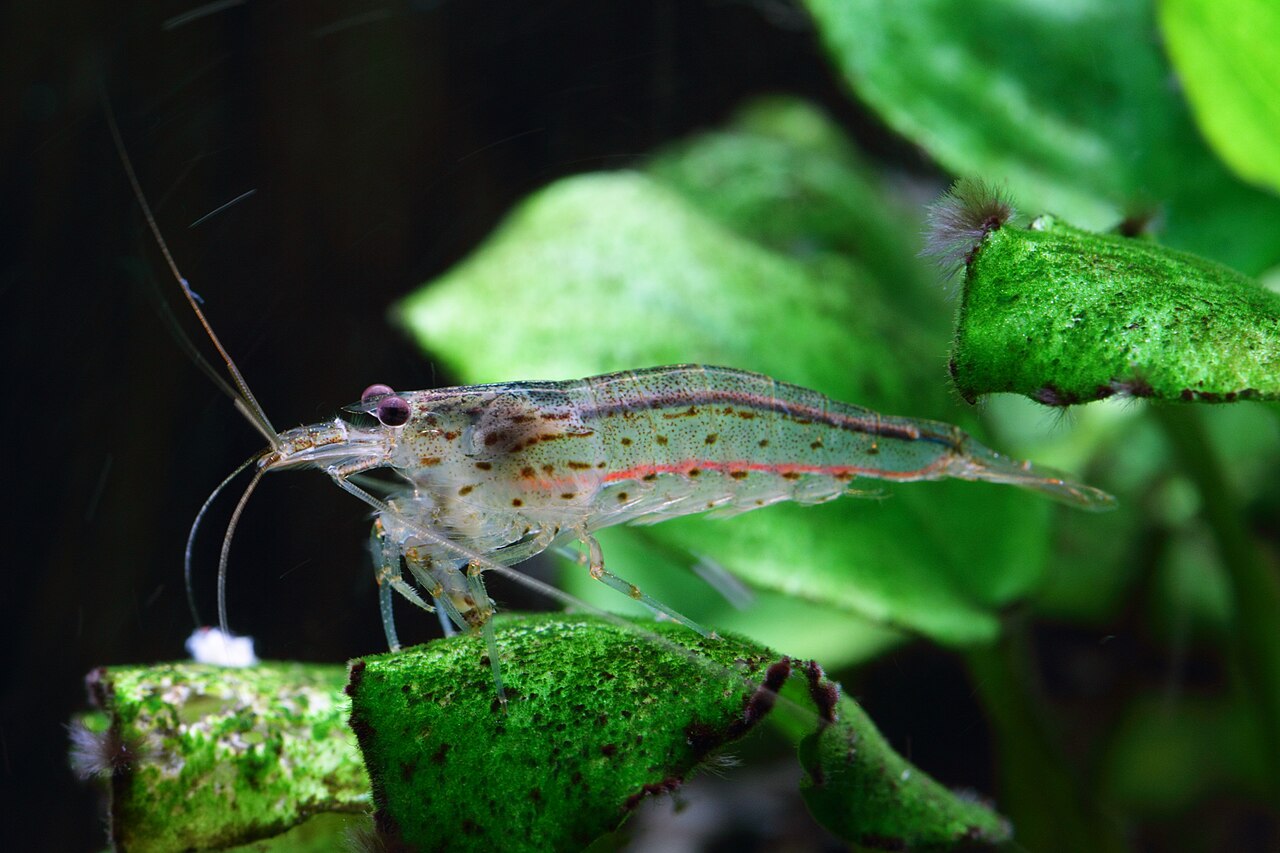
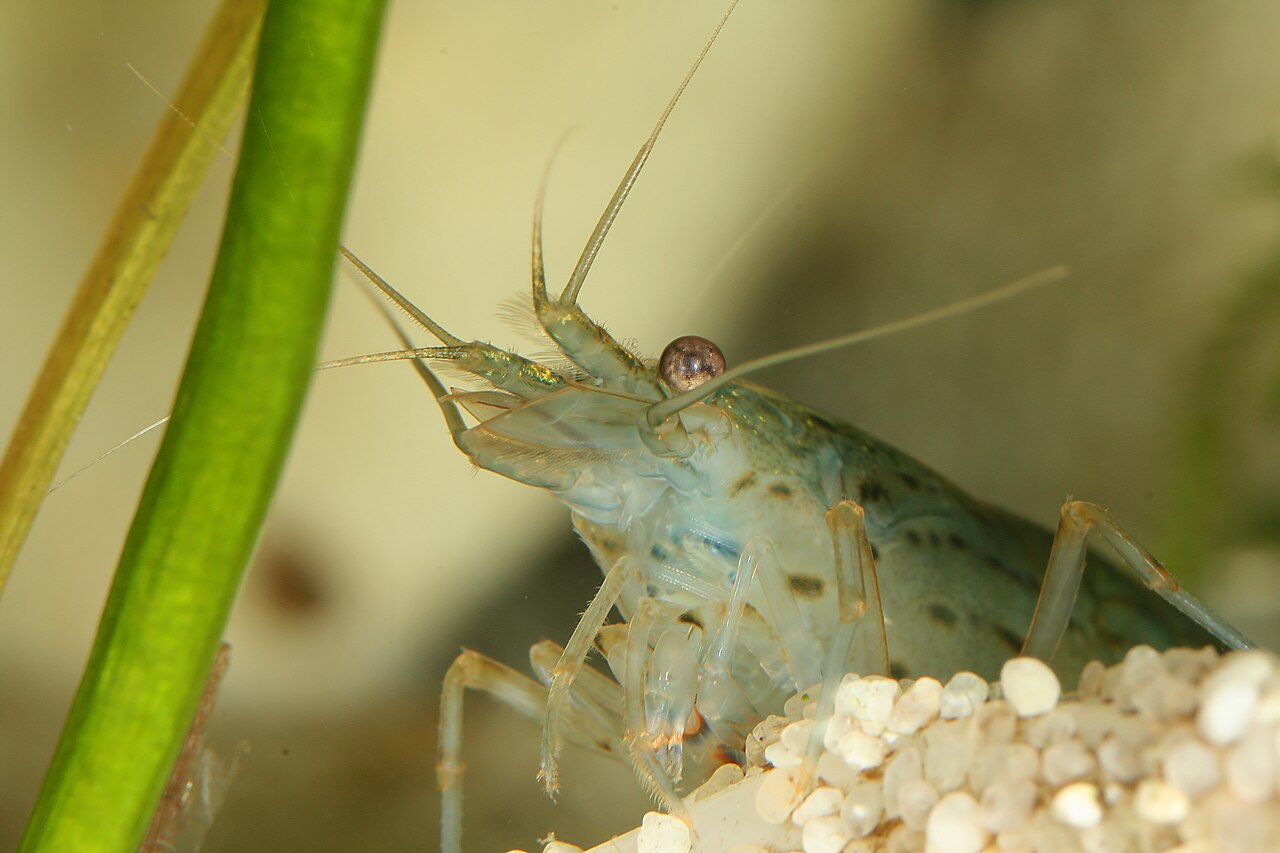
The body is translucent with broken lines of reddish-brown dots along the sides and a light stripe along the back from head to tail. Overall tint depends on diet: light green on a plant-based diet, otherwise clear or reddish.
Sex differences:
- females are larger, with elongated abdominal segments that protect the eggs;
- in females the lower row of markings is drawn out into dashes, in males it consists of separate dots.
Care
- Tank size: at least 30 L (Russian Wikipedia); Tetra recommends at least 5 L of water per shrimp.
- Group: preferably 10 or more.
- Temperature: 22–25 °C, tolerating drops to 18 °C (Russian Wikipedia); 23–27 °C (Tetra); does best at 18–28 °C, more active in warmer water but may live shorter.
- pH: 6.5–7.5 (Wikipedia); 6–8 (Russian Wikipedia, aquarium section); 7.0–7.5 (Tetra).
- Hardness: 5–20 dGH (Russian Wikipedia); GH 2–20 (Tetra). Calcium is needed for the exoskeleton.
- Plants and cover: fine-leaved plants, driftwood, tubes; any substrate suitable for plants.
- Filtration: good filtration and aeration — the shrimp are sensitive to nitrogen compounds and like to swim against the current.
- Lid: essential, with large openings closed — they climb well along hoses and tubes.
- Copper: extremely averse to copper (their blood contains haemocyanin).
- Water changes: up to 20% weekly.
Lifespan is up to 4 years according to Russian Wikipedia; Tetra gives an average of 6 years.
Feeding
Omnivorous but feeds mainly on algae: hair algae and other soft algae, detritus and leftover fish food. It does not eat red algae (such as black beard algae), though an active group hinders their appearance.
Algae alone is not enough: supplement with spirulina flakes and specialised shrimp foods (granules, sinking sticks, wafers). Russian Wikipedia allows occasional animal protein (daphnia, mysis); Tetra, by contrast, does not recommend live or frozen foods.
Amano shrimp may snatch food from fish and from each other.
Compatibility
Peaceful and harmless to other tank inhabitants — it does not touch fish eggs or fry.
- Suitable tankmates: small peaceful schooling fish, bettas, gouramis, barbs, livebearers, corydoras, bristlenose plecos; it gets along with Neocaridina.
- Unsuitable: large and predatory fish; even angelfish prey on young shrimp.
- The shrimp hide from overly active tankmates.
Breeding
The species is amphidromous: mating, egg-laying and hatching happen in fresh water, while the larvae drift into brackish and sea water to develop and return to fresh water as adults.
- A ready female releases pheromones and males swim frantically around the tank searching for her; several males often take part in fertilisation.
- The eggs are dark green, yolk-rich, up to 1,000 per clutch (Tetra); the female carries them on her pleopods for 4–5 weeks.
- Larvae start feeding only at the third zoeal stage.
- Captive breeding is very difficult (Tetra: possible with preparation): the female is moved to a separate freshwater tank; after hatching the water is salted with marine salt to 35 g/L, larvae are kept at 20–22 °C, and after 2–3 weeks salinity is gradually lowered to 17 g/L.
- Larvae metamorphose and become bottom-dwelling at about 45 days (Russian Wikipedia); juveniles are moved to fresh water about 2 months after hatching (Tetra).
Fun facts
- Until 2006 the species was known as Caridina japonica De Man, 1892; it then turned out it had been described 30 years earlier as Caridina multidentata Stimpson, 1860.
- It is named after the Japanese aquascaper Takashi Amano.
- Its short, wide rostrum is an adaptation to fast-flowing water.
- The shrimp are positively phototactic — they move towards light, which is used to catch females with a torch.
- In the wild they live in large aggregations, sometimes several hundred strong.
- The wide range is explained by the good dispersal of larvae at sea.