Plants
Bucephalandra
Bucephalandra spp.
Origin: Endemic to Borneo (Kalimantan). Rheophytes that grow in streams and rivers of moist tropical forest, usually as dense mats over stones, rocks or wood, in fast-flowing clean water.
Also known as: Bucephalandra spp. Sold under many trade names, usually after the stream where a plant was found, sometimes after leaf colour or shape: B. pygmaea 'Wavy Green' ('Bukit Kelam'), B. sp. 'Red', B. diabolica 'Kedagang', B. sp. 'Brownie', 'Brownie Red', 'Arrogant Blue', B. motleyana 'Riam Macam', 'Gunung Sumpit', 'Riam Seterap', 'Kapit' and others.
Fact sheet
- Temperature
- 22–28 °C
- pH
- 5.6–7.4
- Lighting
- Low
- CO₂
- Not needed
- Growth rate
- Slow
- Placement
- On wood or rock
Photos
Overview
Bucephalandra is a genus of evergreen herbs in the arum family (Araceae), related to Anubias and Cryptocoryne. According to English Wikipedia, 32 species had been formally described as of 2026, while the trade knows around two hundred species and varieties, many labelled "sp." or "cf." — that is, without a full description.
A relatively recent addition to the hobby, first popularised by Japanese aquarists, it quickly became a favourite for its slow growth, diverse leaf shapes and colours, iridescent leaves and ease of care. It is used and kept much like Anubias.
Appearance
The stem is a creeping rhizome that clings to the substrate with its roots. Wild plants range from about 2 to 60 cm tall; in the aquarium, according to Tropica, they reach 5–10+ cm after two months.
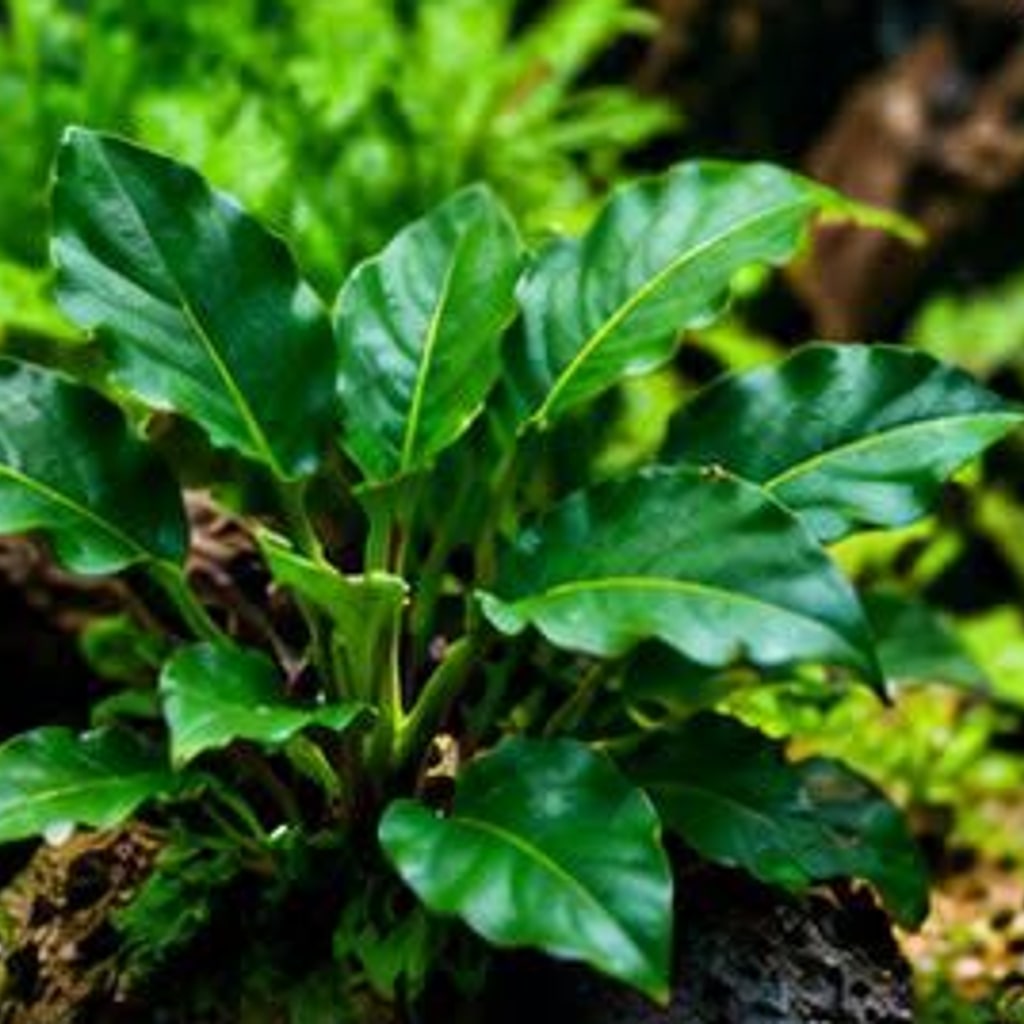
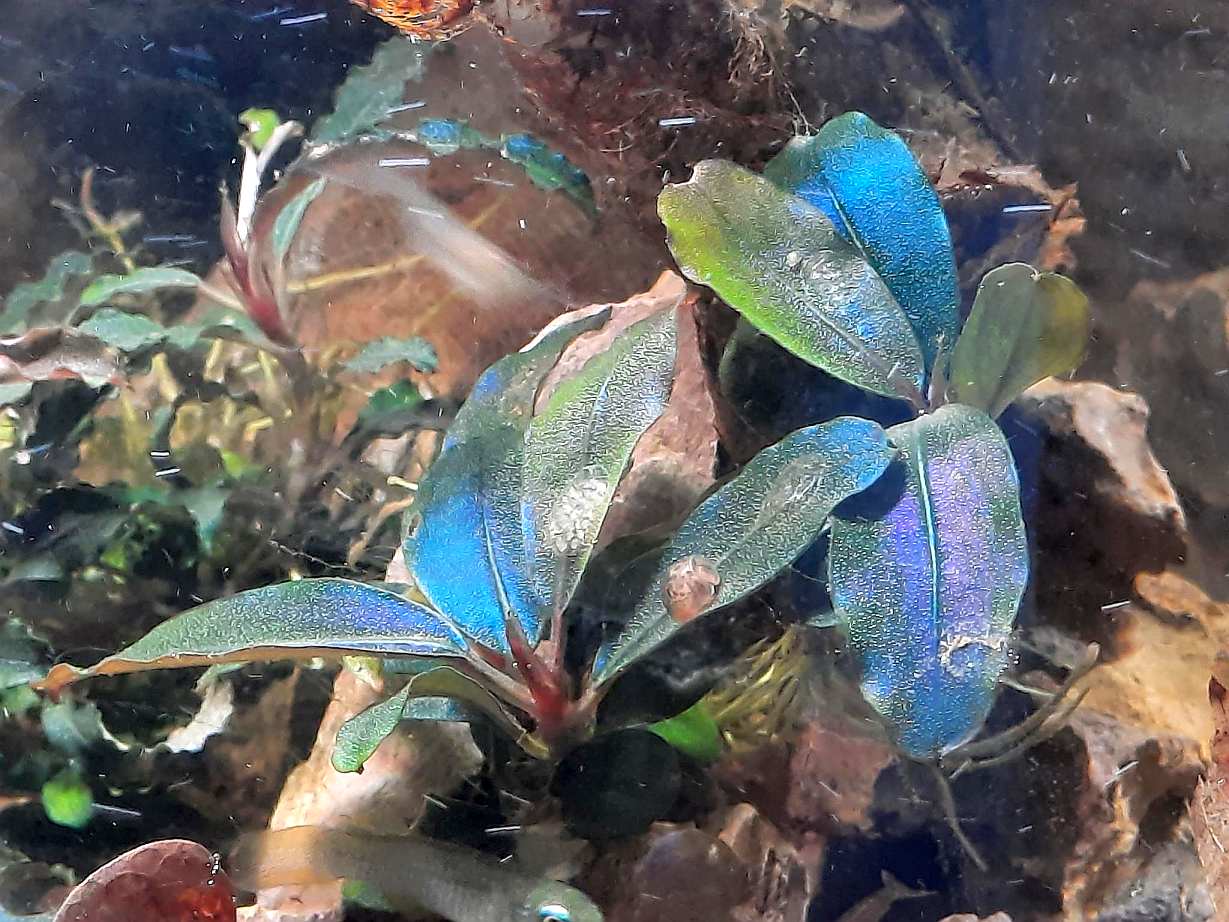
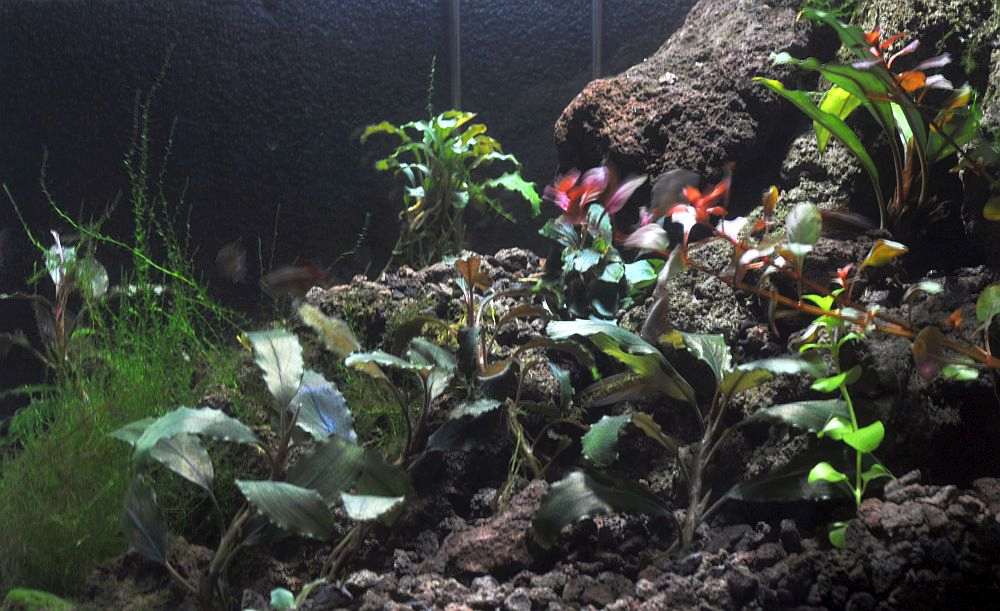
Leaves are firm, often leathery and glossy — elliptic, oblong, linear or oblanceolate — with straight or wavy edges. Colour ranges from dark blue-green to green, often with reddish tones; many have tiny silvery or golden specks on the upper surface, and a metallic blue sheen may appear under water. 'Wavy Green' has leaves about 2 × 5 cm, 'Red' 2–4 × 4–6 cm.
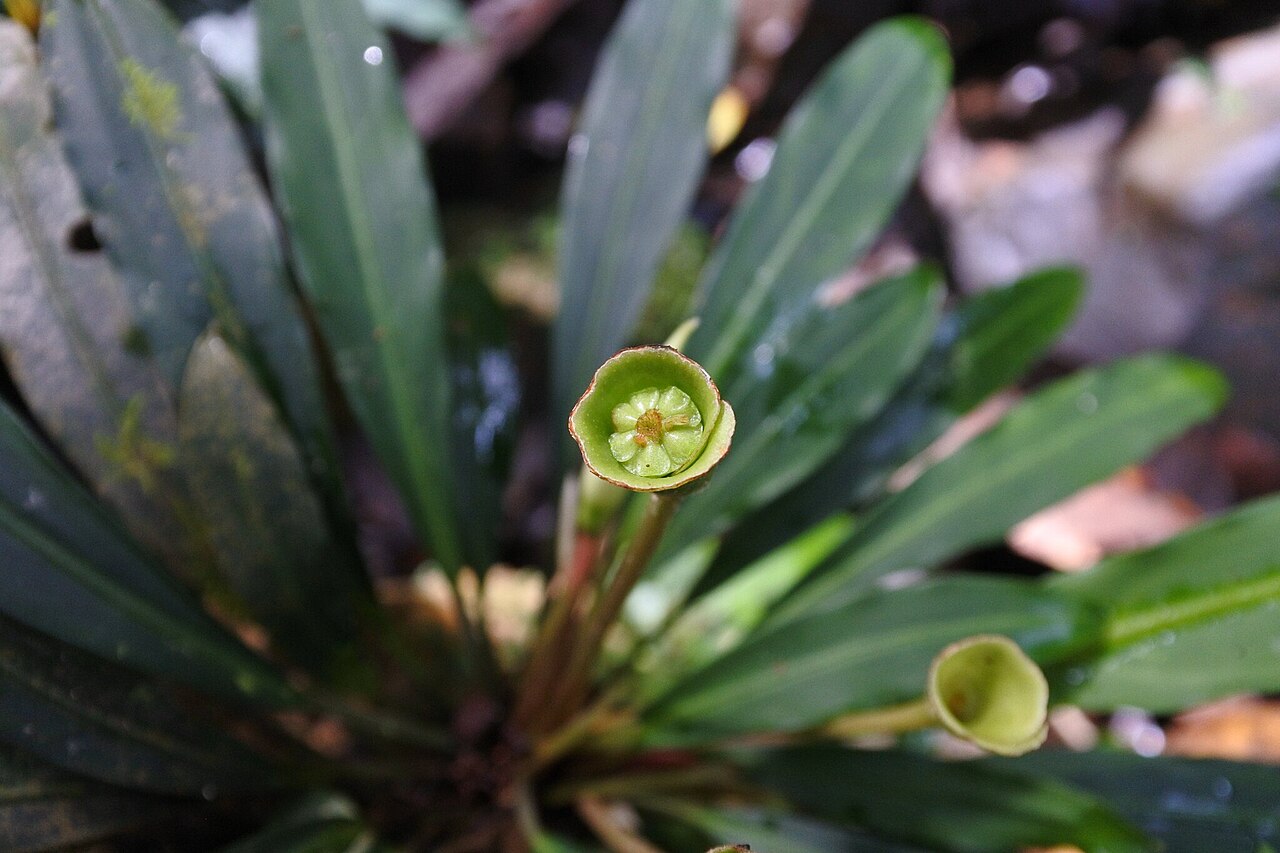
The inflorescence is a spadix in a spathe, usually white or milky, sometimes cream or yellow-orange, on a 5–8 cm stalk; the "flower" is 1–2 cm. Bucephalandra can flower under water.
Care
- Placement: epiphyte. Never bury the rhizome — it will rot and the plant will die. Tie the plant to a rock or piece of wood instead.
- Light: prefers low light. Colour intensity depends on light; in low light the plant keeps growing but looks duller.
- CO2: not required; CO2 together with fertiliser speeds up growth.
- Temperature: 22–28 °C, 20–32 °C for hardier species.
- Water: pH 5.6–7.4 (some species tolerate 5.0–8.0); almost any hardness.
- Stability: avoiding sudden changes matters most. After an abrupt change leaves may turn glassy and die back ("crypt melt"), but the rhizome stores reserves and regrows them. Dim the light and increase aeration to help recovery.
- Algae: leaves are prone to algae growth — keep algae under control.
- Trimming: according to Tropica, 'Wavy Green' branches readily and stays dense even without trimming.
- Difficulty: easy, slow-growing.
Fertilizing
Water-soluble fertilisers can be added to speed up growth; the plant keeps its main nutrient reserve in the rhizome.
Breeding
Propagated by dividing the rhizome, as with Anubias. Cut a large, healthy rhizome with a sharp knife at about 45°, leaving at least 4–5 leaves and 1–2 growing points on each part.
It is best to plant the divisions in the substrate first so they recover and grow roots, and only then attach them to rock or wood. In the wild, seeds are dispersed by splash cups: water drops falling into the funnel-shaped lower spathe throw the seeds out.
Fun facts
- The name comes from Greek words for "bull", "head" and "man", referring to the shape of the male flowers.
- According to Tetra, the genus was discovered and first described in 1858 by Heinrich Wilhelm Schott and James Motley.
- Growth rate varies greatly: some species produce a leaf a week, others one leaf every 1.5–2 months.
- Trade names most often refer to the stream where the plant was found.