
Plants
Hornwort
Ceratophyllum demersum
Origin: Cosmopolitan: found on every continent except Antarctica. English Wikipedia describes it as native to all continents except Antarctica, while Russian Wikipedia and Tetra consider North America its original home and attribute its spread partly to the aquarium and pond plant trade. It grows in lakes, ponds, ditches, streams and small rivers with still or very slow-moving water, at depths of 0.5 to 15.5 m.
Also known as: Coontail, rigid coontail, hornweed, morassweed, cornifle, hornleaf; Ceratophyllum demersum. Synonyms: Ceratophyllum cornutum, Dichotophyllum demersum, C. demersum var. commune.
Fact sheet
- Height
- 80 cm
- Temperature
- 17–30 °C
- pH
- 6.5–7.5
- Hardness GH
- 6–15 °dH
- Lighting
- Low
- CO₂
- Not needed
- Growth rate
- Fast
- Placement
- Floating, Background
Photos
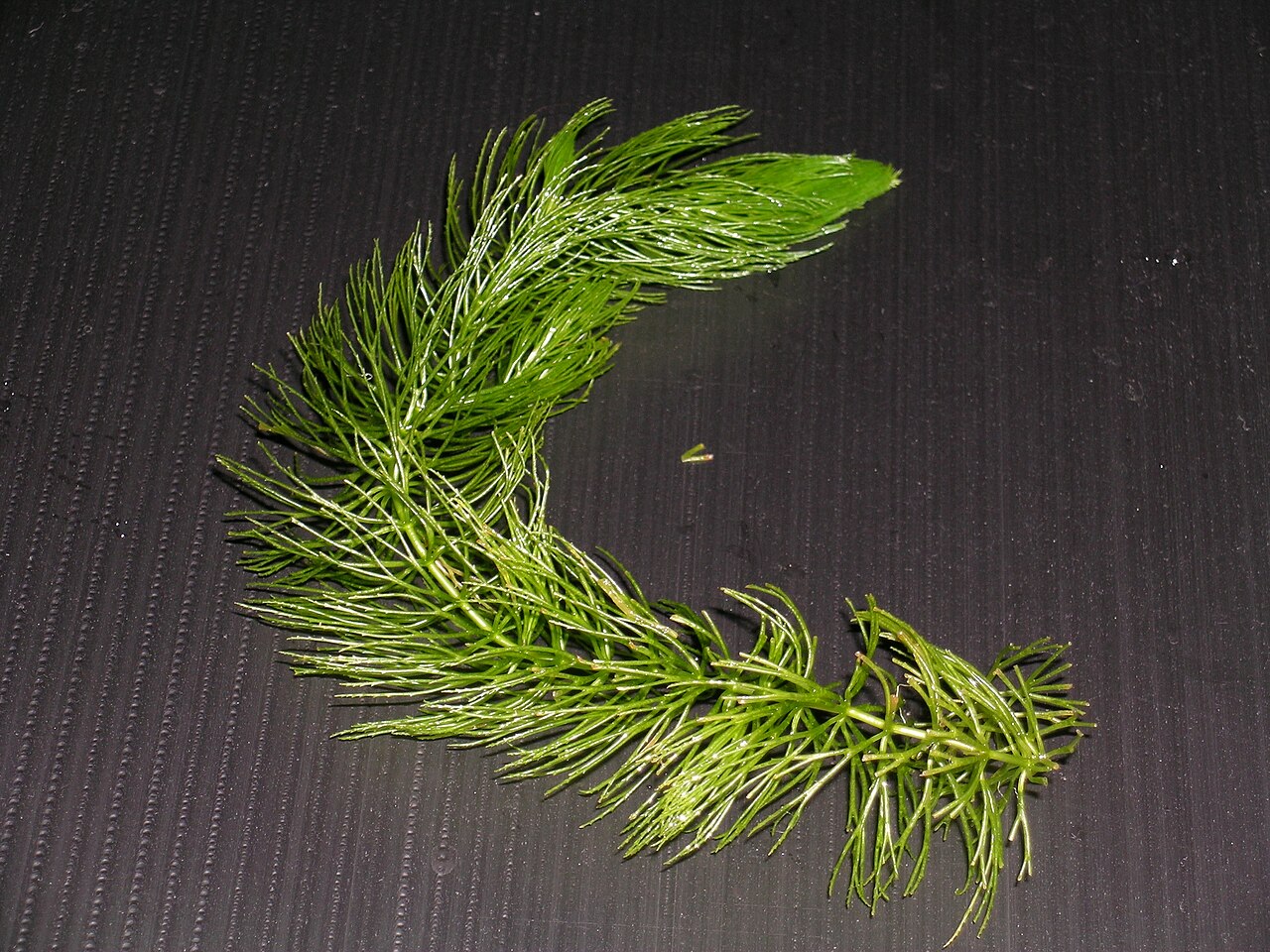
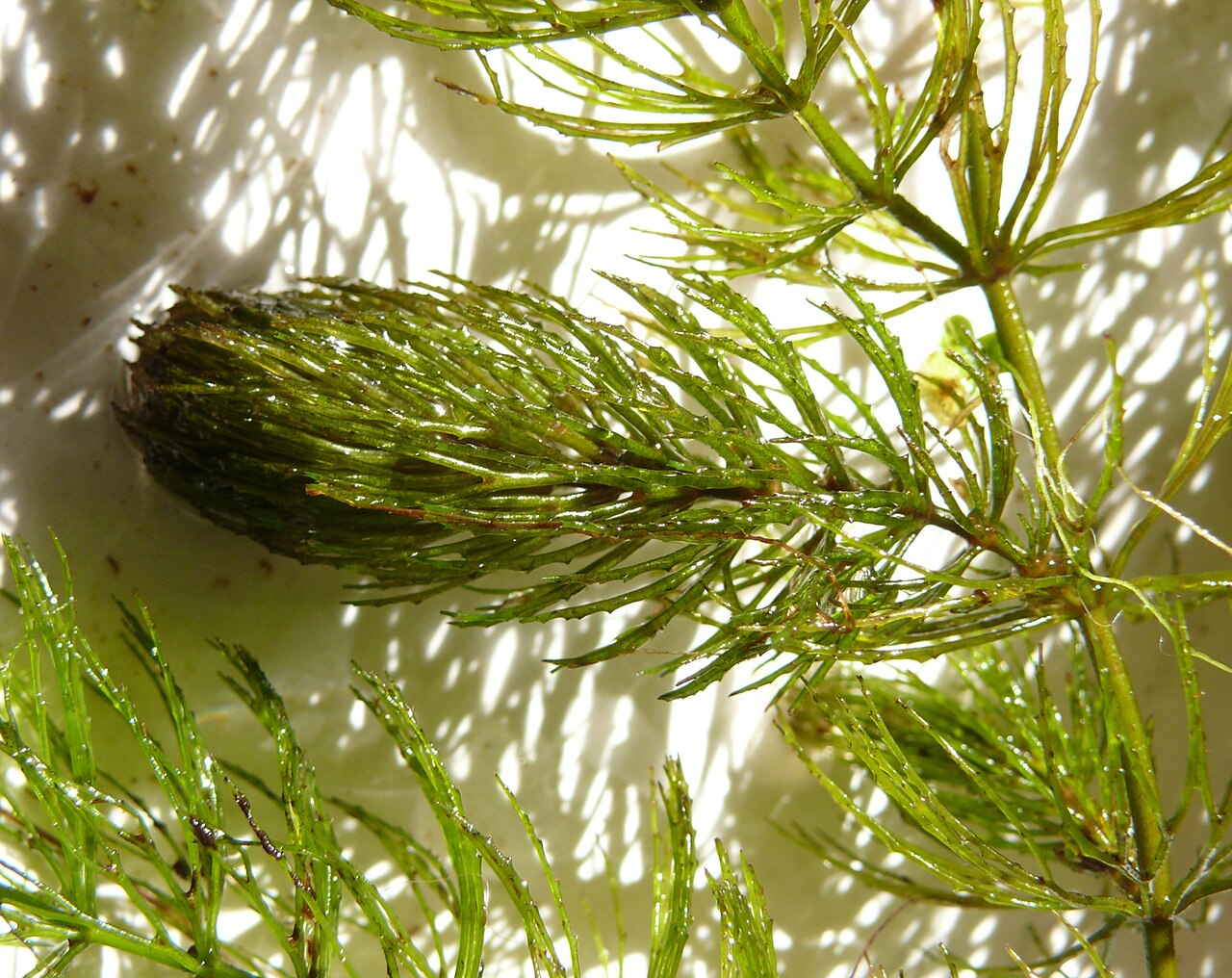
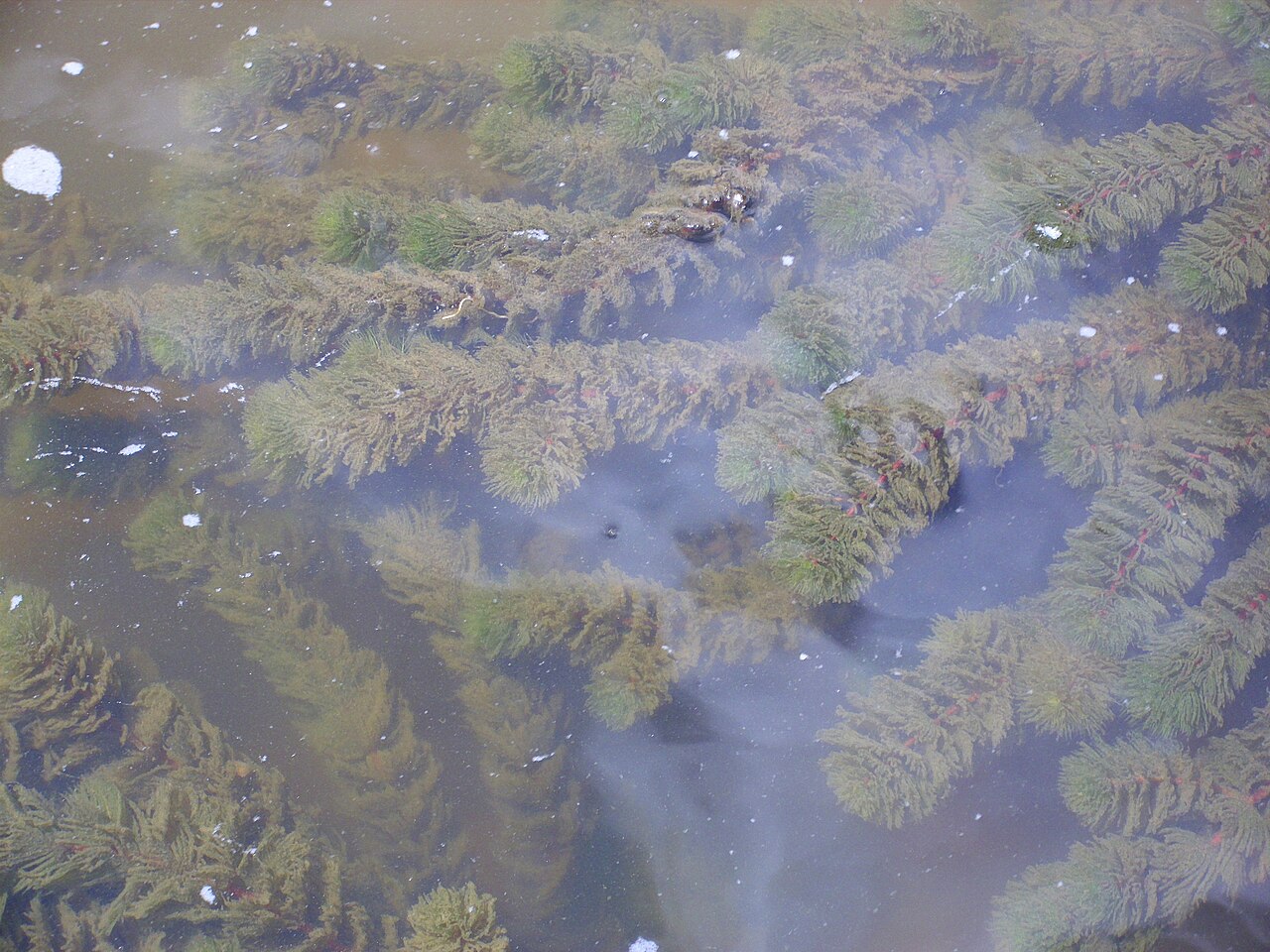
Overview
Hornwort is a rootless flowering aquatic plant of the family Ceratophyllaceae. It floats freely or anchors itself with fine rhizoid-like shoots and takes nutrients directly from the water. It is very hardy, grows fast and suits both coldwater and tropical aquariums, so it is often recommended to beginners.
In the aquarium it serves as a backdrop, as surface shade and as cover for fry and shrimp; its rapid nutrient uptake helps when starting a tank and in fighting algae. In the wild, however, it can become a harmful weed: it is an unwanted organism in New Zealand and a declared weed in Tasmania.
Appearance
Stems are brittle and rootless, usually 30–60 cm long (1–3 m in the wild), with many side shoots that make the plant look like a bushy mass. In the aquarium, according to Tropica, it can reach 80 cm in height and 5 cm in width.
Leaves are sessile, in whorls of 5–12, 1–4 cm long, forked once to three times into thread-like segments edged with small spiny teeth; they are stiff and brittle. Colour ranges from dark green to olive, and stems may be reddish.
Flowers are tiny (1–2 mm), unisexual and sit in the leaf axils; the plant is monoecious. The fruit is a 4–5 mm nut with spines. Shoot tips can form turions — overwintering buds that sink to the bottom.
Care
- Placement: most often kept floating — just drop it into the water. It can also be planted in the background or along the side walls, weighted down with stones (it has no roots, so the stem is simply held down — carefully, so it does not break).
- Light: low demand according to Tropica; dim to moderate light is enough, with a 12–14 h photoperiod. Bright light speeds growth up to 3 cm a day. In too little light it sheds leaves. Floating stems can heavily shade other plants.
- CO2: not required.
- Temperature: 17–30 °C; at lower temperatures growth slows and the stems sink toward the bottom.
- Water: pH 6.5–7.5 (7.0–7.5 in another Tetra article), GH 6–15.
- Trimming: shorten and thin the stems regularly, especially in small tanks, and remove dead parts. Debris settles on the leaves; dirty stems can be rinsed under running water.
- Chemicals: it drops its leaves when exposed to snail-killing products (stems regrow leaves within a few weeks) and is very sensitive to algicides.
- Difficulty: easy, suitable for beginners.
Fertilizing
It absorbs nutrients through its leaves and stems directly from the water. Sources differ on feeding: one Tetra article recommends liquid fertiliser, another says hornwort does not need fertiliser.
Thanks to its fast growth it competes with algae for nutrients and helps keep them in check.
Breeding
Propagated vegetatively: simply cut off a small piece and leave it floating — it will soon produce new shoots. Even a tiny fragment of stem can grow into a full plant under suitable conditions.
In the wild it also spreads by turions and seeds, although flowering and fruiting are rare where winters are cold.
Fun facts
- The genus name comes from the Greek for "horn" and "leaf", after the antler-like leaves.
- It releases substances that inhibit phytoplankton and cyanobacteria (allelopathy).
- Pollination happens under water: anthers float up, and the released pollen sinks onto the female flowers.
- It has been used in the "Aquarack/CEBAS" and "Omegahab" biological life-support systems on space flights.
- Its genome has been sequenced to study the evolution of flowering plants.