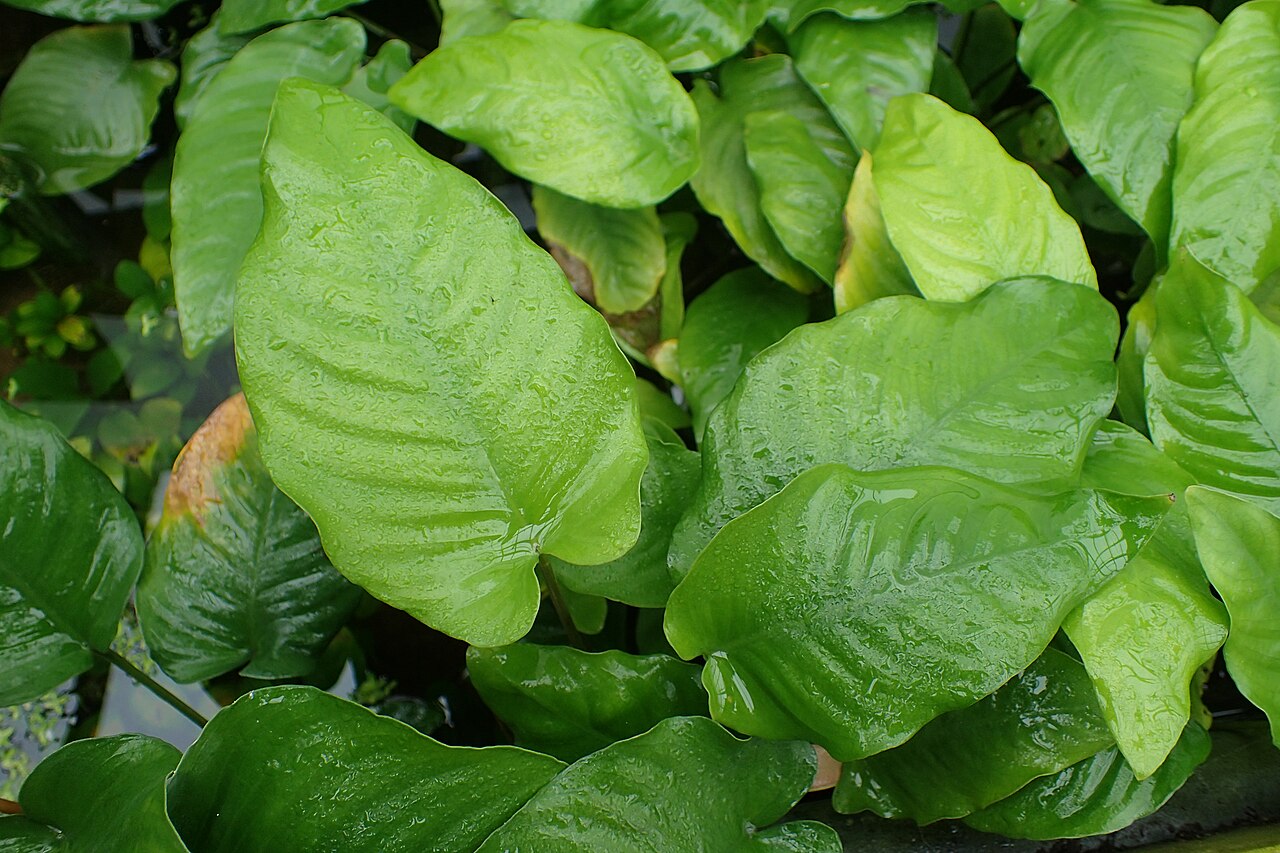
Anubias barteri var. caladiifolia
Anubias barteri var. caladiifolia
Origin: West and Central Africa. According to English Wikipedia — south-eastern Nigeria, Cameroon and Bioko; according to Russian Wikipedia — also Guinea, Côte d'Ivoire, Liberia, Congo and Gabon. It grows near forest waters in shady places and in swamps, along river banks, in ditches and ponds. It is mostly emersed and becomes fully submerged when rivers flood; it roots both in muddy soil and on rocks and wood.
Also known as: Anubias barteri var. caladiifolia Anubias caladiifolia
Fact sheet
- Height
- 45 cm
- Temperature
- 22–28 °C
- pH
- 6.5–7.5
- Hardness GH
- 2–15 °dH
- Lighting
- Low
- CO₂
- Not needed
- Growth rate
- Slow
- Placement
- On wood or rock, Midground, Background
Overview
One of the largest forms of Anubias barteri; it can only be kept in very tall tanks or in paludariums. The variety is listed by English Wikipedia and Tetra; Russian Wikipedia does not name it among the varieties.
Appearance
The rhizome is massive, up to 2 cm in diameter. Petioles reach 40 cm; the large oval-elliptic leaves average 25×15 cm and are held almost at right angles to the petiole. According to Tetra, Australian breeders have produced a form with heart-shaped leaves.
Care
Shared with the species: Anubias
- Placement: suits a tank of any size; large plants are placed singly towards the back or used as a focal point, and can be attached at any height.
- Planting: best tied to driftwood or rock with fishing line or cotton thread (Tetra also mentions safe glue), firmly but without damaging the rhizome. If planted in the substrate (coarse sand, fine gravel), the rhizome must not be buried — it rots.
- Light: low, diffused; not directly under the lamps — in the shade of other plants or under floating plants. Photoperiod no longer than 12 hours.
- CO2: not needed; according to Tetra, adding it has no significant effect on growth.
- Temperature: 24–28 °C (Tetra); 22–28 °C (English Wikipedia).
- Water: pH 6.5–7.5, GH 2–15; grows in both soft and hard water.
- Maintenance: very sensitive to algae on the leaves — keep light moderate and change about 20% of the water weekly. Frequent trimming is not needed.
Difficulty: a very easy plant (Tropica: "Easy"), suitable for beginners.
Fertilizing
Shared with the species: Anubias
Heavy fertilisation is not needed. Regular doses of a liquid fertiliser (e.g. Tetra PlantaMin) help keep the leaves intact and brightly coloured.
The roots of Anubias barteri go fairly deep, so when planted in the substrate it needs a nutrient-rich base; when replanting, it is recommended to put nutrient tablets under the roots.
Breeding
Shared with the species: Anubias
- Rhizome division: cut off a piece of rhizome with several (3–4) leaves and some roots with a knife and plant or attach it elsewhere.
- Side shoots: can be separated from the mother plant.
- A new growth bud appears at the cut on the old plant after 1–2 months.
Fun facts
Shared with the species: Anubias
- The species was described by Heinrich Wilhelm Schott in 1860 and named after plant collector Charles Barter.
- Anubias barteri can flower right in the aquarium.
- It also grows well out of water, so it suits paludariums.