Fish
Neon Tetra
Paracheirodon innesi
Origin: Западная и северная Амазония: Колумбия, Перу, западная Бразилия
Also known as: Неон, Неон иннеса, Параxейродон иннеси
Fact sheet
- Size
- 4 cm
- Lifespan
- 5 years
- Minimum tank size
- 40 L
- Temperature
- 20–26 °C
- pH
- 5.5–7
- Temperament
- Peaceful
- Social behavior
- Schooling
- Swimming zone
- Middle
- Diet
- Omnivore
Varieties
Overview
The neon tetra (Paracheirodon innesi) is a small characin native to the western and northern Amazon basin, specifically the acidic blackwater and clearwater streams of southeastern Colombia, eastern Peru, and western Brazil, where it lives under the dense forest canopy in waters with very low mineral content and high tannin concentrations. The species was first described scientifically in 1936 by ichthyologist George S. Myers and named in honor of the prominent American aquarium writer William T. Innes. Its introduction to the hobby caused a sensation in the late 1930s due to its stunning iridescent coloration, and it quickly became one of the best-selling aquarium fish in history—today approximately 2 million neon tetras are sold monthly in the United States alone, with the vast majority originating from commercial farms in Southeast Asia.
Appearance
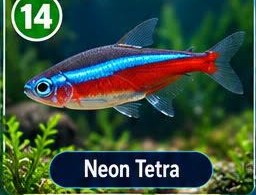
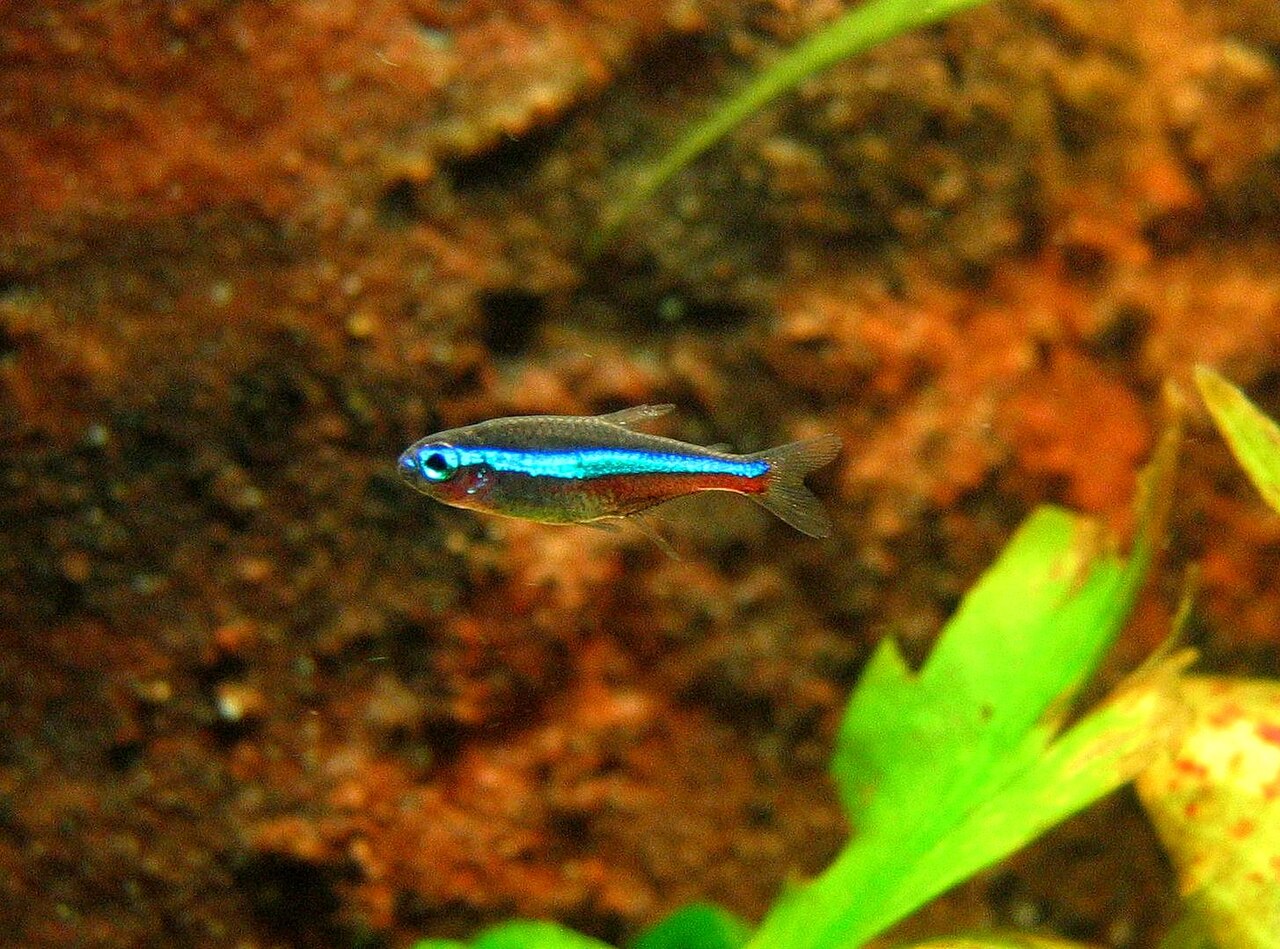
Neon tetras are small fish, reaching approximately 4 cm (1.6 in) in total length with a compact, torpedo-shaped body. The most striking feature is a brilliant iridescent blue-green horizontal stripe running from the tip of the snout to the adipose fin, which appears to glow under aquarium lighting. Below this stripe, a vivid red band extends from approximately the middle of the body to the base of the caudal fin, while the belly is silver-white. This coloration is produced not by pigment but by guanine crystals beneath the skin surface that reflect and refract light. Females are slightly rounder in the abdomen than males, causing their blue stripe to appear slightly curved rather than perfectly horizontal. Notably, the blue and red colors fade to gray or black during the night when the fish is resting, a temporary camouflage that is fully restored by daylight.
Care
Neon tetras require a minimum tank size of 40 liters (10 gallons) and are best kept in groups of at least 6, though groups of 10 or more encourage more confident schooling behavior and reduce stress. They prefer water temperatures of 22–26°C (72–79°F), pH 6.0–7.0, and soft to moderately soft water (GH below 10 dGH). As blackwater fish, they thrive in dimly lit aquariums with dark substrate, driftwood, Indian almond leaves, and dense planting. They are sensitive to ammonia and nitrite and must only be introduced to fully cycled aquariums. Sudden temperature drops or deteriorating water quality can trigger ich (white spot disease) or neon tetra disease. Weekly water changes of 20–30% are recommended.
Feeding
In their natural Amazonian habitat, neon tetras are omnivores that feed on small invertebrates, insect larvae, zooplankton, algae, and organic detritus. In captivity they readily accept micro-sized flake food and small pellets as a staple, and benefit from regular supplementation with frozen or live foods including baby brine shrimp, daphnia, micro-worms, and freeze-dried bloodworms. Because of their small mouths, all food must be appropriately fine. Two small feedings per day are recommended.
Compatibility
Neon tetras are exemplary community fish—completely peaceful and non-aggressive toward any fish they cannot eat. They must always be kept in schools of six or more, as solitary or small-group specimens become stressed and lose color. Ideal tankmates include other small peaceful tetras, rasboras, harlequin rasboras, corydoras catfish, otocinclus, and apistogramma dwarf cichlids. They should absolutely not be kept with any fish large enough to swallow them—angelfish, larger cichlids, and even adult betta fish can prey on them.
Breeding
Breeding neon tetras in a home aquarium is challenging and rarely attempted. A separate breeding tank with very soft, acidic water (pH 5.5–6.0, dH below 1), dim lighting, and fine-leaved plants or moss is required. Eggs are scattered and adhesive, falling among plants; parents will eat them immediately if not removed. Eggs are extremely sensitive to light and must hatch in near-darkness. Fry hatch in approximately 24 hours and require infusoria for the first 5–7 days. Neon tetra disease, caused by the microsporidian parasite Pleistophora hyphessobryconis, is a serious and incurable condition causing color loss, muscle wasting, and curved spine.
Fun facts
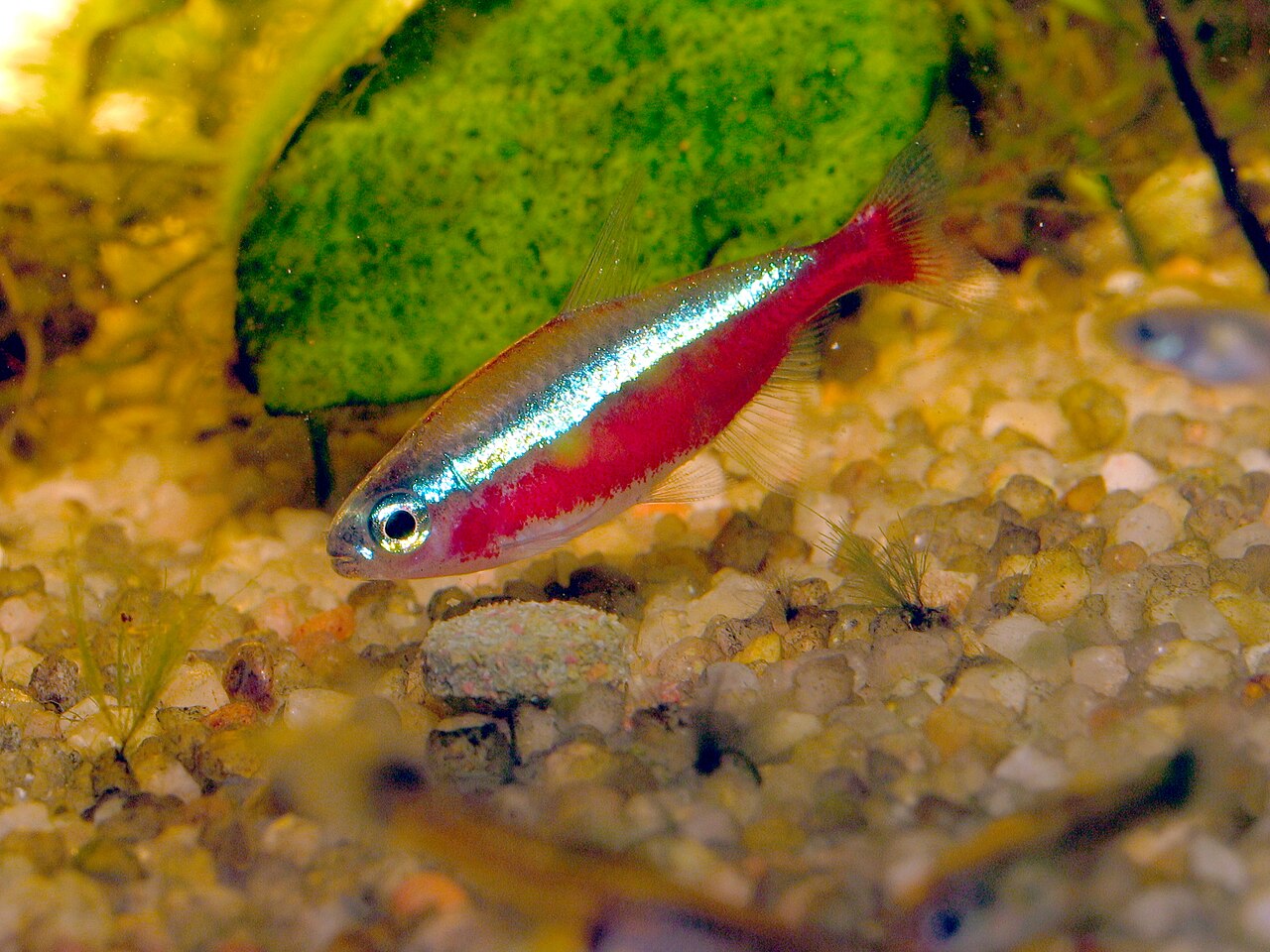
The neon tetra's iridescent coloration serves an important biological function in the wild: the bright stripes help individual fish maintain visual contact with their schoolmates in the dark, tannin-stained blackwater streams of the Amazon where visibility is extremely limited. Cardinal tetras (Paracheirodon axelrodi), often confused with neon tetras, can be distinguished by their red stripe extending the full length of the belly from chin to tail, whereas in neon tetras the red stripe covers only the rear half. Despite decades of commercial breeding, the vast majority of specimens sold globally still originate from large-scale farms primarily in the Czech Republic and Southeast Asia.