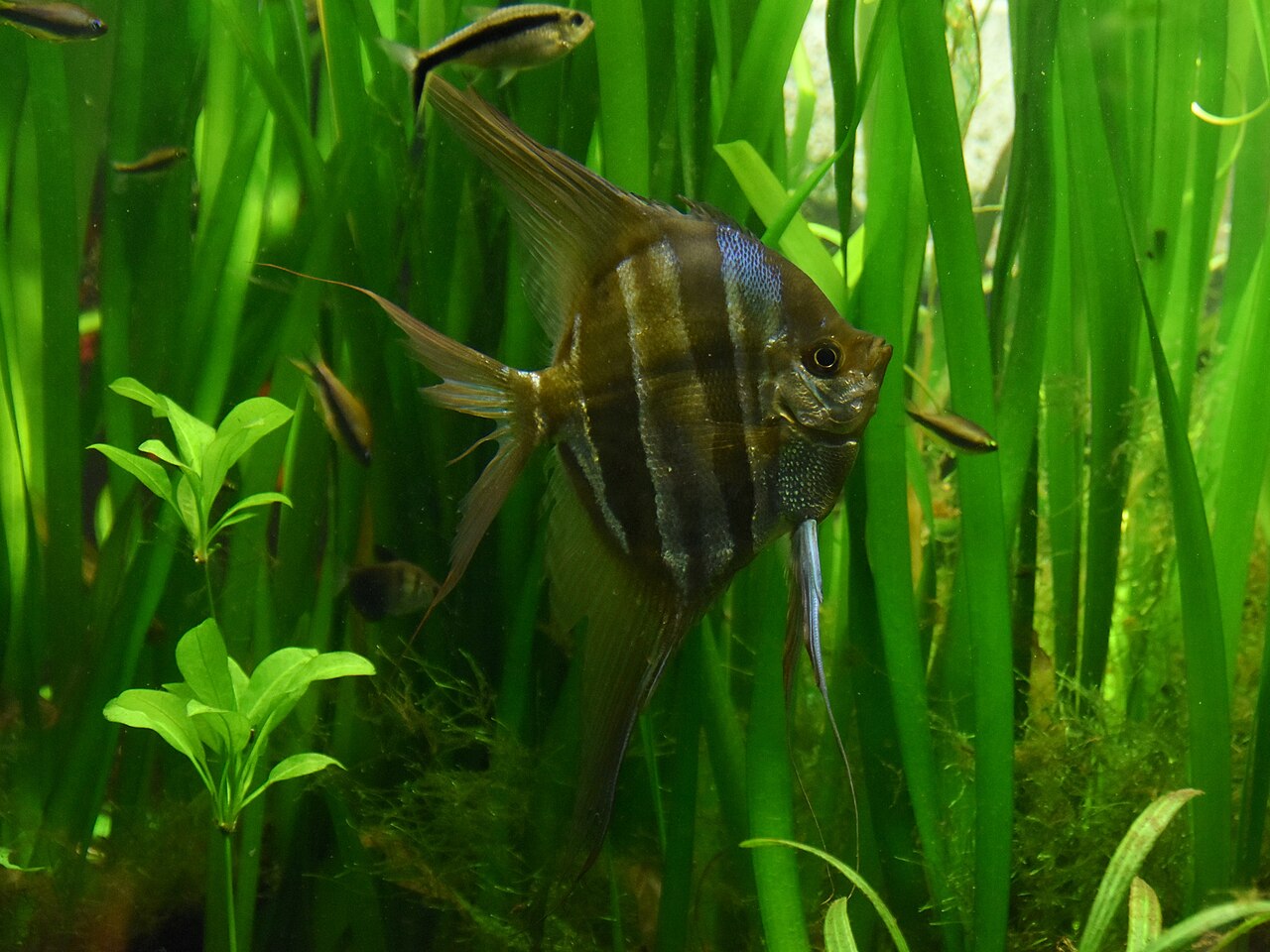
Altum Angelfish
Pterophyllum scalare
Origin: Бассейн Амазонки: Колумбия, Перу, Бразилия, Гайана, Суринам, Французская Гвиана
Also known as: Ангелфиш, Птерофиллюм, Рыба-ангел
Fact sheet
- Size
- 15 cm
- Lifespan
- 10 years
- Minimum tank size
- 100 L
- Temperature
- 24–30 °C
- pH
- 6–7.5
- Temperament
- Semi-aggressive
- Social behavior
- In pairs
- Swimming zone
- Middle
- Diet
- Omnivore
Overview
A separate species (not a color form of P. scalare) included here as it is frequently sold alongside P. scalare in the hobby. Native to the upper Orinoco and Rio Negro, P. altum is even taller than P. scalare—reaching up to 45 cm in total height—with a distinctive notch at the forehead. Far more demanding in water requirements (pH 4.5–6.0, very soft), it is considered expert-level and rarely breeds in captivity. Wild-caught specimens only.
Appearance
Shared with the species: Angelfish
Pterophyllum scalare possesses a highly laterally compressed, roughly diamond-shaped body with greatly elongated dorsal and anal fins that create the species' iconic triangular silhouette when viewed from the side. Adults reach 15 cm (6 inches) in body length but may exceed 20 cm (8 inches) in total height when the extended fins are measured, making a tall aquarium absolutely essential for their long-term welfare. Wild fish are silver with three bold dark vertical bars (the second passing through the eye) and faint horizontal striping across the flanks; the finnage is clear to lightly patterned. Selective breeding over decades has produced a vast palette of color forms including solid black, vibrant gold, marbled, koi-patterned, panda, and veiltail varieties that bear little resemblance to wild fish. Sexual dimorphism is subtle: males often develop a nuchal hump on the forehead at maturity and a longer, more rounded tube-like genital papilla, while females show a more angular, pointed papilla and a gently rounded belly that becomes conspicuously swollen before spawning.
Care
Shared with the species: Angelfish
Angelfish are moderately straightforward to maintain and are often recommended as an entry point into cichlid keeping, provided their spatial requirements are respected. A minimum aquarium footprint of 100 × 40 cm with a depth of at least 50 cm (~200 liters / 55 gallons) is recommended to accommodate both their considerable final size and tall body profile—shallow tanks are entirely unsuitable. Water conditions should be warm (24–30°C / 75–86°F), slightly acidic to neutral (pH 6.0–7.4), and moderately soft (0–15 dGH); the species is adaptable but thrives best when these parameters are stable. The aquarium should be planted with tall background plants such as Amazon Swords, Giant Vallisneria, and Java Fern, with gentle water flow from a filter providing 800–1000 liters per hour. Regular water changes of 25–30% weekly are important, as angelfish are sensitive to elevated nitrate levels and declining water quality.
Feeding
Shared with the species: Angelfish
In their natural floodplain habitat, angelfish are active predators that consume small fish fry, juvenile invertebrates, freshwater shrimp, insects, mosquito larvae, and aquatic worms. In captivity, they readily accept a wide variety of foods including high-quality cichlid pellets, flake food, frozen bloodworms, frozen brine shrimp, and daphnia; a diverse diet is important for maintaining vibrant coloration and strong immune function. Live foods such as small earthworms, feeder guppies, white mosquito larvae, and black worms are enthusiastically accepted and are particularly useful for conditioning breeding pairs. It is important to note that small live or frozen fish must be sourced from disease-free cultures, as wild-caught feeder fish can introduce pathogens. Feed adults twice daily, providing only as much food as they can consume within 3–5 minutes; overfeeding fouls the water rapidly in warmer temperatures.
Compatibility
Shared with the species: Angelfish
Angelfish are generally peaceful cichlids that coexist well with a wide range of community fish, though their cichlid nature means some care in tankmate selection is warranted as they grow larger. Suitable companions include medium-to-large tetras (Black Skirt, Serpae, Congo, Diamond), Corydoras catfish, bristlenose and rubber-lip plecos, dwarf gouramis, and larger rasboras. Extreme caution is needed with small fish: juvenile angelfish will ignore Neon Tetras, but mature adults (15 cm+) may treat small tetras as prey, particularly in smaller aquariums with fewer hiding spots. Within the same species, angelfish exhibit dominance hierarchies and low-level territorial behavior; keeping a small group of 4–6 allows natural pair formation while distributing aggression across multiple individuals. Known fin-nippers (Tiger Barbs, Serpae Tetras in groups, Buenos Aires Tetras) must be strictly avoided, as they will relentlessly harass the angelfish's sweeping finnage.
Breeding
Shared with the species: Angelfish
Angelfish are egg-depositing cichlids that strongly prefer vertical spawning surfaces—broad leaves such as Amazon Sword blades, smooth flat slate, or aquarium glass are all commonly used. A bonded pair will methodically clean the spawning site over 1–2 days before spawning, then the female deposits rows of adhesive eggs (a typical clutch contains 100–400 eggs) while the male fertilizes them in immediate passes. Both parents take turns guarding the clutch fiercely, fanning the eggs continuously for oxygenation and removing any white, fungus-prone infertile eggs with their mouths. Eggs hatch in approximately 48 hours, and the wriggling larvae—still attached to the substrate by sticky threads—are moved to freshly cleaned pits by the parents; the fry become free-swimming 3–5 days after hatching. First foods for the fry are infusoria (paramecia), vinegar eels, or commercial liquid fry food for the first few days, transitioning to newly hatched brine shrimp; the attentive parents continue herding and guarding the free-swimming school for 3–4 weeks.
Fun facts
Shared with the species: Angelfish
The genome of the freshwater angelfish was fully sequenced and publicly assembled in 2022 by Indeever Madireddy, a high school student from the United States, in a project that gained international media attention as an example of citizen science in genomics. Research has suggested that angelfish can visually recognize individual human faces, contributing to their long-standing reputation as unusually personable aquarium fish with distinct 'personalities.' The first successful captive breeding of Pterophyllum scalare is attributed to the American aquarist William Innes in the 1930s, who documented the bubble-nest-adjacent cichlid spawning behavior that surprised hobbyists who had assumed gouramis were the only nest-builders.