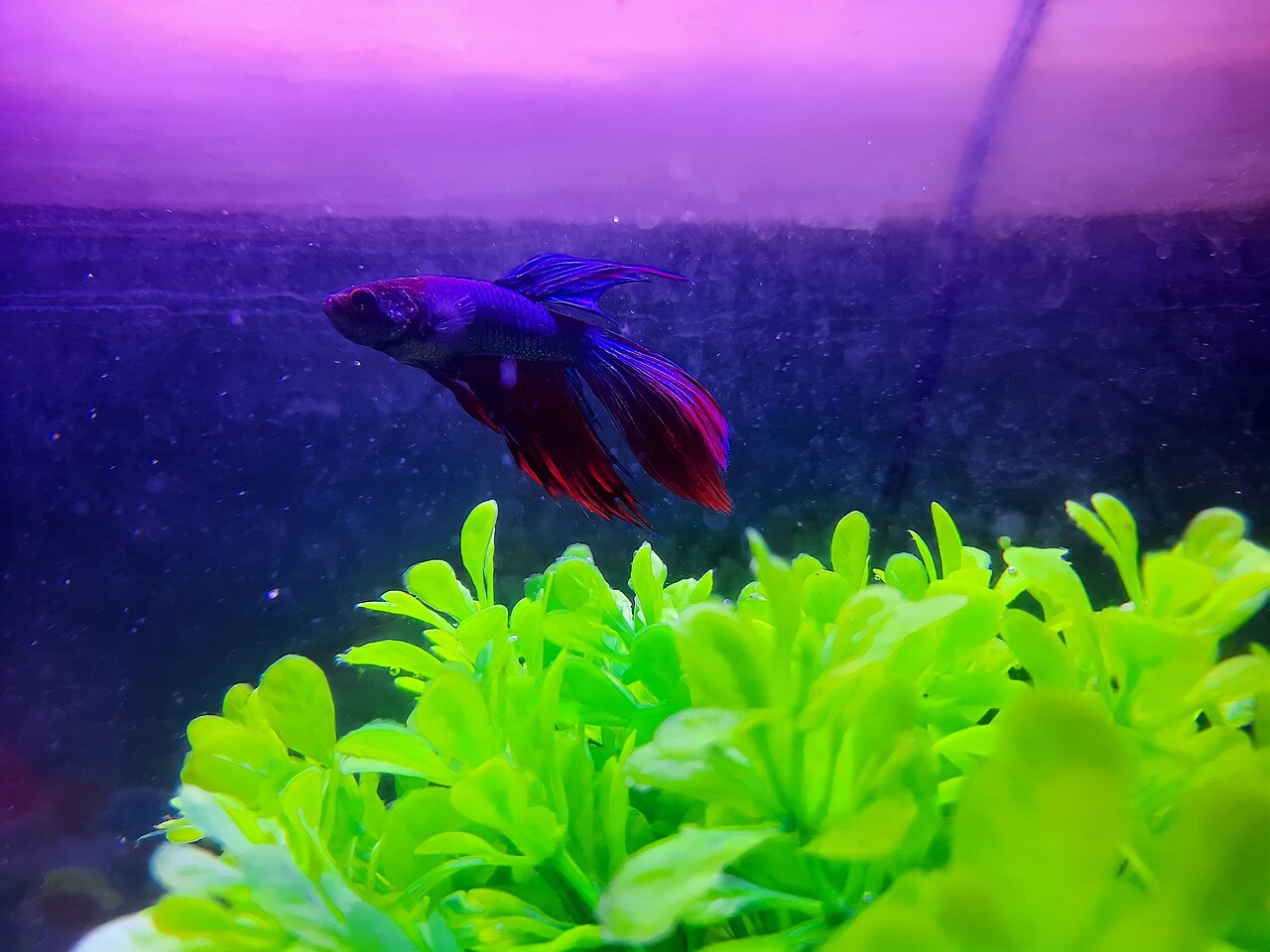
Variety of Siamese Fighting Fish
Veiltail Betta
Betta splendens
Origin: Таиланд, Камбоджа, Лаос, Мьянма, Малайзия, Вьетнам
Also known as: Бетта великолепная, Сиамская бойцовая рыбка, Петушок Betta splendens
Fact sheet
- Size
- 7 cm
- Lifespan
- 3 years
- Minimum tank size
- 20 L
- Temperature
- 24–30 °C
- pH
- 6–7.5
- Temperament
- Aggressive
- Social behavior
- Solitary
- Swimming zone
- Top, Middle
- Diet
- Carnivore
Overview
The most common fin type seen in pet stores worldwide, the Veiltail has a long, asymmetrically drooping caudal fin with a single lobe. The fins flow gracefully when the fish swims and come in virtually every color.
Appearance
Shared with the species: Siamese Fighting Fish
Wild bettas are relatively subdued in appearance, displaying olive-green to brownish bodies with short fins and iridescent blue-green scale highlights that intensify dramatically when the fish is aroused or alarmed. Captive-bred specimens exhibit an extraordinary spectrum of colors: red, blue, royal blue, turquoise, purple, white, yellow, black, orange, and countless multicolored, iridescent, and bi-color combinations. Males typically reach 6–8 cm in total length and possess dramatically elongated fins in many recognized forms—the most common being the veiltail, halfmoon (180° caudal spread), crowntail (spiky, reduced webbing), plakat (short fins resembling wild fish), double tail (two separate caudal lobes), delta tail, and rosetail. Females are smaller, less brightly colored, and have shorter fins, and can be identified by a small white ovipositor tube (egg spot) below their abdomen.
Care
Shared with the species: Siamese Fighting Fish
A single male betta requires a minimum tank of 15–20 liters (4–5 gallons), though larger tanks of 40+ liters greatly improve health, behavior, and longevity. Water temperature should be maintained between 24–30°C (75–86°F) with a pH of 6.0–8.0 and hardness of 1–15 dGH; bettas are tropical fish and must have a heater in most climates. Because bettas possess a labyrinth organ that enables them to breathe atmospheric air, they can survive briefly in oxygen-depleted water, but this should never be used to justify small or unfiltered housing. Gentle filtration, ample hiding spots among live or silk plants, and a secure lid (as bettas are excellent jumpers) are essential. Two males must never be housed together.
Feeding
Shared with the species: Siamese Fighting Fish
In their natural habitat, bettas are carnivores that feed primarily on aquatic and terrestrial invertebrates: zooplankton, small crustaceans, insect larvae (particularly mosquito larvae), and worms at or near the water surface. In captivity, a high-quality betta-specific pellet should form the dietary staple, supplemented regularly with live or frozen foods such as bloodworms, brine shrimp, daphnia, mosquito larvae, and micro-worms. Bettas have relatively small stomachs—feeding two small meals daily (the amount consumed in 2–3 minutes) prevents overfeeding and bloat. Bettas are especially prone to obesity, constipation, and swim bladder issues from overfeeding; fasting one day per week is widely recommended.
Compatibility
Shared with the species: Siamese Fighting Fish
Despite their fame as fighters, bettas can coexist peacefully with many fish in a sufficiently large, well-planted community tank. Compatible tankmates include corydoras catfish, otocinclus, small peaceful tetras, rasboras, mystery snails, and nerite snails. Males must never be housed together, nor with brightly colored or long-finned species that might be mistaken for rival males (such as fancy guppies). Females can sometimes be kept in groups (called 'sororities') of five or more in larger tanks, though they establish dominance hierarchies and must be monitored closely. Fin-nipping species such as tiger barbs and serpae tetras should always be avoided.
Breeding
Shared with the species: Siamese Fighting Fish
Breeding bettas is a deliberate process requiring careful preparation. Both sexes should be conditioned for 1–2 weeks on live or frozen foods. The male is introduced to a clean, shallow breeding tank (15–20 cm water depth) with a piece of polystyrene or floating plant as anchor for the bubble nest he will construct. The female is introduced in a clear separator to allow visual acclimation before full contact. Once the male builds a robust bubble nest and the female shows vertical 'breeding bars' and a receptive posture, they are allowed together. The male wraps himself around the female in a 'nuptial embrace,' releasing 10–40 fertilized eggs per embrace for a total of 12–492 eggs. The male collects fallen eggs in his mouth and places them in the bubble nest, guarding them aggressively. The female must be removed immediately after spawning. Eggs hatch in 24–36 hours; larvae hang from the nest for 2–3 days. The male should be removed once fry are free-swimming.
Fun facts
Shared with the species: Siamese Fighting Fish
Thailand officially declared Betta splendens its national aquatic animal in February 2019, reflecting the deep cultural significance of the species in Thai history. Despite being enormously abundant in captivity worldwide, the species is classified as 'Vulnerable' on the IUCN Red List, as wild populations have declined sharply due to habitat destruction, agricultural runoff, and water pollution throughout their Southeast Asian range. A betta fish named Lala became internationally famous in 2020 after successfully completing the video game Pokémon Sapphire via a laser-grid sensor system that mapped the fish's swimming movements to game controls.