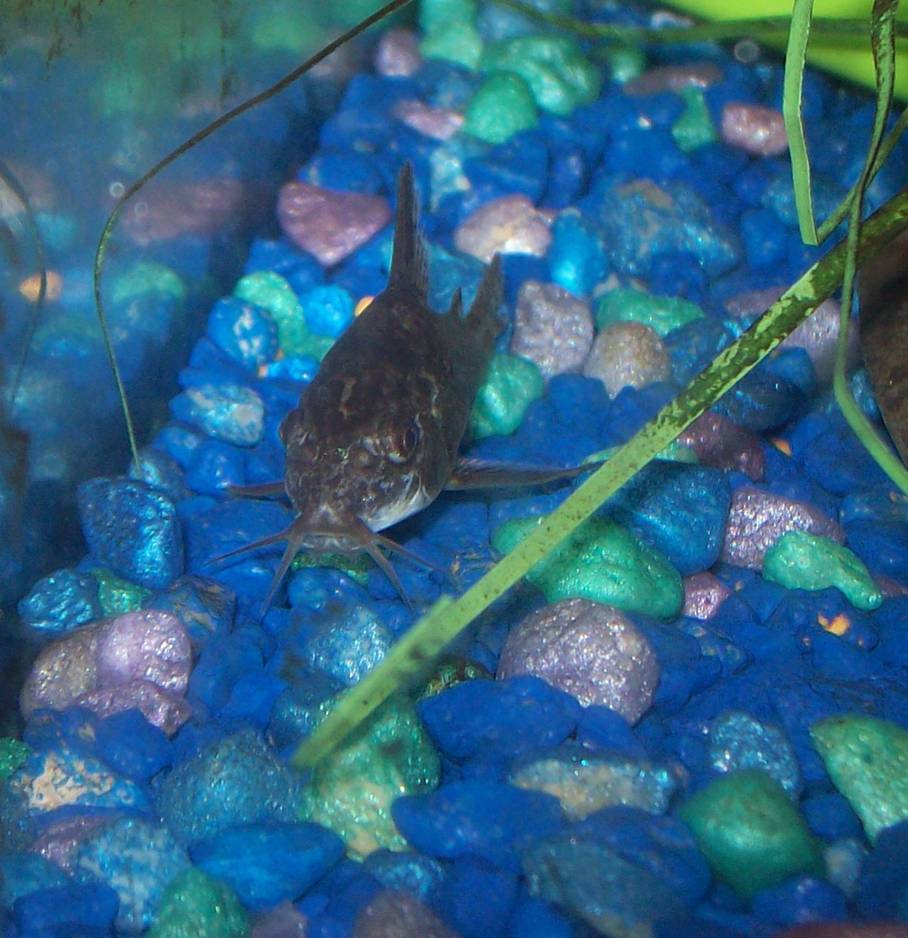
Peppered Cory (Corydoras paleatus)
Corydoras paleatus / spp.
Origin: Южная Америка восточнее Анд: от Тринидада и Колумбии до бассейна Риу-де-ла-Платы
Also known as: Бронированный сомик, Сомик-кольчужник, Коридорасы
Fact sheet
- Size
- 7 cm
- Lifespan
- 10 years
- Minimum tank size
- 60 L
- Temperature
- 20–26 °C
- pH
- 6–7.5
- Temperament
- Peaceful
- Social behavior
- Schooling
- Swimming zone
- Bottom
- Diet
- Omnivore
Overview
One of the most widely kept and historically significant aquarium fish — C. paleatus was among the first tropical fish ever captively bred (Paris, early 1900s) and remains a staple of the hobby. It displays an olive-green to tan body with irregular dark brown-black mottling and blotching creating a 'peppered' or 'salt-and-pepper' pattern, with iridescent blue-green flanks in good light. Native to southern Brazil, Uruguay, Paraguay, and Argentina, it is one of the most cold-tolerant Corydoras, tolerating temperatures as low as 16°C, making it suitable for unheated or lightly heated tanks. Grows to approximately 6–7 cm; males are noticeably slimmer than females.
Appearance
Shared with the species: Corydoras Catfish
Corydoras catfish have a characteristic stocky, somewhat triangular cross-section body profile — arched on the dorsal side and flat on the ventral — covered on the flanks and head by two overlapping rows of bony dermal scutes rather than true scales. Most species are relatively small, ranging from 2.5 cm in pygmy species to around 7–8 cm in larger species such as C. paleatus. They possess three or four pairs of sensitive tactile barbels around the downward-facing mouth used to probe substrate for food, as well as sharp, mildly venomous pectoral and dorsal fin spines that can lock erect as a defense against predation. Color patterns vary dramatically across species: some are plain bronzy olive (C. aeneus), others boldly marked with panda-like patches (C. panda), and many feature intricate reticulated or spotted patterns (C. trilineatus, C. sterbai).
Care
Shared with the species: Corydoras Catfish
Corydoras must be kept in social groups of at least 6 individuals of the same species — they are genuinely unhappy and stressed in isolation or in pairs and will show this through reduced activity, hiding, and poor color. A minimum tank of approximately 60–80 liters (15–20 gallons) suits most medium-sized species, with fine-grain sand or very smooth rounded gravel as substrate; sharp gravel erodes their delicate barbels over time and can lead to bacterial infections. Water parameters should maintain pH 6.5–7.8 and temperature 22–26°C (72–79°F), though this varies by species — C. panda prefers cooler 20–24°C while C. sterbai thrives up to 30°C. Excellent water quality is paramount: elevated nitrates above 20 ppm are the most common cause of barbel erosion and short lifespans in captive Corydoras.
Feeding
Shared with the species: Corydoras Catfish
Corydoras are omnivorous bottom feeders that in the wild consume bottom-dwelling insect larvae, aquatic worms, small crustaceans, plant detritus, and organic matter sifted from the substrate with their sensitive barbels. In captivity, their diet must consist primarily of sinking foods — they are largely unable to compete at the surface — including sinking catfish wafers, mini pellets, and tablet foods as a daily staple. High-quality protein supplementation with frozen or live bloodworms, tubifex, daphnia, and brine shrimp should be offered several times per week for optimal conditioning and breeding readiness. They are not primarily algae eaters and should not be relied on as tank cleaners without dedicated feeding; in tanks with competitive faster-eating species, target feeding after lights-out ensures the corydoras receive adequate nutrition.
Compatibility
Shared with the species: Corydoras Catfish
Corydoras are among the safest and most universally compatible fish in the hobby — entirely peaceful, unaggressive even toward their own species, and compatible with virtually any fish that will not eat them. They share bottom-dwelling space quietly and do not compete aggressively for territory, though single-species groups generally work better than mixing multiple Corydoras species due to social bonding dynamics. Ideal community tank mates include tetras, rasboras, danios, livebearers, small peaceful cichlids, gouramis, and other catfish; they do well in planted tanks with shrimp as well. They should not be kept with large predatory cichlids, large carnivorous catfish, or goldfish — the latter due to incompatible temperature requirements and the goldfish's tendency to uproot plants and cloud water excessively.
Breeding
Shared with the species: Corydoras Catfish
Corydoras breed via a highly distinctive 'T-position' courtship in which the male presses perpendicular against the female's head, releasing milt which the female takes into her mouth; the sperm passes through her digestive system and is expelled alongside 2–6 eggs held cupped between her pelvic fins, which she then presses adhesively onto a hard surface such as glass, broad plant leaves, or smooth stones. Conditioning with high-protein live foods and then performing a water change with water 5–8°C cooler than the tank temperature closely mimics seasonal rainfall triggers and reliably initiates spawning in most species. Eggs should be moved to a separate container with gentle aeration and a small dose of antifungal treatment (such as methylene blue) to prevent fungal spread, as one infected egg can destroy a whole clutch. Fry hatch in 3–5 days depending on temperature and should be started on infusoria, micro-worms, or commercial liquid fry food before graduating to baby brine shrimp nauplii; they grow rapidly and are straightforward to raise.
Fun facts
Shared with the species: Corydoras Catfish
Corydoras aeneus holds a remarkable longevity record — individual specimens have been documented living 27 years in captivity, with lifespans of 15–20 years being not uncommon in well-maintained aquariums. Uniquely among bony fish, Corydoras possess the ability to breathe atmospheric air by occasionally surfacing to gulp air and absorbing oxygen through the posterior intestine, an adaptation to surviving hypoxic conditions in warm, oxygen-poor waters during the dry season. Their pectoral and dorsal fin spines carry a mild venom produced by glandular cells at the spine base — sufficient to cause a painful wound and even mild systemic effects if a spine punctures skin, meaning they should never be handled carelessly or kept with predatory fish that might attempt to swallow them. Between 2006 and 2015, over 8.6 million Corydoras were legally exported from Brazil's Amazonas state alone, reflecting the enormous global demand for these fish in the ornamental trade.