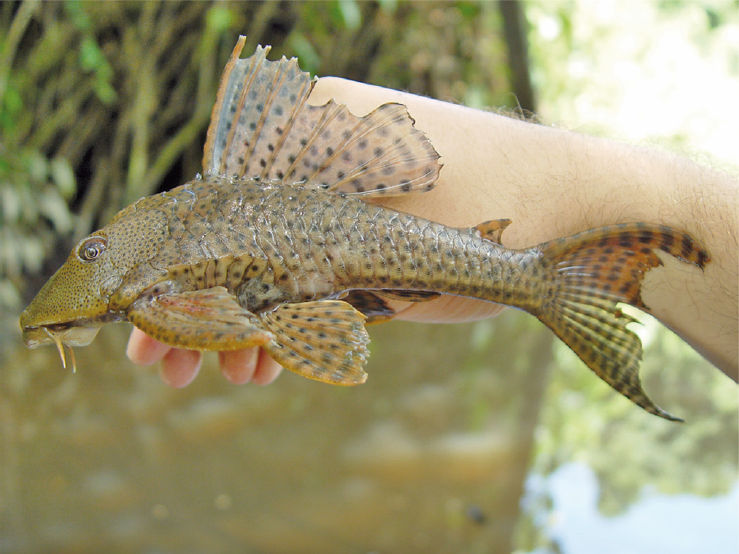
Common Pleco
Hypostomus plecostomus
Origin: Северо-восточная Бразилия, Карибское побережье; натурализован во Флориде и других регионах
Also known as: Плеко, Кольчужный сом, Присоска
Fact sheet
- Size
- 45 cm
- Lifespan
- 20 years
- Minimum tank size
- 200 L
- Temperature
- 20–28 °C
- pH
- 6–7.5
- Temperament
- Peaceful
- Social behavior
- Solitary
- Swimming zone
- Bottom
- Diet
- Herbivore
Overview
The original species of the genus and family, described by Linnaeus in 1758, with an olive-brown to dark gray body covered in rows of dark spots and bony scute armor. Grows to 30–50 cm in captivity (up to 50 cm in the wild) and requires aquariums of 300 liters or more as an adult; widely considered unsuitable for standard home aquariums and better suited to large public displays or outdoor ponds in warm climates. Extremely hardy and long-lived (10–15 years in captivity). Note: most 'common plecos' sold in shops are actually the closely related Pterygoplichthys pardalis or P. multiradiatus.
Appearance
Shared with the species: Plecostomus
All loricariid plecos share a family-characteristic body plan: the head and flanks are covered by rows of overlapping, interlocking bony dermal scute plates that form a flexible but tough armor, while the belly and underside remain soft and unplated. The mouth is positioned ventrally and adapted as a muscular suction cup lined with small teeth for rasping algae, biofilm, and wood from hard surfaces. Body shapes range from the more slender, somewhat cylindrical form of the Royal Pleco to the compact, rounded build of the Bristlenose. Coloration varies enormously by species: the common pleco is matte olive-brown with rows of dark spots; the Bristlenose is mottled dark brown-grey with white or yellow spots (or pearly white in the albino form); the Clown Pleco features striking alternating black and orange-cream wavy banding; and the Royal Pleco displays bold cream and dark gray striping. Males of most Ancistrus (Bristlenose) species develop prominent bushy tentacle-like growths (odontodes) on the snout and head, a unique trait within the family.
Care
Shared with the species: Plecostomus
Care requirements differ dramatically among pleco species and selecting the right species for one's tank size is the most important consideration. Hypostomus plecostomus and Pterygoplichthys (Sailfin Pleco) grow to 40–50+ cm and require aquariums of 300–500 liters or more as adults; they are genuinely unsuitable for standard home community setups and are unfortunately still frequently sold as small juveniles without adequate disclosure of their adult size. The Bristlenose Pleco (Ancistrus sp., max ~15 cm) and Clown Pleco (Panaqolus maccus, max ~10 cm) are far more suitable and thrive in aquariums from 100–120 liters. All plecos are nocturnal, benefit significantly from driftwood (mandatory for wood-eating species), require caves and sheltered retreats, and prefer well-oxygenated water; temperature range is typically 22–28°C and pH 6.5–7.5 for most commonly kept species.
Feeding
Shared with the species: Plecostomus
Plecostomus species are predominantly herbivorous to omnivorous but with significant variation by species. The common pleco and Bristlenose consume algae, biofilm, plant material, sinking algae wafers, and blanched vegetables (zucchini, cucumber, spinach, sweet potato, peas) as their dietary foundation. Clown Plecos (Panaqolus maccus) and Royal Plecos (Panaque nigrolineatus) are xylivorous — they rasp and partially digest wood as a significant component of their diet, and without permanent access to driftwood in their tank they will slowly deteriorate and starve over weeks to months. All plecos benefit from protein supplementation with frozen foods (bloodworms, brine shrimp) offered occasionally, though herbivorous species should not receive high-protein foods routinely as this can cause internal organ damage. Overfeeding should be avoided; a sunken abdomen in a pleco indicates malnutrition while a very rounded, extended belly may indicate overfeeding or internal parasites.
Compatibility
Shared with the species: Plecostomus
Most pleco species are passive toward other fish but can be territorial among their own kind and congeners, particularly males competing for cave spaces; providing one cave per individual significantly reduces aggression. The common pleco becomes increasingly semi-aggressive as it grows and may rasp at the slime coat of large, flat-bodied fish such as discus, oscars, or large goldfish while they rest at night — a behavior that causes lesions and secondary infections. Smaller species like the Bristlenose and Clown Pleco coexist peacefully with virtually any non-predatory community fish and are genuinely excellent community tank residents. Plecos should not be kept together without adequate space and hiding places, and mixing multiple large species in an undersized tank almost always leads to conflict.
Breeding
Shared with the species: Plecostomus
The Bristlenose Pleco (Ancistrus sp.) is one of the most easily and reliably bred aquarium fish — the male selects and defends a cave, courts the female with fin displays, and once she deposits her clutch of 20–100+ adhesive orange eggs on the cave ceiling, the male takes sole responsibility for fanning, cleaning, and guarding the eggs and newly hatched fry for 7–10 days after hatch. Breeding Hypostomus plecostomus in the home aquarium is essentially never achieved — in the wild they excavate burrow nests in river banks, a behavior impossible to replicate in standard aquariums. Clown and Royal Plecos can be bred in larger, well-maintained aquariums with appropriate caves and constant driftwood, though success requires patience and ideal water conditions. Fry of cave-breeding plecos initially cling to cave walls absorbing their yolk sac before becoming free-swimming and are relatively easy to raise on algae wafers, blanched vegetables, and biofilm.
Fun facts
Shared with the species: Plecostomus
Many pleco species possess a remarkable accessory respiratory adaptation — they can gulp air at the water surface and extract oxygen through a modified, highly vascularized section of the gastrointestinal tract, allowing survival in hypoxic conditions that would kill most other fish. Hypostomus plecostomus and several Pterygoplichthys species have become seriously invasive on multiple continents — feral populations are established in Florida, Texas, Hawaii, parts of Asia, and elsewhere, where their grazing and burrowing devastate aquatic vegetation beds and outcompete native species. The 'L-number' catalog system — assigning codes like L001 or L144 to undescribed loricariid species entering the trade — was developed by German aquarium magazines in the late 1980s and now contains over 500 entries, many of which still lack formal scientific descriptions. Panaque nigrolineatus and related Royal Pleco species are among a very small number of known vertebrates capable of digesting cellulose, harboring specialized gut microbiota (including Acetivibrio cellulolyticus relatives) that ferment wood fiber.