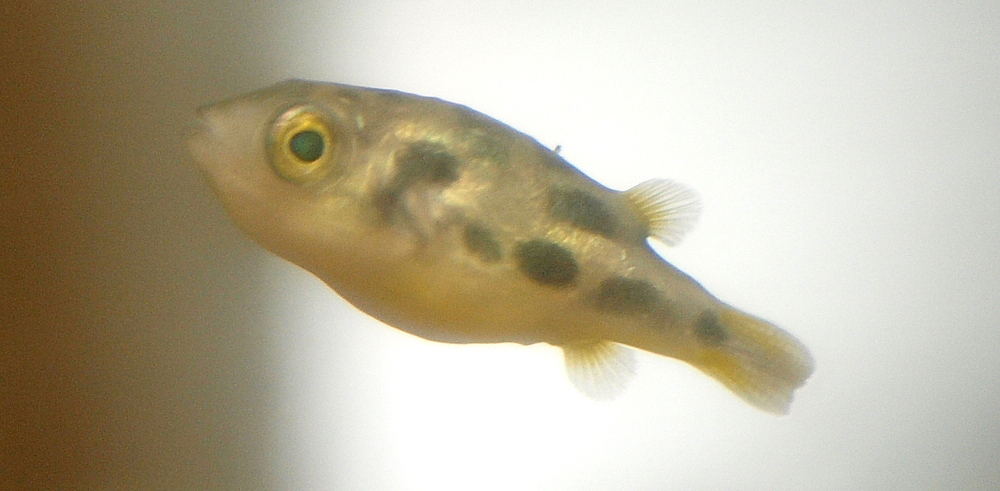
Dwarf Malabar Puffer
Carinotetraodon travancoricus
Origin: Юго-западная Индия: реки Кералы и южной Карнатаки (Западные Гаты)
Also known as: Малабарский иглобрюх, Горошина-иглобрюх, Карликовый пафф
Fact sheet
- Size
- 3 cm
- Lifespan
- 5 years
- Minimum tank size
- 40 L
- Temperature
- 24–28 °C
- pH
- 6.5–7.5
- Temperament
- Aggressive
- Social behavior
- Solitary
- Swimming zone
- Middle
- Diet
- Carnivore
Overview
Formally described only in 1999, this species closely resembles C. travancoricus and was sold alongside it in the aquarium trade for decades before being distinguished. It is slightly larger and originates from a more restricted range in southern India's Western Ghats, sharing similar care requirements.
Appearance
Shared with the species: Dwarf Puffer
The Dwarf Puffer is one of the world's smallest pufferfish, reaching a maximum total length of just 3.5 cm, making it ideal for nano aquariums. Its body is rounded and oblong with short, fan-shaped pectoral fins and a truncate caudal fin, giving it a distinctive waddling swimming style. The base coloration is greenish-yellow, overlaid with irregular dark green to brown-black iridescent patches on the flanks and dorsal surface. Sexual dimorphism is pronounced: males are more intensely colored with yellow ventral surfaces, a dark stripe along the belly, and distinctive iridescent 'eye wrinkle' patterns radiating from the eyes, while females are rounder and plumper with white abdomens and may show a yellow throat patch. Juveniles of both sexes resemble adult females until the male's coloration develops with maturity.
Care
Shared with the species: Dwarf Puffer
Dwarf Puffers can be kept in remarkably small aquariums — a single specimen requires as little as 12 liters (about 30 x 20 x 20 cm), with an additional 2-3 liters per additional fish. Water parameters should be kept at a temperature of 22-28°C, pH 6.8-8.0, and hardness of 5-25 dGH, reflecting their preference for neutral to moderately hard water. The tank should be densely planted with fine-leaved vegetation such as Cabomba and Java moss, with twisted roots and branches to provide sightlines and territories, as plant cover has been shown to significantly reduce mortality and aggression in captive groups. Water movement should be minimal, mimicking the still or sluggish waters of their native habitat, and regular partial water changes are essential as pufferfish are sensitive to deteriorating water quality. Floating plants to diffuse light and a dark substrate help replicate natural conditions and reduce stress.
Feeding
Shared with the species: Dwarf Puffer
Dwarf Puffers are specialized carnivores that generally refuse dry foods, requiring a varied diet of live and frozen invertebrates. Small snails — especially ramshorn and pond snails fed shell-on — are critical not only as nutrition but for maintaining their continuously growing teeth, which can overgrow without hard food to wear them down. They readily accept frozen bloodworms, daphnia, brine shrimp, and micro-worms, and can be effective biological controls for snail infestations in planted tanks. In the wild they prey on small insect larvae, crustaceans, worms, and other small invertebrates found among dense aquatic vegetation.
Compatibility
Shared with the species: Dwarf Puffer
Despite being social animals that form large shoals in the wild, Dwarf Puffers are notorious fin-nippers and are generally not suitable for community aquariums with long-finned or slow-moving fish. They are best kept as a species-only group or with fast-moving, short-finned companions such as small Otocinclus catfish, which can serve as algae cleaners without being targeted. Some larger freshwater shrimp species may coexist successfully, though smaller shrimp species will often be eaten. Males can be aggressive toward each other, especially in confined spaces, so providing ample planting and visual barriers is essential when keeping multiple males.
Breeding
Shared with the species: Dwarf Puffer
Breeding Dwarf Puffers in captivity is achievable and has been documented regularly in the hobby. They are best bred in a dedicated species tank using a harem setup of one male and two or three females, as two males together will fight relentlessly, often to the death. The female scatters 1-5 tiny, non-adhesive eggs among fine-leaved plants every 1-4 days during the spawning period, which peaks naturally between May and August, coinciding with the monsoon season in their native range. The male fertilizes the eggs externally and may guard the spawning site briefly, though parental care is minimal. Eggs hatch in approximately five days at 27°C, and the tiny fry must be fed infusoria or paramecia initially, progressing to microworms and then Artemia nauplii as they grow.
Fun facts
Shared with the species: Dwarf Puffer
Dwarf Puffers possess tetrodotoxin (TTX), a potent neurotoxin with no known antidote, synthesized through bacteria in their diet rather than genetically produced. Like all pufferfish they can inflate their body by rapidly gulping water or air as a defense mechanism, causing their embedded spines to erect outward. Their eyes can move independently of each other in a manner similar to chameleons, allowing them to track prey and monitor their surroundings simultaneously without moving their body.