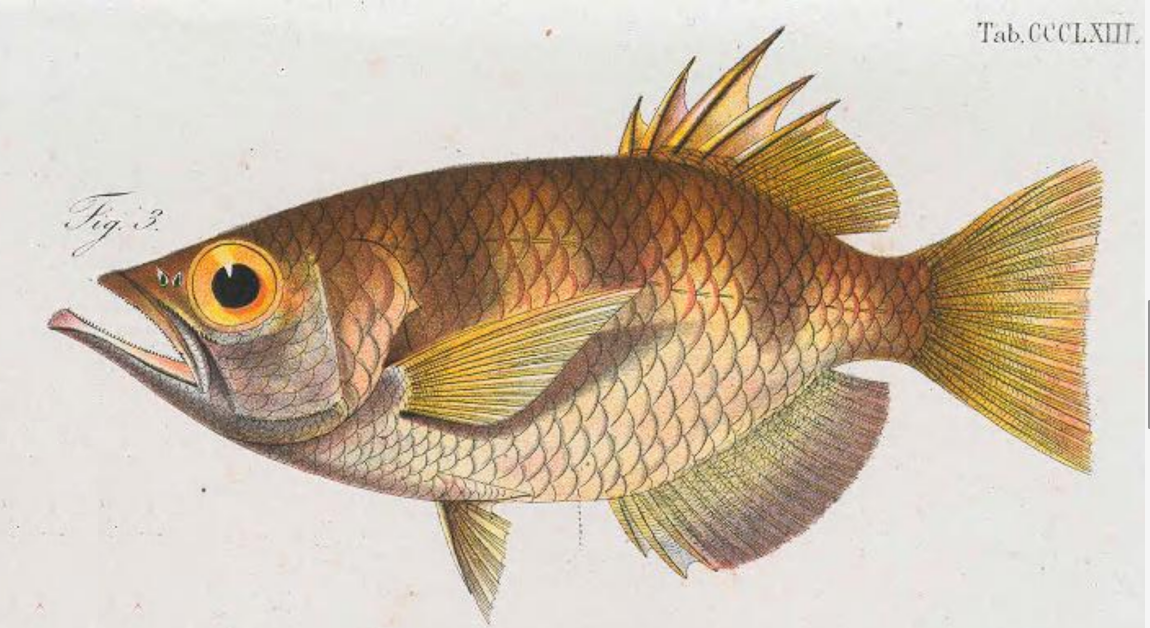
Big Scale Archerfish
Toxotes jaculatrix
Origin: Прибрежные воды Индии, Юго-Восточной Азии, Австралии и Океании; солоноватые и пресные воды мангровых зарослей
Also known as: Архерфиш, Toxotes jaculatrix, Полосатая рыба-лучник
Fact sheet
- Size
- 25 cm
- Lifespan
- 10 years
- Minimum tank size
- 200 L
- Temperature
- 25–30 °C
- pH
- 7–8
- Temperament
- Semi-aggressive
- Social behavior
- Schooling
- Swimming zone
- Top
- Diet
- Carnivore
Overview
A medium-sized archerfish from Australian coastal rivers and estuaries, notable for having fewer but proportionally larger scales than other Toxotes species. It is rarely seen in the aquarium trade and is considered an Australian endemic with limited commercial availability.
Appearance
Shared with the species: Archerfish
The Banded Archerfish has an oblong, moderately deep and laterally compressed body with a notably flat dorsal profile and a distinctly pointed snout featuring a protruding lower jaw, which facilitates accurate targeting of aerial prey. The body is silvery-white to pale cream on the ventral surface, with an olive-green to brown dorsal region; 4 to 6 bold black bands cross the flanks from the dorsal surface partway down the sides, giving the fish its 'banded' common name. The dorsal fin is positioned well toward the rear of the body — an adaptation that may aid rapid surface acceleration — while the eyes are positioned high on the head to provide good aerial vision with binocular overlap. Maximum length is approximately 30 cm, though aquarium specimens typically reach 20-25 cm, and juveniles display a more yellowish-green dorsal coloration with silvery undersides. Sexual dimorphism has not been formally investigated in this species, with males and females appearing externally similar.
Care
Shared with the species: Archerfish
Archerfish require a large aquarium due to their eventual size and active behavior, with a recommended minimum footprint of 120 x 60 cm and a volume of approximately 400-430 liters for a small group of adults. Water must be maintained in brackish conditions with a specific gravity of 1.005-1.015, a temperature of 25-30°C, a pH of 7.0-8.0, and hardness in the range of 20-30 dGH, reflecting their natural estuarine habitat. Ideally, a paludarium setup (a half-water, half-terrestrial enclosure) is used to replicate natural hunting conditions, allowing overhanging plants and a dry area above the waterline where live insects can be introduced to encourage natural shooting behavior. The tank must be very securely covered with a tall canopy, as archerfish are powerful jumpers that will launch themselves out of open-topped tanks when pursuing insects. Adding mangrove roots and salt-tolerant plants enhances both aesthetics and the fish's behavioral expression.
Feeding
Shared with the species: Archerfish
In the wild, archerfish are primarily insectivores and small-vertebrate predators, using their remarkable water-shooting ability to dislodge insects, spiders, and small lizards from overhanging vegetation up to 3 meters above the water surface. In captivity they will accept floating pellets, flake food, and freeze-dried or frozen foods such as bloodworm and brine shrimp, though they are far more engaged when offered live prey including crickets, mealworms, and fruit flies introduced above the water surface. A paludarium setup with living overhanging plants encourages the most natural feeding behavior and provides significant enrichment. Young fish and those newly acquired may refuse non-living foods entirely and require a transition period using live feeder insects.
Compatibility
Shared with the species: Archerfish
Archerfish are generally peaceful toward fish that are too large to eat, but their preference for surface-dwelling behavior and large eventual size means they are best housed with robust, similarly-sized companions. In their native habitat they coexist with mullet, scats, monos, and other larger brackish or euryhaline species, and these make appropriate tankmates in a spacious brackish display. Groups of 4-5 archerfish of similar size are recommended, as a school provides environmental enrichment and reduces individual stress; significant size disparities within the group can lead to aggression and even cannibalism. Very small fish or shrimp will be treated as food, and the archerfish's surface presence can disturb less assertive species.
Breeding
Shared with the species: Archerfish
Archerfish breeding in captivity is extremely rare and has never been reliably documented in a home aquarium setting. In the wild, the species is believed to require full oceanic seawater conditions for spawning, as eggs and larvae have been found in coastal marine environments, making it difficult to reconcile with the brackish conditions they require day-to-day. A female can produce an extraordinary 20,000-150,000 eggs per spawning event, with fertilization occurring externally in open water. Sexual maturity is reached at a body length of approximately 10 cm, and the species can live 5-10 years in captivity. The logistical challenges of replicating full marine salinity while maintaining the brackish living conditions these fish require makes captive breeding essentially inaccessible for home aquarists.
Fun facts
Shared with the species: Archerfish
The archerfish's shooting accuracy depends on compensating for Snell's window refraction — the optical bending of light as it crosses the water-air interface — meaning the fish must calculate the true position of aerial prey despite visual displacement caused by physics, a feat equivalent to a marksman accounting for air-density gradients. Research has demonstrated that archerfish benefit from observational learning: naive juveniles who watch an experienced fish shoot at targets develop significantly higher accuracy faster than fish trained in isolation. Archerfish can target prey up to 3 meters above the water surface, and adult fish hit their target with the first shot in the vast majority of attempts, delivering a jet that strikes with sufficient force to stun or knock insects free from vegetation.