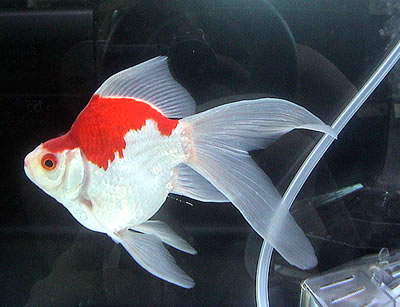
Tamasaba (Sabao)
Carassius auratus (Ranchu)
Origin: Выведен в Японии в XIX веке из Carassius auratus (золотая рыбка)
Also known as: Ранчу, Китайский лев, Голова-лев (Lionhead)
Fact sheet
- Size
- 20 cm
- Lifespan
- 15 years
- Minimum tank size
- 150 L
- Temperature
- 15–22 °C
- pH
- 7–8
- Temperament
- Peaceful
- Social behavior
- Schooling
- Swimming zone
- Middle, Bottom
- Diet
- Omnivore
Overview
A rare Japanese fancy goldfish combining a round, dorsal-finless Ranchu-like body with a single, flowing mackerel-type (saba) tail rather than the double-lobed tail of the Ranchu. Developed in the Yamagata prefecture of Japan, the Tamasaba is cold-water hardy and serves as a distinct regional variety rarely encountered outside Japan.
Appearance
Shared with the species: Ranchu Goldfish
The Ranchu's body is distinctly egg-shaped and deeply rounded, with a body depth that can equal 5/8 to 3/4 of the body length, creating the stout, compact profile that distinguishes it from other goldfish varieties. The complete absence of a dorsal fin is a defining breed characteristic, and any trace of a dorsal fin structure is considered a disqualifying fault in show fish; the back curves smoothly and steeply without interruption from head to tail. The head develops a prominent fleshy growth called a wen that covers the crown and cheeks, though this may not be visible in fish under one year of age and reaches its full development over 2-3 years. The caudal fin is typically double and divided, meeting the short caudal peduncle at approximately a 45-degree downward angle rather than the nearly horizontal set seen in most goldfish, causing the characteristic tail-up swimming posture. Adult Ranchu typically reach 6-8 inches (15-20 cm) in length under good conditions, and coloration encompasses orange, red, white, black, grey, and bi- or tri-colored combinations, with metallic, nacreous (calico), and matte scale varieties.
Care
Shared with the species: Ranchu Goldfish
Ranchu goldfish are cold-water fish that can tolerate a wide temperature range, typically kept between 10-25°C, and are well adapted to handle fluctuations in pH and water hardness, making them relatively robust in terms of water chemistry compared to more delicate fancy goldfish. However, their intensive selective breeding for extreme physical traits creates significant health vulnerabilities: the absence of a dorsal fin reduces swimming efficiency and directional stability, and the extreme body curvature predisposes fish to swim bladder disorders and buoyancy problems that require management through diet and feeding technique. A minimum tank volume of 100 liters per adult fish is recommended, with good biological filtration maintained at a gentle flow rate, as the fish are weak swimmers that can be exhausted by strong currents. Traditional Japanese keepers house Ranchu in wide, shallow earthenware vats or outdoor ponds that provide optimal top-down viewing and allow the fish to exercise natural foraging behavior across a large substrate area. Regular partial water changes of 25-30% weekly are essential to manage the significant waste load these fish produce.
Feeding
Shared with the species: Ranchu Goldfish
Ranchu are omnivorous foragers that in nature (as with all goldfish) consume algae, aquatic plants, small invertebrates, and organic detritus found along the bottom. In captivity they thrive on high-quality sinking goldfish pellets or gel foods formulated for fancy goldfish, as floating foods can cause buoyancy issues if air is swallowed during surface feeding — a particular risk given the Ranchu's already compromised swim bladder. Diet should be supplemented with blanched vegetables such as zucchini, shelled peas (a classic remedy for constipation), and spinach, as well as occasional live or frozen foods including bloodworms, daphnia, and brine shrimp. Feeding should be moderate and consistent — overfeeding is a significant health risk for Ranchu, contributing to obesity, swim bladder complications, and poor water quality.
Compatibility
Shared with the species: Ranchu Goldfish
Ranchu are peaceful, social fish that do well when kept in groups of their own kind or with other similarly-shaped fancy goldfish varieties of comparable size and swimming ability. They should not be kept with faster, more streamlined goldfish such as common, comet, or shubunkin varieties, as the Ranchu's poor swimming ability means it will consistently lose in competition for food and may become malnourished even in a well-fed tank. Other suitable companions include Lionhead, Oranda, Telescope Eye, Pearlscale, and other round-bodied fancy goldfish, though care must be taken to ensure all fish can feed effectively without competition from faster or more dominant individuals. Ranchu are cold-water fish and should not be housed with tropical species, and their heavy biological load and feeding requirements differ fundamentally from most aquarium fish.
Breeding
Shared with the species: Ranchu Goldfish
Ranchu goldfish breed in the same manner as all Carassius auratus, engaging in vigorous chasing behavior in which males pursue females and nudge their abdomens to stimulate egg release over a period of hours. Spawning typically occurs in spring as water temperatures rise from 15°C to about 20-22°C, and can be induced in aquariums by performing a partial water change with cooler water followed by gradual warming to simulate seasonal conditions. Females scatter adhesive eggs among fine-leaved plants, spawning mops, or other surfaces, where they adhere and develop; a single large female can produce thousands of eggs in one spawning event. Both parents will readily eat the eggs if not removed, so spawning mops or plants should be transferred immediately to a separate rearing container after spawning. Fry hatch in 4-7 days depending on temperature and must be fed infusoria, liquid fry food, or freshly hatched brine shrimp nauplii; culling of deformed or standard-type fry is a traditional and expected practice in serious Ranchu breeding to maintain breed standards over generations.
Fun facts
Shared with the species: Ranchu Goldfish
The name 'Ranchu' (蘭鋳) is derived from Japanese and is believed to reference Dutch (Oranda) traders who historically imported Chinese fancy goldfish to Japan — 'Ran' being a Japanese reading of the character for 'orchid' or 'Dutch' and 'chu' meaning 'cast' or 'model.' Japanese competitive Ranchu judging uses a top-view system with shallow bowls at eye level, evaluating the fish on extremely specific criteria of rectangular silhouette proportion, wen development, tail angle, and the quality of the fish's characteristic rolling swimming motion — an entirely different aesthetic system from the Western glass-tank side-view approach. Research has confirmed that goldfish lacking a dorsal fin swim measurably slower and less efficiently than standard-finnage goldfish, experiencing reduced acceleration, greater rolling instability, and higher energy expenditure per unit distance traveled, making the Ranchu's graceful movement all the more remarkable given its aerodynamic disadvantage.