Fish
Jack Dempsey Cichlid
Rocio octofasciata
Origin: Central America: southern Mexico (Yucatan), Guatemala, Honduras, Belize
Also known as: JD, Electric Blue Jack Dempsey (color form), Rocio octofasciata
Fact sheet
- Size
- 20 cm
- Lifespan
- 10 years
- Minimum tank size
- 200 L
- Temperature
- 22–28 °C
- pH
- 6–7
- Hardness GH
- 5–15 °dH
- Temperament
- Aggressive
- Social behavior
- In pairs
- Swimming zone
- Middle, Bottom
- Diet
- Carnivore
- Jumps out
- No
- Eats plants
- No
Varieties
Overview
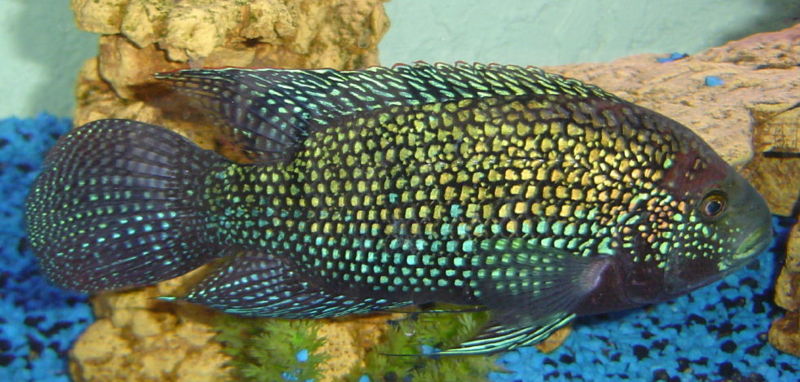
The Jack Dempsey Cichlid (Rocio octofasciata) is a large, pugnacious Central American cichlid named after the legendary heavyweight boxing champion for its fighting temperament. Described by Regan in 1903. Inhabits slow rivers, swamps, canals, and sluggish streams with warm, turbid water and muddy or sandy substrate. Distinguished by brilliant teal-blue iridescent spotting on a dark base. Not a beginner fish — aggressive, large, and a powerful digger.
Appearance
Reaches 20–25 cm, robust deep body. Dark gray-brown base with dense clusters of iridescent teal-blue to green-blue spots and scales covering body and fins. Mature males show more intensified coloration and slightly pointed fins.
Care
Tank minimum 400 L for a pair. Temperature 22–28°C, pH 6.5–8.0. Strong filtration. Robust rock and driftwood only — they excavate substrate extensively. Species tank strongly recommended.
Feeding
Opportunistic carnivore: large cichlid pellets, frozen/live foods — earthworms, prawns, fish. Will eat almost anything meaty.
Compatibility
Highly aggressive. Best as mated pair in species tank. If mixed, only with cichlids of similar size and aggression: Texas Cichlid, large Flowerhorn, Oscar (with caution).
Breeding
Pair cleans a large flat rock or excavates a pit; female deposits 500–800 eggs. Both parents guard fiercely. Fry free-swimming at 5–8 days; parents continue to protect for several weeks.
Fun facts
The 'Electric Blue Jack Dempsey' is a natural recessive color mutation (not a hybrid) where reduced dark pigmentation reveals brilliant electric-blue iridescence. Because the mutation is recessive, breeding for it is challenging. Named after Jack Dempsey, world heavyweight champion 1919–1926.