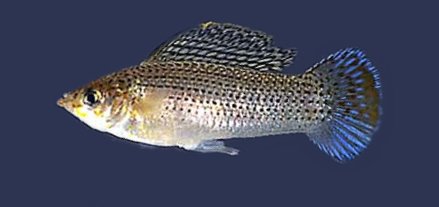
Black Molly
Poecilia sphenops
Origin: Central and North America, ranging from Mexico to Colombia. Found in freshwater, brackish, and coastal marine environments including rivers, lagoons, and coastal streams.
Also known as: Common Molly, Shortfin Molly, Liberty Molly, Sailfin Molly
Fact sheet
- Size
- 6 cm
- Lifespan
- 5 years
- Minimum tank size
- 60 L
- Temperature
- 22–28 °C
- pH
- 7–8
- Hardness GH
- 10–25 °dH
- Temperament
- Peaceful
- Social behavior
- Schooling
- Swimming zone
- Middle
- Diet
- Omnivore
- Jumps out
- Yes
- Eats plants
- No
Overview
The most iconic molly variety with an all-black velvety body. Highly hardy and well suited to beginner aquarists.
Appearance
Shared with the species: Molly
The molly has an elongated, laterally compressed body with a slightly upturned mouth adapted for surface feeding and algae grazing. Body coloration varies enormously across varieties: solid jet black, silver, gold, orange, white, and multicolored dalmatian patterns are all common. Males are slimmer than females and possess a modified anal fin called a gonopodium used for internal fertilization. Adult size ranges from 6 to 12 cm depending on species and conditions, with sailfin males (P. latipinna, P. velifera) being the largest.
Care
Shared with the species: Molly
A minimum tank of 60 liters is recommended for mollies, with good filtration and regular water changes of 20–25% weekly. Optimal water temperature is 22–28 °C, pH 7.5–8.2, and hardness 11–30 dH. Adding a small amount of aquarium or marine salt (1–2 g/L) significantly improves their health and disease resistance. A tight-fitting lid is advisable as mollies can occasionally jump. Planted aquariums with open swimming space suit them well, and they will naturally graze on algae growing on surfaces.
Feeding
Shared with the species: Molly
Mollies are omnivores that in the wild feed on algae, small invertebrates, and organic matter. In the aquarium they accept flakes, granules, live and frozen foods such as bloodworm, daphnia, and brine shrimp. A significant proportion of their diet should be plant-based: blanched spinach, cucumber, spirulina flakes, or algae wafers support proper digestion and immune health. Feed 2–3 times daily in small portions to avoid water quality issues.
Compatibility
Shared with the species: Molly
Mollies are peaceful schooling fish that coexist well with other small, non-aggressive species such as guppies, platies, danios, small tetras, and Corydoras catfish. They should not be housed with aggressive or fin-nipping species such as cichlids, tiger barbs, or bettas. Keeping 2–3 females per male reduces male harassment behavior. They are safe with live plants and generally will not damage them beyond gentle grazing.
Breeding
Shared with the species: Molly
Mollies are livebearers that give birth to fully formed, free-swimming fry. Gestation lasts approximately 28 days, after which the female delivers between 20 and 150 fry depending on her age and size. No special setup is required to trigger spawning—mixed-sex groups will breed naturally. Moving the female to a separate breeding tank or densely planting the main tank before birth helps protect the fry from being eaten. Fry can be fed baby brine shrimp, micro-worms, and finely crushed flake food from day one.
Fun facts
Shared with the species: Molly
Mollies are one of the few freshwater fish capable of fully adapting to saltwater, and they are occasionally kept in reef aquariums. The species is named in honor of French naturalist Nicolas Mollien. Hundreds of selectively bred color and fin varieties exist, making the molly one of the most morphologically diverse aquarium fish in the hobby.