Fish
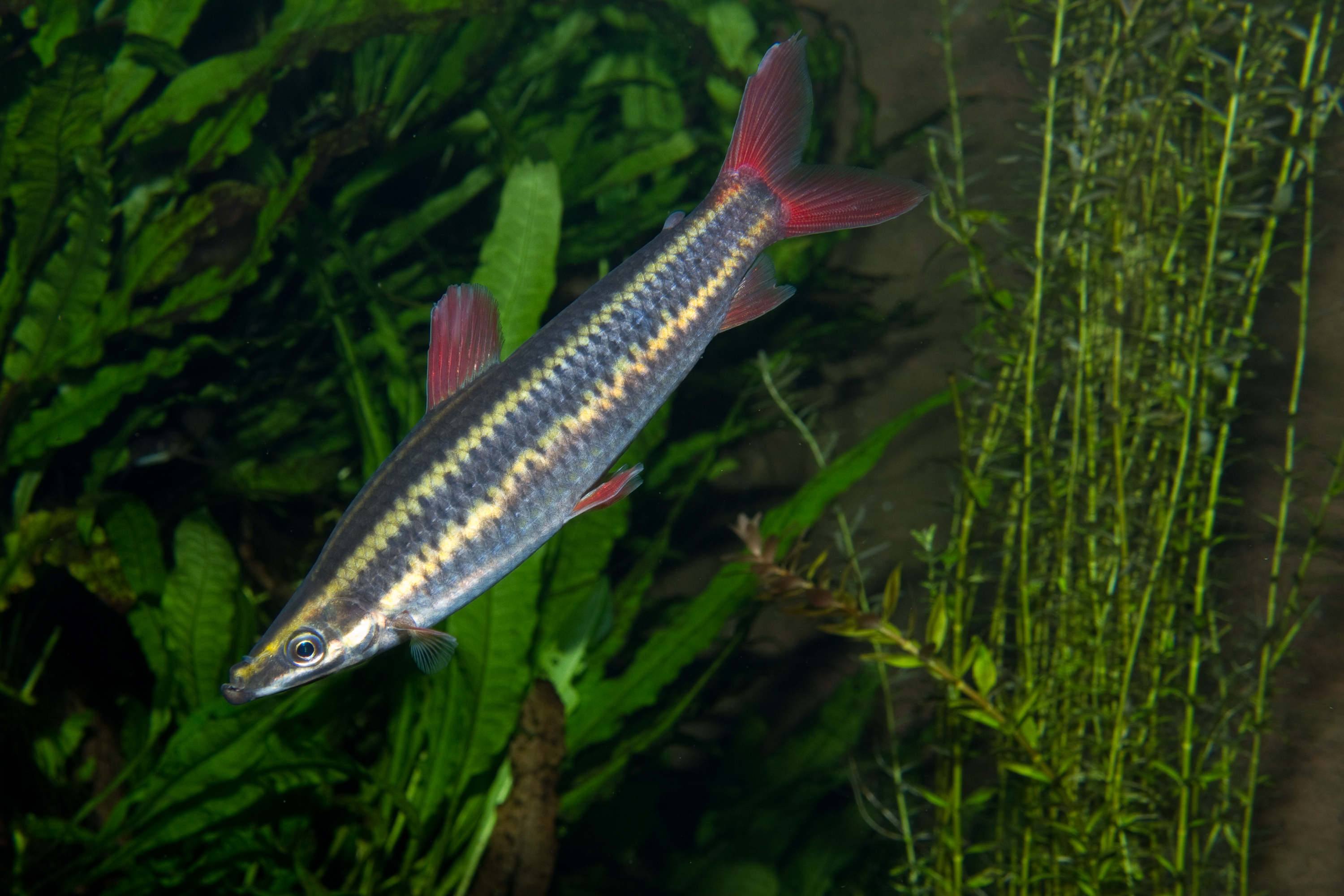
Striped Headstander
Anostomus anostomus
Origin: South America: Amazon and Orinoco river basins, including waterways of Venezuela, Colombia, Brazil, Guyana, and Peru. Prefers fast to moderate currents with rocky and gravelly substrate and marginal vegetation.
Also known as: Anostomus, Striped Anostomus
Fact sheet
- Size
- 18 cm
- Lifespan
- 10 years
- Minimum tank size
- 200 L
- Temperature
- 22–28 °C
- pH
- 6–7.5
- Hardness GH
- 5–15 °dH
- Temperament
- Semi-aggressive
- Social behavior
- Schooling
- Swimming zone
- Middle
- Diet
- Omnivore
- Jumps out
- Yes
- Eats plants
- No
Varieties
Overview
The striped headstander is an unusual and attractive South American fish in the family Anostomidae, famous for its characteristic head-down posture adopted while resting and feeding. This behavior is explained by its upturned mouth, which allows the fish to scrape algae and biofilm from rocks, branches, and driftwood in its natural habitat. The species grows to 15–18 cm and can live 5–10 years in aquaria under proper care. It shows moderate territoriality, particularly in small groups, and keeping just two individuals is not recommended. The fish is active mainly during daylight hours and shows curious interest in decorations. Its bold striped coloration makes the headstander an excellent centerpiece species in a South American biotope aquarium.
Appearance
The body is elongate and cylindrical with a pointed head and small upturned mouth. Three bright yellow horizontal stripes run the full body length against a dark brown to near-black background. The bases of the pectoral and caudal fins and the lower caudal lobe often show brilliant red coloration, as may the dorsal fin. Adults reach 15–18 cm; males tend to be slimmer than females.
Care
The striped headstander requires a spacious aquarium of at least 200–250 liters with a base length of 100 cm or more. Strong filtration with moderate current and regular 20–30% weekly water changes are needed. Temperature 22–28 °C, pH 5.5–7.5, soft to medium hardness. Decorate generously with driftwood, rocks, caves, and dense planting to provide retreats and reduce aggression. A tight-fitting lid is essential as the fish is a capable jumper. Avoid housing with small fin-nipping targets.
Feeding
The striped headstander is primarily herbivorous, naturally scraping algae and biofilm from surfaces. In the aquarium the diet should be dominated by plant-based foods: spirulina tablets, algae wafers, blanched spinach, zucchini, and cucumber. Bloodworm, brine shrimp, and daphnia can supplement the diet in small amounts. Feed 2–3 times daily, ensuring all food is consumed within a few minutes.
Compatibility
Striped headstanders are moderately territorial and may show aggression toward conspecifics in small groups. They are best kept singly or in groups of six or more, where a more even hierarchy develops. They coexist well with larger characins, medium-sized cyprinids, and catfish. Avoid housing with long-finned or very small fish, or with other anostomids in confined space. Provide ample hiding spots when kept alongside other territorial species.
Breeding
Breeding in the home aquarium is almost entirely undocumented and remains very difficult. Soft, slightly acidic water, high nutritional condition, and a large tank volume are believed to be prerequisites. The species is a substrate spawner that scatters eggs among plants. Adults do not guard eggs or fry and will eat both given the opportunity. Most specimens in trade are wild-caught or commercially farmed in Asia.
Fun facts
The name 'anostomus' derives from the Greek 'anoston' meaning 'going back,' reflecting the fish's unusual posture. The upturned mouth is so precisely adapted that the fish can feed efficiently while angled 45–60 degrees head-down. In the wild, striped headstanders form dense schools that can number in the hundreds.