Fish
Cape Lopez Lyretail
Aphyosemion australe
Origin: West Africa — coastal lowlands of Gabon and Congo; specifically described from Cape Lopez near the Ogooué River mouth in Gabon
Also known as: Lyretail Panchax, Golden Lyretail, Lyretail Killifish
Fact sheet
- Size
- 5 cm
- Lifespan
- 3 years
- Minimum tank size
- 40 L
- Temperature
- 20–25 °C
- pH
- 6–7.5
- Hardness GH
- 2–12 °dH
- Temperament
- Peaceful
- Social behavior
- In pairs
- Swimming zone
- Middle, Top
- Diet
- Carnivore
- Jumps out
- Yes
- Eats plants
- No
Varieties
Overview
Aphyosemion australe, the Cape Lopez Lyretail, is one of the most widely kept and beginner-friendly killifish species in the aquarium hobby, having been imported from West Africa since 1913. This small, colorful fish inhabits permanently water-filled environments—swamps, forest streams, and slow-moving water bodies—in the coastal lowlands of Gabon and Congo. Unlike many killifish species, A. australe is not an annual fish and can live 3–4 years in captivity under optimal conditions. Males are remarkably beautiful, displaying orangey-brown bodies covered in vivid red spots with lyre-shaped tails edged in brilliant yellow and red, while females are more subdued. The species is an 'egg hanger' rather than an egg burrier, depositing adhesive eggs on fine-leaved plants or mops from which they can be easily collected and incubated. A. australe is universally regarded as an ideal introductory species for aquarists wishing to explore the diverse world of killifish.
Appearance
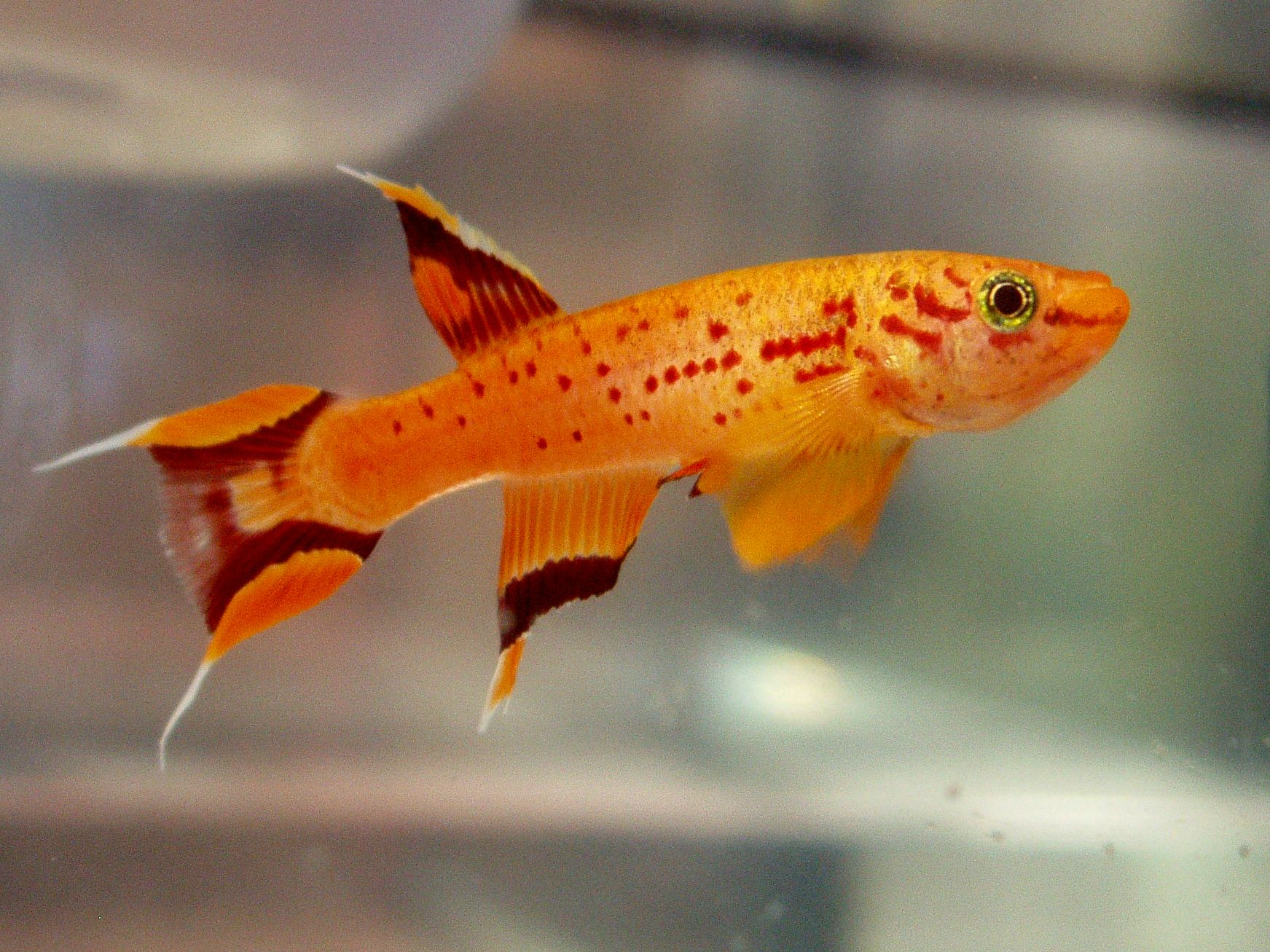
The male Cape Lopez Lyretail has a stunning brownish-orange to reddish-brown base coloration densely covered with crimson or violet-red spots and streaks across the body. The caudal fin is distinctly lyre-shaped, with extended upper and lower rays tipped in brilliant yellow, while the dorsal and anal fins are pointed and richly colored. Females are noticeably smaller and much less vibrant, displaying a brownish-tan body with only faint spotting and no elongated fin extensions. Total body length for males is approximately 6 cm, with females slightly smaller.
Care
Aphyosemion australe thrives in small aquariums with a minimum base of 45 × 25 cm; a capacity of 28–40 liters is adequate for a pair or trio. Water parameters should include pH 5.5–7.0, soft to medium hardness (1–10 dGH), and temperature 21–25°C. The aquarium should have a dark substrate, floating plants to diffuse light, and fine-leaved plants or spawning mops for egg deposition. A very tight-fitting lid is absolutely essential, as killifish are notorious jumpers. Regular water changes of 20–25% weekly help maintain the clean, slightly acidic conditions the species prefers.
Feeding
In the wild, Aphyosemion australe preys on small insects, insect larvae, crustaceans, and other tiny invertebrates found on or near the water surface. In captivity it prefers live or frozen small foods such as daphnia, bloodworms, artemia, white mosquito larvae, and fruit flies. Most tank-bred specimens also accept quality flake food, though live and frozen foods significantly improve coloration and breeding readiness. Feed small amounts once or twice daily to avoid overfeeding.
Compatibility
Aphyosemion australe is a peaceful, somewhat timid species best kept with other small, non-aggressive fish of similar size. Suitable tankmates include small tetras, pencilfish, hatchetfish, small rasboras, dwarf corydoras, and other peaceful killifish. It is best kept as a pair or a trio (one male, two females) to reduce male competition. Avoid boisterous or fin-nipping species that could stress this relatively shy fish.
Breeding
Aphyosemion australe is one of the easiest killifish to breed and is a plant spawner that deposits adhesive eggs one at a time on fine-leaved plants or yarn mops. Females produce 10–20 eggs daily over a period of 1–2 weeks; eggs are collected from the spawning substrate and incubated either in shallow water or in a slightly moist medium. At 22–24°C, eggs hatch after approximately 10–20 days. Newly hatched fry are large enough to immediately accept freshly hatched brine shrimp nauplii and microworms. The species is non-annual, meaning eggs do not require a dry incubation period, greatly simplifying the breeding process.
Fun facts
Aphyosemion australe was first imported to Europe for the aquarium hobby in 1913 from Gabon, making it one of the oldest continuously kept killifish species with over a century in the hobby. Unlike most killifish which are annual species tied to temporary pools, A. australe lives in permanent water bodies and has a significantly longer natural lifespan of up to 4 years. The golden/orange morph—the most commonly seen form in the trade—was developed through selective breeding and displays considerably more intense orange coloration than wild-caught brownish specimens.