Fish
Gardner's Killifish
Fundulopanchax gardneri
Origin: West Africa — Nigeria and Cameroon; shallow shaded streams, forest pools, and seasonal swamps with soft, tannin-rich water
Also known as: Blue Lyretail, Steel Blue Killie, Blue Gularis (trade name)
Fact sheet
- Size
- 6 cm
- Lifespan
- 3 years
- Minimum tank size
- 40 L
- Temperature
- 20–25 °C
- pH
- 6–7
- Hardness GH
- 2–12 °dH
- Temperament
- Peaceful
- Social behavior
- In pairs
- Swimming zone
- Middle, Top
- Diet
- Carnivore
- Jumps out
- Yes
- Eats plants
- No
Varieties
Overview
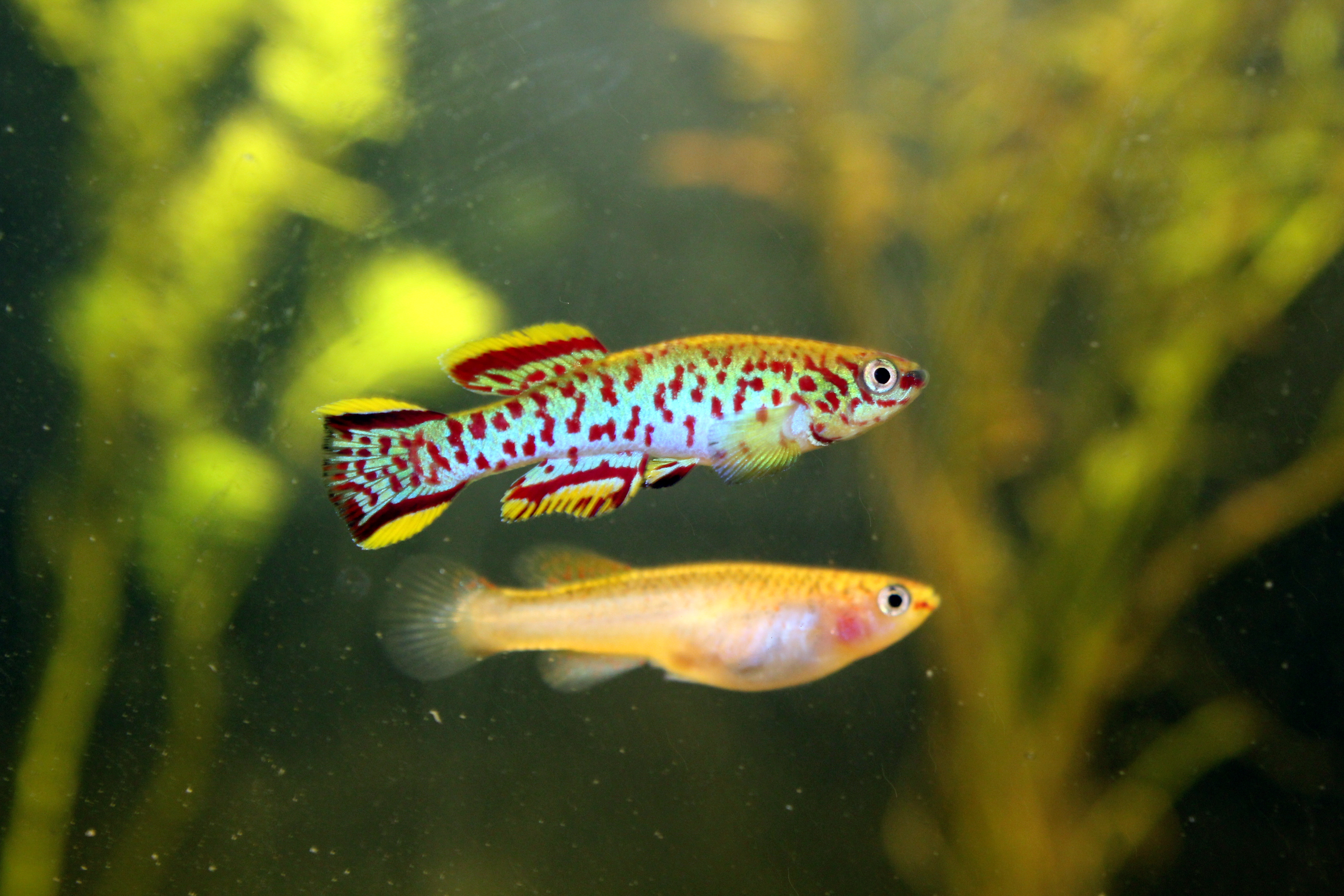
Fundulopanchax gardneri, formerly classified as Aphyosemion gardneri, is a strikingly beautiful killifish from West Africa considered one of the best entry-level killifish for beginners due to its hardiness, vivid coloration, and ease of breeding. Males display spectacular metallic blue or turquoise-green coloration peppered with irregular red spots, with fins edged in yellow and orange, making them among the most colorful small freshwater fish in the hobby. The species is semi-annual—unlike true annual species that live only one season, F. gardneri lives 2–3 years in captivity. Native to Nigeria and Cameroon, the fish inhabits shallow, shaded streams and seasonal swamps with soft, tannin-rich water. Multiple geographic variants and subspecies are recognized, each with slightly different coloration patterns highly prized by killifish collectors. Originally described by Boulenger in 1911, the species has remained a flagship killifish ever since.
Appearance
Male Fundulopanchax gardneri are brilliantly colored, displaying a metallic blue, steel-blue, or turquoise-green body densely covered with irregular crimson or rust-red spots. The fins are rounded to slightly pointed with a distinctive yellow to orange outer edge that makes the fish appear almost luminous. Females are much less colorful—brownish-tan with faint sparse spots—and smaller than males, which typically reach 6–7 cm. The intensity of male coloration varies significantly between geographic strains, with some showing predominantly blue and others more green or teal tones.
Care
Fundulopanchax gardneri is one of the hardier killifish and can be kept in tanks as small as 30 liters for a pair, though 40–60 liters is preferred for a trio. Water parameters should be pH 6.2–7.0, hardness 3–8 GH, and temperature 22–26°C; the species tolerates slightly cooler conditions in winter. Dense planting with fine-leaved species and floating plants creates natural shelter and spawning sites. A secure, tight-fitting lid is absolutely mandatory as this species is an excellent jumper. Partial water changes of 25–30% weekly maintain water quality.
Feeding
Fundulopanchax gardneri is a micropredator that thrives on small live and frozen foods including bloodworms, daphnia, artemia, white mosquito larvae, and small insect larvae. While most captive specimens learn to accept quality micro-pellets and small flake foods, a diet heavy in live or frozen foods dramatically improves coloration and breeding success. Feed twice daily in small amounts, ensuring all food is consumed within 2–3 minutes to prevent water quality deterioration.
Compatibility
Fundulopanchax gardneri is generally peaceful toward fish of different species but males of the same species may spar with each other in small aquariums. The best configuration is a trio of one male and two females, which distributes male attention and reduces stress on individual females. Suitable tankmates include small tetras, rasboras, pencilfish, and dwarf corydoras. Avoid housing with fast, aggressive, or large fish that would outcompete or harm these killifish.
Breeding
Fundulopanchax gardneri breeds readily in captivity and is considered one of the easiest killifish to spawn. It is a plant spawner using dark acrylic yarn mops or fine-leaved plants as deposition sites. Females lay approximately 1–5 adhesive eggs per day over an extended period. Eggs are collected and incubated either in shallow water or on slightly damp peat at 24°C for 14–21 days. Newly hatched fry are robust and immediately accept microworms and freshly hatched artemia nauplii. Color in juveniles begins appearing by 5–6 weeks of age.
Fun facts
Fundulopanchax gardneri was first described by the prominent ichthyologist G.A. Boulenger in 1911 from specimens collected by J.R. Gardner, after whom the species is named. It holds the distinction of being one of the most widely distributed killifish in West Africa, with populations found across a vast range spanning Nigeria and Cameroon. The species has been selectively bred to produce the brilliant 'Nigerian Gold' strain, which displays dramatically enhanced yellow-gold and blue coloration compared to wild populations.