Fish
Bloodfin Tetra
Aphyocharax anisitsi
Origin: South America: Paraná River basin (Argentina, Paraguay, Bolivia)
Also known as: Red-finned tetra, Glass bloodfin, Bloodfin
Fact sheet
- Size
- 5 cm
- Lifespan
- 5 years
- Minimum tank size
- 60 L
- Temperature
- 18–28 °C
- pH
- 6–8
- Hardness GH
- 5–15 °dH
- Temperament
- Peaceful
- Social behavior
- Schooling
- Swimming zone
- Middle
- Diet
- Omnivore
- Jumps out
- Yes
- Eats plants
- No
Varieties
Overview
Aphyocharax anisitsi, the bloodfin tetra, is a hardy and undemanding characin of the family Characidae that has become a popular aquarium fish thanks to the vivid blood-red colouration of its fins against a silver body. The species is widely known under the trade name 'bloodfin tetra'. Fish are very active and prefer to occupy the middle and upper water layers. One of the species' most remarkable qualities is its exceptional longevity — captive specimens over 10 years old are not uncommon, which is extraordinary for a small tetra. The species is well suited to beginners and coexists well with most peaceful fish. In nature it schools in large groups for protection against predators.
Appearance
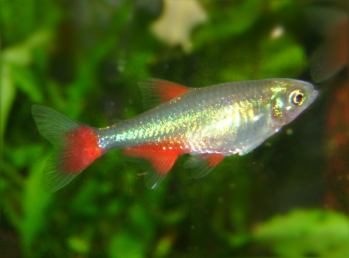
Body length up to 5.5 cm. The body is slender, elongated, and silvery with a slight greenish sheen on the back. The caudal, dorsal, anal, and adipose fins are coloured vivid blood-red, which gives the fish its characteristic name. Females are slightly rounder than males and have marginally less intense fin colouration. In mature males the fins may become particularly intensely red during the spawning period.
Care
Best kept in groups of at least 5–6 individuals in a tank of 60 litres or more. Water parameters: pH 6.0–8.0, hardness up to 20 dH, temperature 18–28°C — the species is very tolerant of parameter fluctuations. A tank with floating plants, a dark substrate, and a gentle current suits them well. Good filtration and aeration are essential. Weekly water changes of 25–30% are recommended. With proper care the fish easily live over 10 years.
Feeding
Omnivorous and eagerly accepts live, frozen, and dry foods. Diet includes bloodworm, daphnia, brine shrimp, tubifex, and quality flake food or micro-pellets. Avoid very large food items — the mouth is small. Feed twice daily in small portions. A varied diet ensures vivid red fin colouration and good overall health.
Compatibility
An excellent community fish compatible with virtually any peaceful species of similar size. Avoid housing with long-finned varieties (angelfish, veil-tail guppies) as the bloodfin may nip their fins. Coexists well with other tetras, danios, rasboras, corydoras, and dwarf cichlids. A shoaling species — solitary keeping is inadvisable.
Breeding
Breeding is not particularly difficult. Broodstock are placed in a breeding tank with fine-leaved plants or a spawning grid. Spawning is triggered by slightly warmer water (26–28°C) and additions of fresh soft water. The female deposits 200–500 transparent eggs. Adults are separated from the eggs after spawning. Larvae hatch in 24–36 hours, become free-swimming in 2–3 days, and accept infusoria and brine shrimp nauplii as first foods.
Fun facts
Captive specimens can exceed 10 years of age, which is exceptional for a small tetra. In the wild the species schools in large groups for protection against predators. The synonym Aphyocharax rubripinnis is an older name for the same species now considered invalid in current taxonomy.