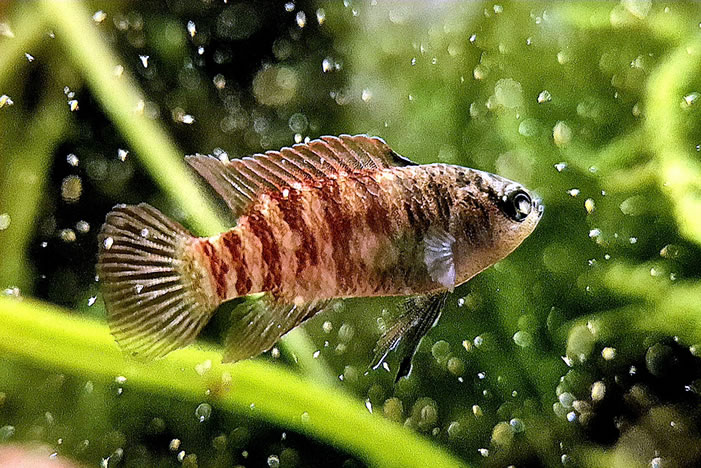
Dario hysginon
Dario dario
Origin: India: lower Brahmaputra River catchment in West Bengal and Assam; shallow, slow-moving and stagnant streams and ponds
Also known as: Scarlet gem, Dario, Red badis
Fact sheet
- Size
- 2 cm
- Lifespan
- 3 years
- Minimum tank size
- 20 L
- Temperature
- 16–25 °C
- pH
- 6.5–7.5
- Hardness GH
- 5–10 °dH
- Temperament
- Semi-aggressive
- Social behavior
- Solitary
- Swimming zone
- Middle
- Diet
- Carnivore
- Jumps out
- No
- Eats plants
- No
Overview
A closely related species from India and Myanmar, traded as 'Red melon Dario' or 'Flame red Dario'. Males show more orange-red colouration and reach 2–4 cm in length.
Appearance
Shared with the species: Scarlet Badis
Males reach 2–2.5 cm in length and display dazzling colouration: a silvery-scarlet body bearing seven vivid iridescent blue vertical bars on the flanks. Two thin dark streaks cross the eye. Females are considerably more subdued — greyish-green with paler transverse bars — and reach only about 1.5 cm. Sexual dimorphism is very pronounced and allows easy distinction of males from females even in juveniles.
Care
Shared with the species: Scarlet Badis
A minimum tank volume of 20–30 litres is needed for a small group. Water parameters: pH 6.5–8.0, hardness up to 17 dH, temperature 20–26°C (68–79°F), preferably towards the lower end of this range. The tank must be densely planted with fine-leaved plants and offer plenty of hiding spots — caves, tubes, broad leaves. Good filtration and aeration are required along with weekly water changes of 25–30%. A species-only tank or a nano setup with non-competitive, peaceful inhabitants is ideal.
Feeding
Shared with the species: Scarlet Badis
Scarlet badis is a predator with a very small mouth. It accepts only small live and frozen foods: brine shrimp nauplii, small bloodworm, daphnia, cyclops, and micro worms. Dry foods are generally completely ignored — acclimatisation is extremely difficult. Feed small portions twice daily. Insufficient feeding leads to rapid emaciation, which is the primary challenge in keeping this species.
Compatibility
Shared with the species: Scarlet Badis
Males are territorial and may aggressively chase conspecifics — a ratio of one male to 2–3 females is recommended. Not suitable for housing with active or large fish. Compatible with small, peaceful nano species: kubotai rasboras, oryziias, and other non-competitive microfish. Pairs excellently with neocaridina shrimp as it does not prey on adult shrimp. Avoid species that compete for the same small live foods.
Breeding
Shared with the species: Scarlet Badis
Sexual maturity is reached at around 5 months of age. The male prepares a spawning site (a cave, leaf, or tube) and courts the female with elaborate displays. Eggs are deposited on the underside of the shelter; the male guards the clutch and drives the female away. Eggs are small; hatching occurs in 2–3 days; fry become free-swimming after a further 7–10 days. First food is infusoria, followed by brine shrimp nauplii after 5–7 days. Fry grow slowly and require a continuous supply of live food.
Fun facts
Shared with the species: Scarlet Badis
Dario dario is the only species in the genus in which males possess exactly seven iridescent blue vertical bars, making this a reliable diagnostic feature. The species is found only in the lower Brahmaputra catchment, making it a range-restricted endemic. Despite their tiny size, males are capable of aggressively defending a territory and perform impressive courtship displays that rival those of fish many times their size.