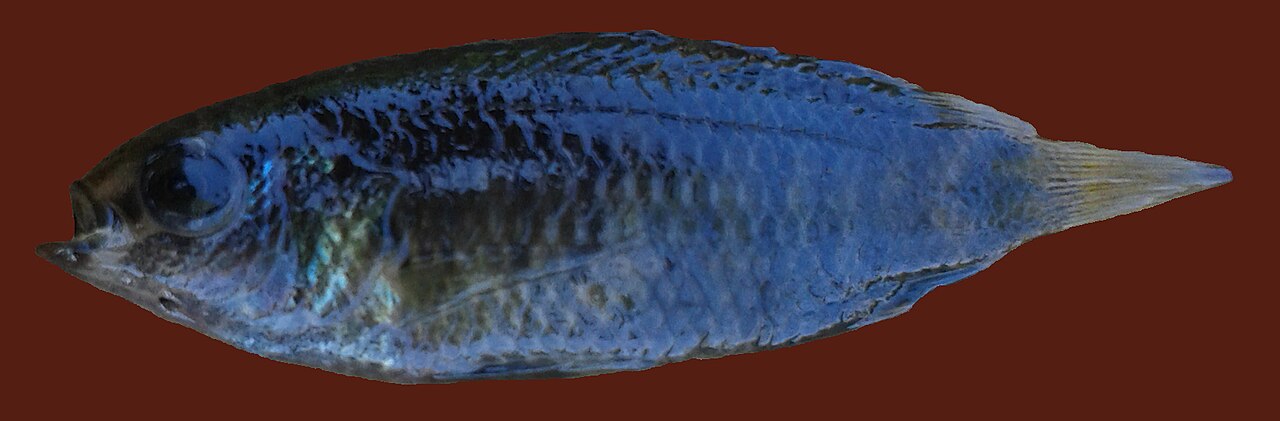
Badis assamensis
Badis badis
Origin: India (Ganges and Brahmaputra river basins), Nepal, Bangladesh
Also known as: Badis, Blue Perch, Dwarf Chameleon Fish
Fact sheet
- Size
- 8 cm
- Lifespan
- 5 years
- Minimum tank size
- 40 L
- Temperature
- 15–25 °C
- pH
- 6–7.5
- Hardness GH
- 5–15 °dH
- Temperament
- Semi-aggressive
- Social behavior
- Solitary
- Swimming zone
- Bottom, Middle
- Diet
- Carnivore
- Jumps out
- No
- Eats plants
- No
Overview
A species from Assam, northeastern India, considered one of the most beautiful in the genus. Males display vivid blue and orange tones; similar to B. badis but distinguishable by pattern details.
Appearance
Shared with the species: Chameleon Fish
The body of Badis badis is laterally compressed and reaches about 6–8 cm in length, with females being somewhat smaller than males. Base coloration ranges from brownish-beige to deep blue depending on the fish's mood; males become nearly black with vivid blue iridescence in their dorsal, anal, and caudal fins when breeding. Dark transverse bars are visible on the flanks, appearing and disappearing with mood changes. Sexual dimorphism is pronounced: males are more vibrantly colored and slimmer, while females develop a noticeably rounded abdomen during the breeding season.
Care
Shared with the species: Chameleon Fish
A tank of at least 60 liters with dense planting and plenty of hiding places — caves, driftwood, flowerpots, and tubes — is suitable for keeping badis. Recommended water parameters are pH 6.0–8.0, hardness 3–16 dGH, temperature 24–29°C. The species is sensitive to water pollution, so regular water changes of 20–25% per week and quality filtration are essential. It is best to keep one male per tank or a harem of one male with several females, as males aggressively compete for territory. The tank must have a secure lid, as the fish are prone to jumping.
Feeding
Shared with the species: Chameleon Fish
Badis badis is a carnivorous micro-predator that in the wild feeds on small invertebrates, insect larvae, and crustaceans. In the aquarium the fish frequently refuses dried foods, so the diet should consist mainly of live and frozen items: bloodworms, tubifex, daphnia, brine shrimp, and cyclops. Some individuals can gradually be weaned onto high-quality sinking pellets. Feed small portions twice daily, avoiding overfeeding and leftover food on the substrate.
Compatibility
Shared with the species: Chameleon Fish
Despite a generally peaceful temperament, badis is not suitable for tanks housing dwarf shrimp or small snails, as it actively hunts them. In a community aquarium the fish is typically calm, but males may quarrel over territory. Good tank mates include small tetras, danios, rasboras, small corydoras, and other peaceful fish of similar size. Avoid keeping badis with active or larger species that may stress it.
Breeding
Shared with the species: Chameleon Fish
For breeding, set up a dedicated tank of 30–50 liters with hiding places such as rock caves or clay flowerpots. Raise the water temperature to 27–30°C and maintain pH 6.5–7.0. The male claims a shelter and courts the female vigorously; the female then deposits up to 100 eggs inside the refuge. The male guards the eggs and newly hatched larvae, and the female should be removed after spawning to prevent conflict. Larvae appear after 2–3 days and become free-swimming on days 4–5. Starter foods include infusoria, micro-worms, and freshly hatched brine shrimp nauplii.
Fun facts
Shared with the species: Chameleon Fish
The generic name Badis is derived from a local Indian name for the fish. Badis can shift color patterns almost instantaneously in response to changes in lighting, the presence of a rival, or a potential mate — which is why it earned the common name 'chameleon fish.' The genus Badis now contains more than 23 described species, many of which were discovered only in the early 21st century.