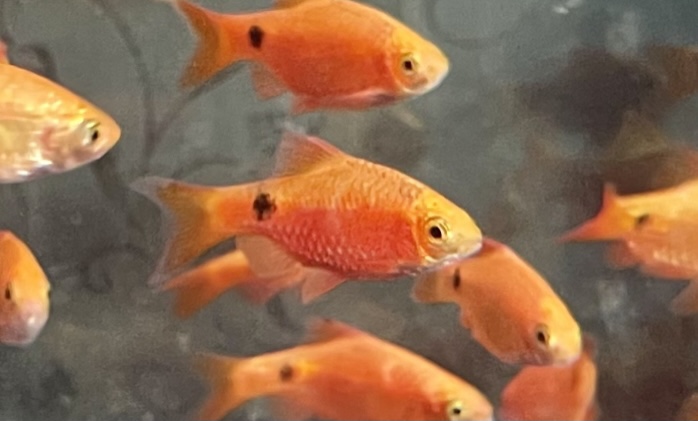
Fish
Rosy Barb
Pethia conchonius
Origin: Northern India, Bangladesh, Nepal, Afghanistan (Ganges and Brahmaputra river basins)
Also known as: Rosy barb, Red barb, Conchonius barb
Fact sheet
- Size
- 14 cm
- Lifespan
- 5 years
- Minimum tank size
- 100 L
- Temperature
- 18–25 °C
- pH
- 6–7.5
- Hardness GH
- 5–15 °dH
- Temperament
- Peaceful
- Social behavior
- Schooling
- Swimming zone
- Middle
- Diet
- Omnivore
- Jumps out
- Yes
- Eats plants
- Yes
Varieties
Overview
The rosy barb (Pethia conchonius) is a large, colorful barb of the family Cyprinidae, one of the first representatives of the group to enter the aquarium hobby in the early 20th century. Its natural range spans rivers and streams across the northern Indian subcontinent from Afghanistan to Bangladesh. The species has achieved widespread popularity in the aquarium trade due to its hardiness, resilience, and the vivid coloration males display during the spawning season. Taxonomically the species has undergone several reclassifications, with Barbus conchonius and Puntius conchonius as long-standing synonyms. The rosy barb is an active schooling fish that needs a spacious tank with ample open swimming space. The species is notably long-lived, reaching up to 5 years under good care.
Appearance
The body of the rosy barb is moderately elongated, reaching 10–14 cm in length, with a characteristic dark spot at the base of the caudal fin. Males in spawning condition develop a rich rose-red to scarlet body coloration that extends to the belly and lower fins, while the back remains olive-green. Females are more modestly colored — beige to silvery-pink — and are larger and more round-bodied. Fins in both sexes are yellowish-red with dark tips.
Care
An aquarium of at least 150 liters is recommended for a school of 8–10 fish. Water: pH 6.0–8.0, hardness 5–19 dGH, temperature 18–22°C (tolerates down to 15°C). Good filtration and weekly water changes of 25–30% are important as the fish are sensitive to nitrate buildup. Aquascape with open swimming zones combined with dense planting along the perimeter. Keeping the fish in a group reduces aggression and stress.
Feeding
The rosy barb is omnivorous, feeding in nature on aquatic invertebrates, insects, plant matter, and detritus. In the aquarium it readily accepts quality dried foods — flakes and granules — but live and frozen foods such as bloodworms, daphnia, brine shrimp, and tubifex should be provided regularly to maintain vibrant color and good health. Occasional plant-based supplementation in the form of blanched spinach leaves or spirulina-based tablets is also beneficial.
Compatibility
The rosy barb is a peaceful schooling fish that coexists well with most similarly sized species: other barbs, danios, rasboras, tetras, rainbowfish, anabantoids, and catfish. The species may occasionally nip the long fins of slow-moving tank mates, so it should not be kept with veiltail goldfish or bettas. Always keep in groups of at least 6–8 individuals — solitary fish become shy or aggressive.
Breeding
Breeding is straightforward. Condition the brood fish with live foods for a week beforehand. Set up a 50–80 liter spawning tank with fine-leaved plants or a spawning mesh. Raise temperature to 24–26°C, pH 7.0. During the spawn the female scatters up to 200–500 small adhesive eggs among plants. Remove the parents immediately after spawning as they will eat the eggs. Larvae hatch in 24–36 hours and become free-swimming on days 3–4. Feed fry infusoria initially, then brine shrimp nauplii.
Fun facts
The rosy barb is one of the most cold-tolerant tropical barbs, surviving water temperatures as low as 10–12°C, which makes it suitable for unheated aquariums in temperate climates. Selective breeding has produced several ornamental forms including veiltail and fluorescent variants. The species has been introduced into waters of Australia and several other regions, where it has established invasive populations.