Fish
Arulius Barb
Dawkinsia arulius
Origin: Southeastern India (Kaveri River basin, Tamiraparani drainage system)
Also known as: Longfin barb, Tamiraparani barb, Silas barb
Fact sheet
- Size
- 12 cm
- Lifespan
- 5 years
- Minimum tank size
- 120 L
- Temperature
- 22–28 °C
- pH
- 6.5–7.5
- Hardness GH
- 5–15 °dH
- Temperament
- Peaceful
- Social behavior
- Schooling
- Swimming zone
- Middle
- Diet
- Omnivore
- Jumps out
- Yes
- Eats plants
- No
Varieties
Overview
The arulius barb (Dawkinsia arulius) is a large freshwater cyprinid native to the fast-flowing mountain rivers and streams of southeastern India. The species was transferred from the genus Puntius into the newly erected genus Dawkinsia in 2012; notably, the new genus is named after evolutionary biologist Richard Dawkins in recognition of his contribution to the public understanding of science. Many specimens sold under the name D. arulius are actually the closely related D. tambraparniei from the Tamiraparani drainage. The fish is prized for its attractive coloration and the elongated dorsal fin rays of males, which earned it the trade synonym 'longfin barb.' It is an active schooling fish that requires spacious aquariums.
Appearance
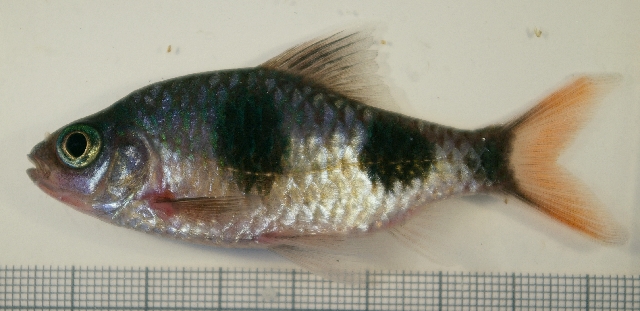
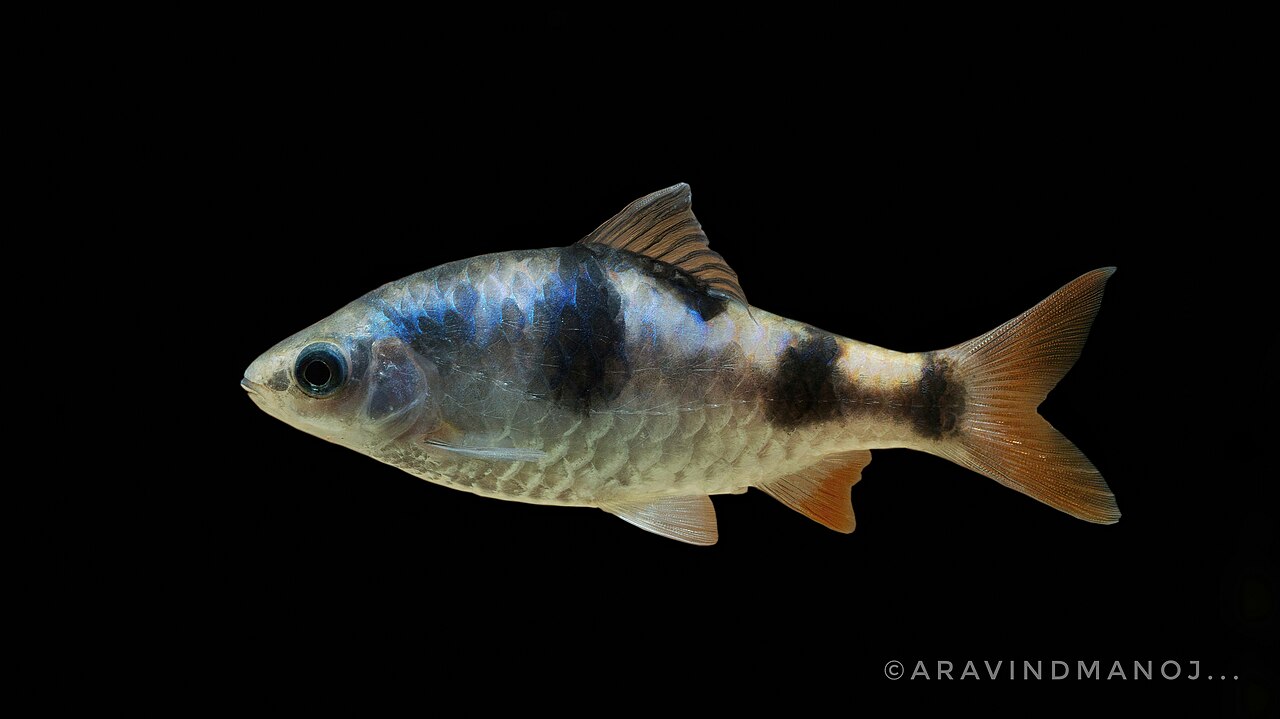
Adult fish reach 10–12 cm in length. The back is dark olive-brown, the sides lighten progressively toward a whitish belly. A distinctive feature is three vertical dark blotch-marks on the body: one in the mid-body above the pelvic fin origin, one above the anal fin, and one at the caudal fin base. Fins are yellowish to orange-red with dark margins. Males are slimmer than females, develop more intense coloration during spawning, and have distinctly extended dorsal fin rays.
Care
A group of 5–6 fish requires an aquarium with a base of at least 120×45 cm and a volume of 200 liters or more. Water parameters: pH 6.0–7.5, hardness 2–10 dGH, temperature 19–25°C. The species prefers moderate current, good oxygenation, and regular water changes of 25–30% per week. The aquascape should include open swimming areas combined with driftwood and plant cover. Lighting should be moderate.
Feeding
The arulius barb is omnivorous and undemanding when it comes to food. In nature it consumes aquatic invertebrates, insects, and plant material. In the aquarium it readily accepts quality dried flakes and granules as well as live and frozen items such as bloodworms, brine shrimp, and daphnia. Plant-based supplements in the form of blanched vegetables or spirulina-enriched foods help enhance coloration and support digestive health.
Compatibility
Although barbs are known for fin-nipping behavior, the arulius barb is considerably calmer when kept in a school of 5–6 or more individuals. Good tank mates include other large barbs, danios, rasboras, medium-sized tetras, and large catfish. It is not advisable to keep it with veiltail or slow-moving species.
Breeding
Spawning takes place in a larger breeding tank of 80–100 liters furnished with fine-leaved plants or a spawning mesh. Raise the temperature to 24–27°C and maintain pH 6.5–7.0. The female scatters several hundred adhesive eggs among the plants; remove the parents after spawning. Incubation lasts 24–48 hours; larvae become free-swimming on days 3–5. Feed fry infusoria initially, then brine shrimp nauplii and finely crushed flakes.
Fun facts
The genus Dawkinsia was established in 2012 and named after evolutionary biologist Richard Dawkins — a rare example of a fish genus being named after a science communicator rather than a professional ichthyologist. D. arulius is frequently confused with D. tambraparniei, and the majority of trade fish sold under the arulius name may actually belong to the latter species. The arulius barb is particularly sensitive to water quality and loses its coloration when nitrate levels rise.