Fish
Cherry Barb
Puntius titteya
Origin: Sri Lanka (slow-moving shaded forest rivers and streams)
Also known as: Cherry barb
Fact sheet
- Size
- 5 cm
- Lifespan
- 5 years
- Minimum tank size
- 60 L
- Temperature
- 23–27 °C
- pH
- 6–8
- Hardness GH
- 5–15 °dH
- Temperament
- Peaceful
- Social behavior
- Schooling
- Swimming zone
- Middle
- Diet
- Omnivore
- Jumps out
- Yes
- Eats plants
- No
Varieties
Overview
The cherry barb (Puntius titteya) is a small, brightly colored cyprinid endemic to Sri Lanka that inhabits slow-moving, shaded forest streams across the island. Males in breeding condition turn a deep cherry-red, giving the fish its common name. The species is one of the few barbs valued in the aquarium hobby for its relatively peaceful temperament — it is considerably calmer than most other barbs and does not typically nip the fins of tank mates. In the wild the cherry barb is endangered: deforestation in Sri Lanka and river pollution have caused sharp declines in natural populations, and the species is listed on the IUCN Red List. In the aquarium trade the fish has been bred in captivity for decades and remains consistently popular with beginners and experienced hobbyists alike.
Appearance
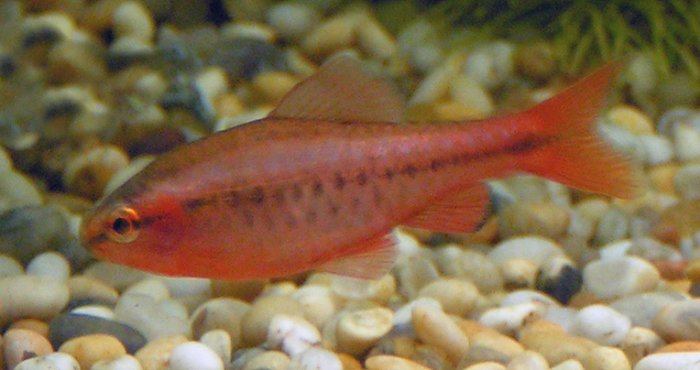
The body is elongated and slender, 3.5–5 cm in length. Males are colored a vivid cherry-red from the snout to the caudal fin base, most intense during spawning; a dark horizontal stripe runs along the flank. Females are paler — brownish-beige with a silvery sheen and the same dark lateral stripe, with the belly becoming noticeably rounder during the breeding season. Fins in males are reddish; in females they are transparent to slightly yellowish.
Care
A minimum aquarium volume of 60–80 liters is suitable for a group of 6–8 fish. Water parameters: pH 6.0–7.5, hardness 4–18 dGH, temperature 22–27°C. The species prefers moderately planted tanks with a dark substrate, driftwood and leaf-litter cover, and subdued lighting. Weekly water changes of 25–30% and quality filtration are essential. Keep the tank covered.
Feeding
The cherry barb is omnivorous and undemanding with regard to food. In nature it feeds on small invertebrates, insect larvae, zooplankton, and plant detritus. In the aquarium it readily accepts good-quality small dried flakes and granules. Regular inclusion of live and frozen foods — brine shrimp nauplii, daphnia, bloodworms — improves male coloration and supports fish health. Feed 2–3 times daily in small portions.
Compatibility
The cherry barb is one of the most peaceful barbs and an excellent community aquarium resident. Good tank mates include other small cyprinids, tetras, danios, rasboras, small anabantoids, nannostomus, small corydoras, and otocinclus. Unlike most barbs it does not tend to nip fins. Keep in groups of at least 6 — solitary fish or those in very small groups become timid and lose their color.
Breeding
Breeding is relatively straightforward. Set up a breeding tank of 20–40 liters with Java moss or fine-leaved plants; temperature 26–28°C, pH 6.0–6.5. Introduce a pair or a few pairs in the evening — spawning typically occurs the following morning. The female scatters 200–300 small adhesive eggs among plants. Remove the parents immediately. Larvae hatch in 24–36 hours and become free-swimming on days 2–3. Feed fry infusoria initially, then brine shrimp nauplii and micro-worms.
Fun facts
In the wild the cherry barb is endangered due to the degradation of Sri Lanka's forest ecosystems, yet in the aquarium hobby it has been bred successfully in captivity for decades. Males can maintain vivid cherry-red coloration year-round — not only during spawning — when provided with optimal diet and tank conditions. The species was first formally described in 1929 by Ernest William Gunther.