Fish
Denison Barb
Sahyadria denisonii
Origin: Endemic to the Western Ghats, Kerala, India: fast-flowing mountain rivers and streams with clean, highly oxygenated water
Also known as: Roseline Shark, Red-line Torpedo Barb, Miss Kerala, Chorai Kanni, Puntius denisonii
Fact sheet
- Size
- 15 cm
- Lifespan
- 5 years
- Minimum tank size
- 200 L
- Temperature
- 15–25 °C
- pH
- 6.5–7.5
- Hardness GH
- 5–15 °dH
- Temperament
- Peaceful
- Social behavior
- Schooling
- Group size
- 6+ individuals
- Swimming zone
- Middle
- Diet
- Omnivore
- Jumps out
- Yes
- Eats plants
- No
Varieties
Overview
The Denison Barb, or Roseline Shark (Sahyadria denisonii), is one of the most visually striking aquarium barbs, endemic to the mountain rivers of Kerala State in southwestern India. It earned the nicknames 'Roseline Shark' for its torpedo-shaped body and 'Red-line Torpedo Barb' for the vivid scarlet stripe running the full length of its body. The species is classified as Endangered on the IUCN Red List due to large-scale collection for the aquarium trade and habitat destruction. Today, captive-bred specimens are strongly preferred. In the wild it inhabits fast-flowing, cold, oxygen-rich rivers with rocky substrates.
Appearance
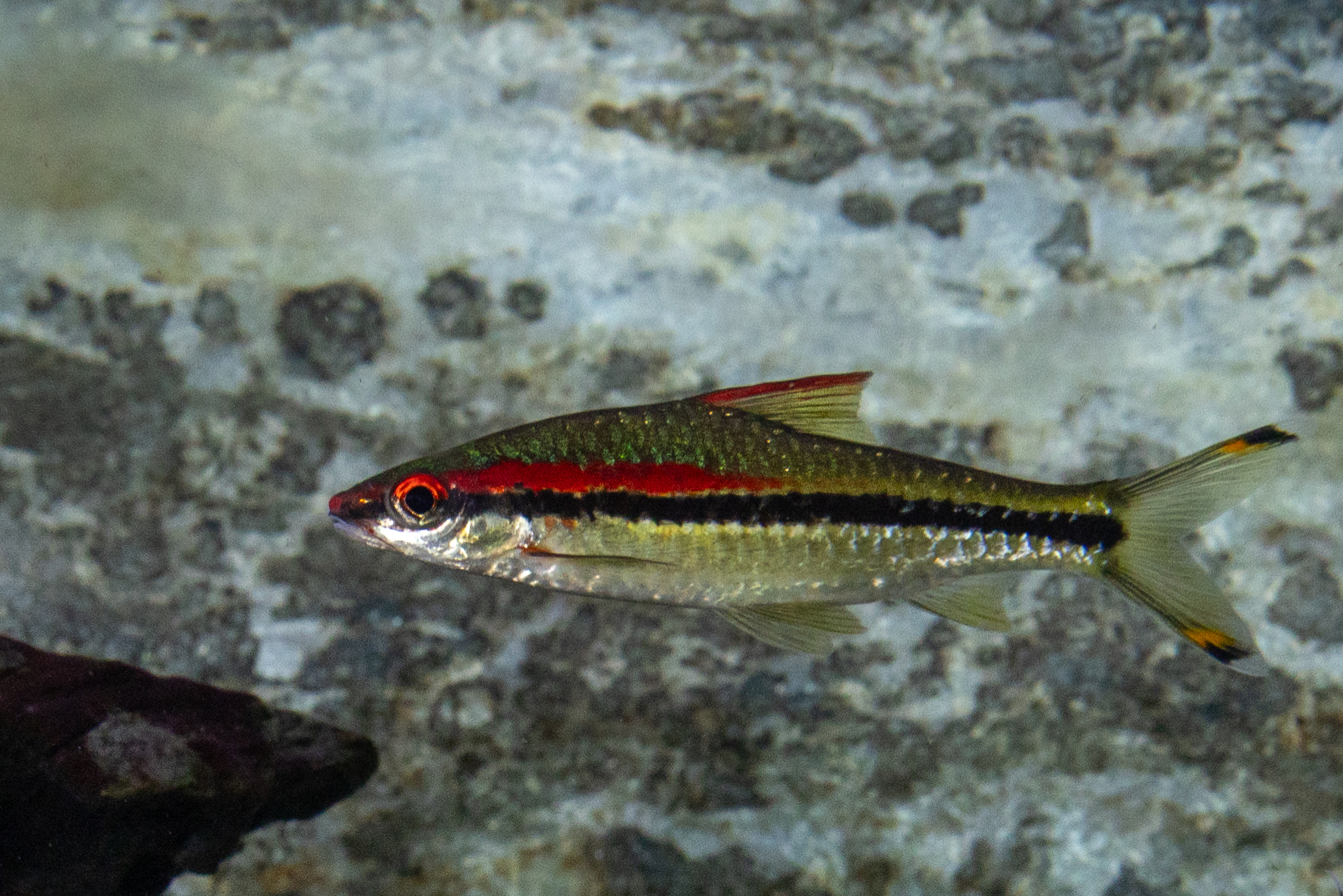
The body is torpedo-shaped and silvery, reaching up to 15 cm in length. A vivid scarlet horizontal stripe runs from the snout tip to the caudal base. A parallel black lateral line runs beneath it. The dorsal fin bears a red blotch edged with yellow and black, and the caudal fin lobes are black and yellow. On mature adults, the forehead develops a beautiful emerald-green metallic sheen.
Care
Requires a spacious aquarium of at least 200 liters, minimum 120 cm long, for a school of 5–6 individuals. Powerful filtration, strong flow, and high dissolved oxygen are mandatory. Water parameters: temperature 15–26°C (optimal 18–22°C), pH 6.5–7.8, hardness 5–25 dGH. The tank must be tightly covered as the fish are prone to jumping. Sensitive to nitrate and nitrite accumulation — weekly water changes of 30–40% are required.
Feeding
Omnivorous and accepts a wide range of foods. The staple diet consists of high-quality flakes or pellets containing carotenoids to maintain intense coloration. Readily takes live and frozen foods: artemia, bloodworms, daphnia. A plant-based component is important: blanched cucumber, spinach, spirulina. Feed twice daily in small portions.
Compatibility
Peaceful schooling species that mixes well with other active fish of similar size: loaches, large tetras, giant danios, rainbowfish. Must be kept in groups of at least 5 to reduce stress and distribute any minor aggression. Avoid slow-moving veiltail fish and sedentary species unable to compete with these active swimmers.
Breeding
Breeding in home aquariums is nearly impossible without hormonal injections. In nature, spawning coincides with the monsoon season; commercial breeding uses hormonal treatments. Only in recent years have the first successful home-aquarium breedings been documented under precisely replicated natural conditions. Females scatter eggs among plants and rocks; incubation takes about 24–36 hours. Purchasing captive-bred specimens from fish farms is strongly recommended.
Fun facts
The Denison Barb is listed as Endangered on the IUCN Red List — one of the very few aquarium fish species to carry this status. In India, the fish is locally known as 'Miss Kerala,' named after its endemic home state in southwestern India. The species was only scientifically described in 1999, despite having already been exported to the aquarium trade for several years prior.