Fish
Green Barb
Barbodes semifasciolatus
Origin: Vietnam, Taiwan, southwestern China (Yunnan, Guangdong provinces), northern Laos; inhabits slow-moving rivers, canals, swamps, and rice paddies
Also known as: Golden Barb, Chinese Barb, Schuberti Barb, Half-striped Barb
Fact sheet
- Size
- 7 cm
- Lifespan
- 5 years
- Minimum tank size
- 80 L
- Temperature
- 18–25 °C
- pH
- 6–7.5
- Hardness GH
- 5–15 °dH
- Temperament
- Peaceful
- Social behavior
- Schooling
- Swimming zone
- Middle
- Diet
- Omnivore
- Jumps out
- Yes
- Eats plants
- No
Varieties
Overview
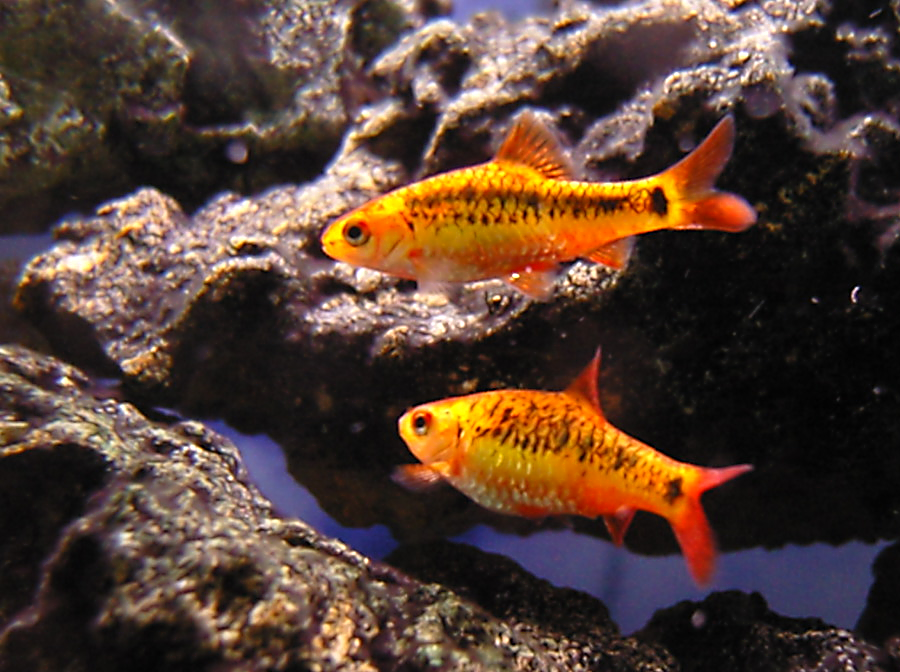
The Green Barb, or Golden Barb (Barbodes semifasciolatus), is a well-known aquarium cyprinid from East and Southeast Asia. The natural form called the 'Green Barb' is rarely available in the trade, while the selectively bred 'Golden' form with bright golden-orange coloration has become one of the most popular aquarium fish worldwide. The first golden barbs were developed in the 1960s through selective breeding. The species is distinguished by its hardiness, undemanding nature, and tolerance of a wide range of water parameters. Lifespan in the aquarium is 5–7 years.
Appearance
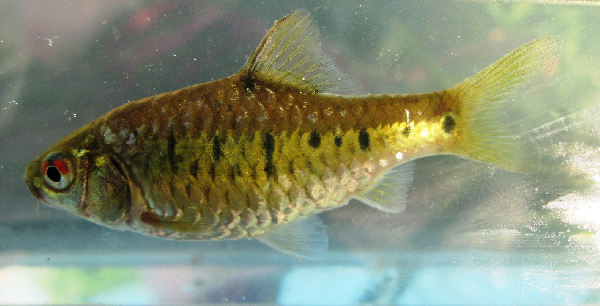
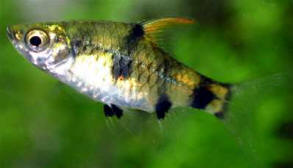
Wild form: body moderately elongated, olive-green with a silvery sheen, with several incomplete dark vertical bars along the sides. Aquarium golden form: intense golden-orange coloration without dark bars, with a metallic sheen. Fins of the golden form are orange with a reddish tinge. Adults reach 6–7.5 cm in length.
Care
An undemanding species; an aquarium of 80–100 liters suits a school of 8–10 fish. Optimal water parameters: temperature 16–24°C (tolerates cool water well), pH 6.0–8.0, hardness 2–20 dGH. Plant the tank along the back and sides with an open swimming area in the center. Weekly water changes of 20–25% maintain optimal water quality.
Feeding
Omnivorous fish with a good appetite that accept a wide variety of foods. The staple diet consists of quality flakes and fine pellets. Live and frozen foods — bloodworms, artemia, daphnia — are eagerly consumed. Plant-based foods are necessary as the fish graze on soft aquarium plants; include spirulina-based foods and blanched vegetables in the diet.
Compatibility
A peaceful schooling species excellent for community aquariums. Mixes well with danios, other small cyprinids, tetras, corydoras, and many other similarly-sized fish. Individual specimens or small groups may nip fins of neighbors. A school of 8–10 individuals significantly reduces this behavior.
Breeding
One of the easiest barbs to breed at home. Spawning occurs in the early morning at first light. Condition breeders with live foods for 1–2 weeks, then move to a breeding tank with fine-leaved plants or a spawning mop. The female scatters 100–400 adhesive eggs among plants. Remove parents after spawning. Eggs incubate for 24–48 hours; fry become free-swimming within 24 hours and feed on infusoria, later transitioning to artemia nauplii.
Fun facts
The golden aquarium form was developed in the 1960s in the USA and has since become one of the most mass-produced aquarium fish in the world. The natural green form has been so thoroughly displaced by the golden form in the trade that many beginners are unaware it even exists. The species tolerates water temperatures down to 16°C, making it suitable for unheated aquariums in temperate climates during summer.