Fish
Clown Barb
Barbodes everetti
Origin: Island of Borneo (Sarawak, Malaysia; West Kalimantan, Indonesia), Singapore and adjacent islands; favors forest streams and shallow forest pools with clean, clear water
Also known as: Everett's Barb, Clown Barb
Fact sheet
- Size
- 12 cm
- Lifespan
- 5 years
- Minimum tank size
- 120 L
- Temperature
- 25–30 °C
- pH
- 6–7
- Hardness GH
- 5–12 °dH
- Temperament
- Peaceful
- Social behavior
- Schooling
- Swimming zone
- Middle
- Diet
- Omnivore
- Jumps out
- Yes
- Eats plants
- Yes
Varieties
Overview
The Clown Barb (Barbodes everetti) is a colorful cyprinid from the island of Borneo, distinguished by its striking 'clown' pattern of several broad dark transverse bars on a bright orange body. Despite sharing a name, it must not be confused with the Clown Loach — this is a true barb of the family Cyprinidae. The species inhabits clean mountain streams and forest pools of Borneo, making it demanding of water quality. In the aquarium hobby it is valued for its unique vivid coloration, activity, and hardiness. When kept in groups it displays interesting social behavior. Lifespan in captivity is 5–7 years.
Appearance
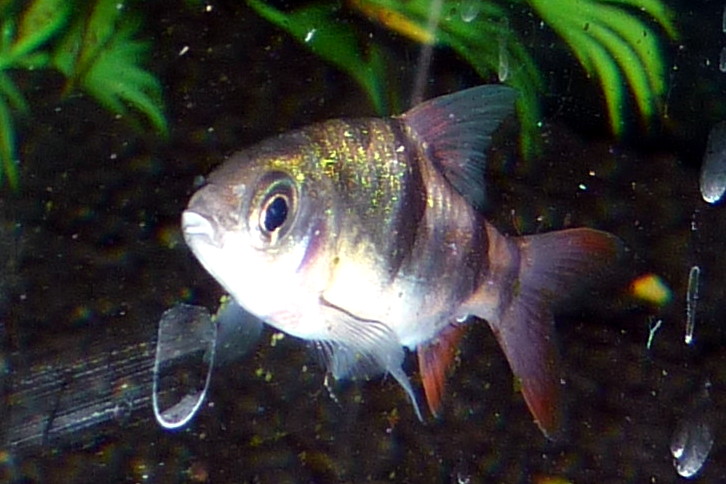
The body is elongated and moderately deep, colored in orange-brown tones with a yellowish-white belly. Four to five irregular broad dark transverse bars and blotches run along the body, creating the 'clown' effect. All fins are reddish-orange. The front part of the iris is often vivid red. Coloration intensifies with age and proper care. Adults reach 10–12 cm in aquariums.
Care
A group of 6+ specimens requires a tank of at least 120–150 liters, minimum 120 cm long. Powerful filtration, moderate flow, and high dissolved oxygen are mandatory — the species is extremely sensitive to organic waste. Optimal parameters: temperature 24–30°C, pH 6.0–7.2 (ideally 6.8), hardness 2–10 dGH. Furnish with driftwood, rocks, and plants leaving open swimming space. Perform 30–50% water changes weekly.
Feeding
Omnivorous with a good appetite. Readily accepts quality flakes and pellets. Live and frozen foods (bloodworms, artemia, tubifex, daphnia) are valuable dietary supplements. A plant component is mandatory: lettuce, spinach, blanched zucchini or cucumber. The fish may graze on soft aquarium plants.
Compatibility
Peaceful schooling species, best kept in groups of 6+. Pairs well with danios, other medium-sized barbs, loaches, and similarly tempered fish. Can be somewhat boisterous during feeding, so avoid veiltail or very slow-moving tankmates. Well suited to Bornean biotope aquariums.
Breeding
Home breeding requires preparation. Set up a breeding tank with 10–15 cm of water, line the bottom with fine gravel or a mesh, and plant fine-leaved plants. Condition the pair separately for 3–4 weeks with intensive live food feeding. Spawning occurs in early morning at 26–29°C. The female lays 500–2000 eggs; remove parents immediately. Fry hatch within 24–48 hours and become free-swimming a day later.
Fun facts
The Clown Barb is frequently confused with the Clown Loach (Chromobotia macracanthus) due to their similar names, but they are entirely different species belonging to different families. The species was described by British zoologist George Albert Boulenger in 1894 from specimens collected in Borneo. Coloration in the Clown Barb intensifies and brightens with age — juvenile specimens appear noticeably paler than well-conditioned adults.