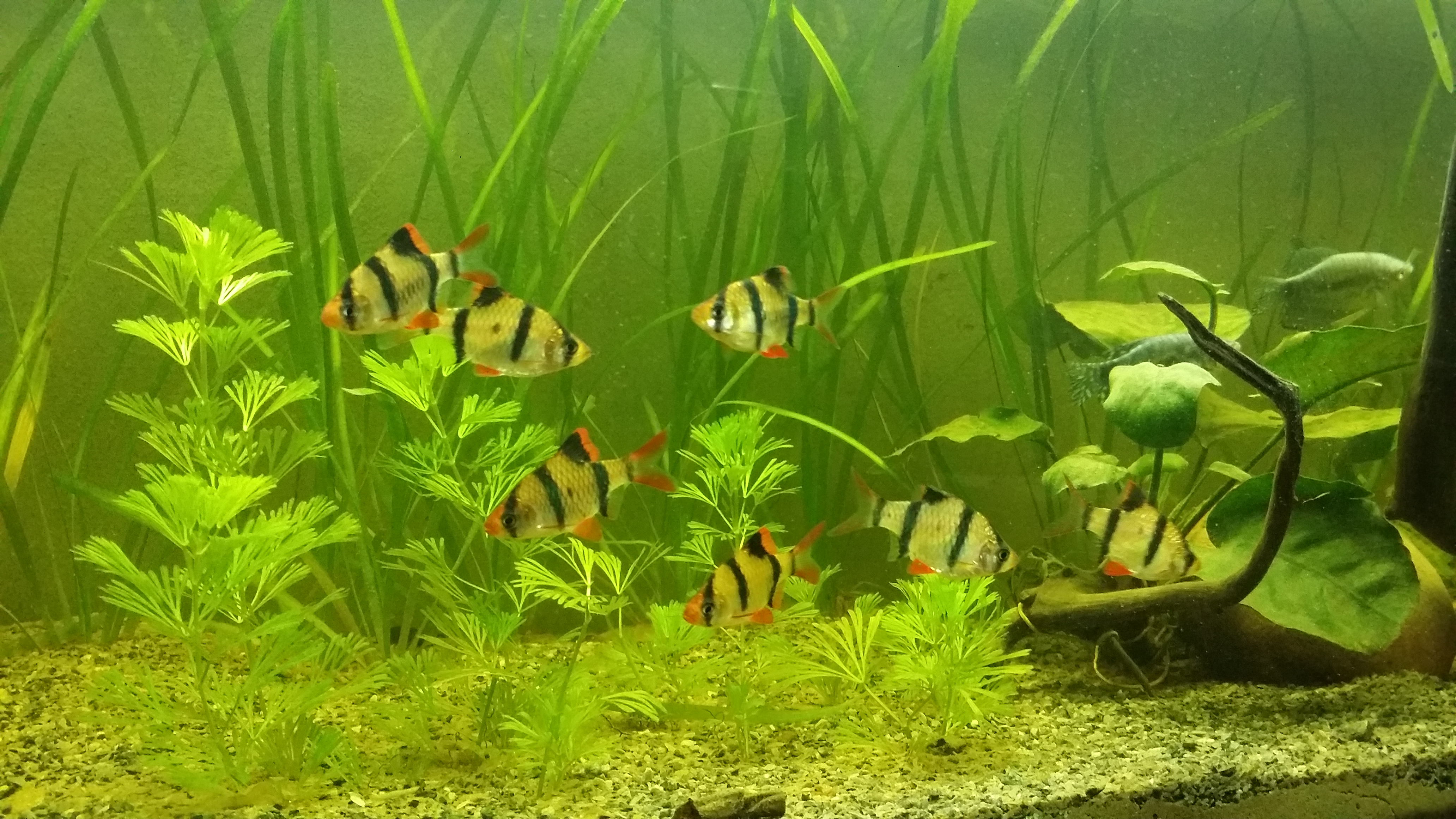
Fish
Mutant Barb
Puntigrus tetrazona var.
Origin: A selectively bred melanistic form of the tiger barb (Puntigrus tetrazona / P. anchisporus). The wild ancestor originates from rivers and streams of Sumatra and Borneo, Indonesia.
Also known as: Moss Barb, Green Tiger Barb, Moss Green Barb, Mossgreen Tiger Barb
Fact sheet
- Size
- 7 cm
- Lifespan
- 5 years
- Minimum tank size
- 80 L
- Temperature
- 20–26 °C
- pH
- 6–7.5
- Hardness GH
- 5–15 °dH
- Temperament
- Semi-aggressive
- Social behavior
- Schooling
- Group size
- 6+ individuals
- Swimming zone
- Middle
- Diet
- Omnivore
- Jumps out
- Yes
- Eats plants
- No
Varieties
Overview
The mutant barb is an artificially developed melanistic form of the tiger barb in which the four characteristic black vertical stripes have merged into a uniform dark green to near-black body coloration. It is also marketed as the moss barb or green tiger barb, names that reflect its distinctive mossy hue. Selective breeding to produce this form began in earnest in the 1970s. In temperament and husbandry needs it is virtually identical to the standard tiger barb. It remains a popular aquarium fish thanks to its striking coloration and hardy nature.
Appearance
Body compact and deep-bodied, typical of the barb family. Overall coloration is a deep forest green to dark olive, sometimes appearing almost black under bright light. The vertical banding of the wild form is fused into a solid dark field on the flanks. Fins are red-orange; males display more vivid fin color and a bright red snout. Adults reach 6–7 cm in length.
Care
A tank of at least 80 liters with open swimming space and dense peripheral planting is recommended. Water parameters: temperature 20–26 °C, pH 6.0–7.5, hardness 5–15 dGH. Moderate current from filtration is appreciated. Keep in groups of at least 8–10 individuals to distribute aggression within the shoal. A tight-fitting lid is essential as these fish are active jumpers.
Feeding
Omnivorous and accepting of most aquarium foods. Offer quality flake and granule foods alongside live and frozen items such as bloodworm, Daphnia, and Artemia. Include vegetable-based foods to support color and immune health. Feed small portions 2–3 times daily.
Compatibility
Notorious fin-nippers when kept in insufficient numbers or with slow-moving, long-finned species. In groups of 8 or more, aggression is directed inward, making them acceptable community fish with danios, rasboras, other barbs, and corydoras. Avoid pairing with bettas, gouramis, or any veil-finned fish.
Breeding
Egg-scattering, free spawner with no parental care. Condition breeders separately on live foods before introducing them to a densely planted or marbled-bottom breeding tank. A female may scatter 300–500 eggs; parents should be removed immediately after spawning. Eggs hatch in 24–48 hours; fry become free-swimming 1–2 days later and require infusoria initially, then Artemia nauplii.
Fun facts
The mossy green color results from melanophore expansion and fusion across the lateral stripe areas, essentially a concentration of black pigment cells over the entire flank. Due to intensive inbreeding during line development, mutant barbs can have weaker immune systems than wild-type tiger barbs and may be more susceptible to bacterial infections. The color appears most vivid in aquariums with dark substrate and subdued lighting, which maximizes the contrast of the green sheen against the red fins.