Fish
Five-banded Barb
Desmopuntius pentazona
Origin: Northwestern Borneo, Sarawak, Malaysia. Inhabits peat swamps, blackwater streams, and other slow-moving or still waters characterized by dark, soft, acidic water.
Also known as: Fiveband Barb, Five Bar Barb, Pentazona Barb
Fact sheet
- Size
- 5 cm
- Lifespan
- 5 years
- Minimum tank size
- 60 L
- Temperature
- 22–28 °C
- pH
- 6–7.5
- Hardness GH
- 2–12 °dH
- Temperament
- Peaceful
- Social behavior
- Schooling
- Swimming zone
- Middle
- Diet
- Omnivore
- Jumps out
- Yes
- Eats plants
- No
Varieties
Overview
The five-banded barb is a small cyprinid from the peat swamps of Borneo. Its golden-orange body crossed by five bold black vertical bars makes it one of the most ornamental small barbs available. The species requires soft, acidic water mimicking blackwater biotope conditions. An important trade note: the closely related six-banded barb (D. hexazona) is frequently sold under the five-banded name — identification is confirmed by counting body bars and checking pigmentation distribution. The five-banded barb is a timid fish that reveals its full beauty only in a properly set-up aquarium with a sufficiently large shoal.
Appearance
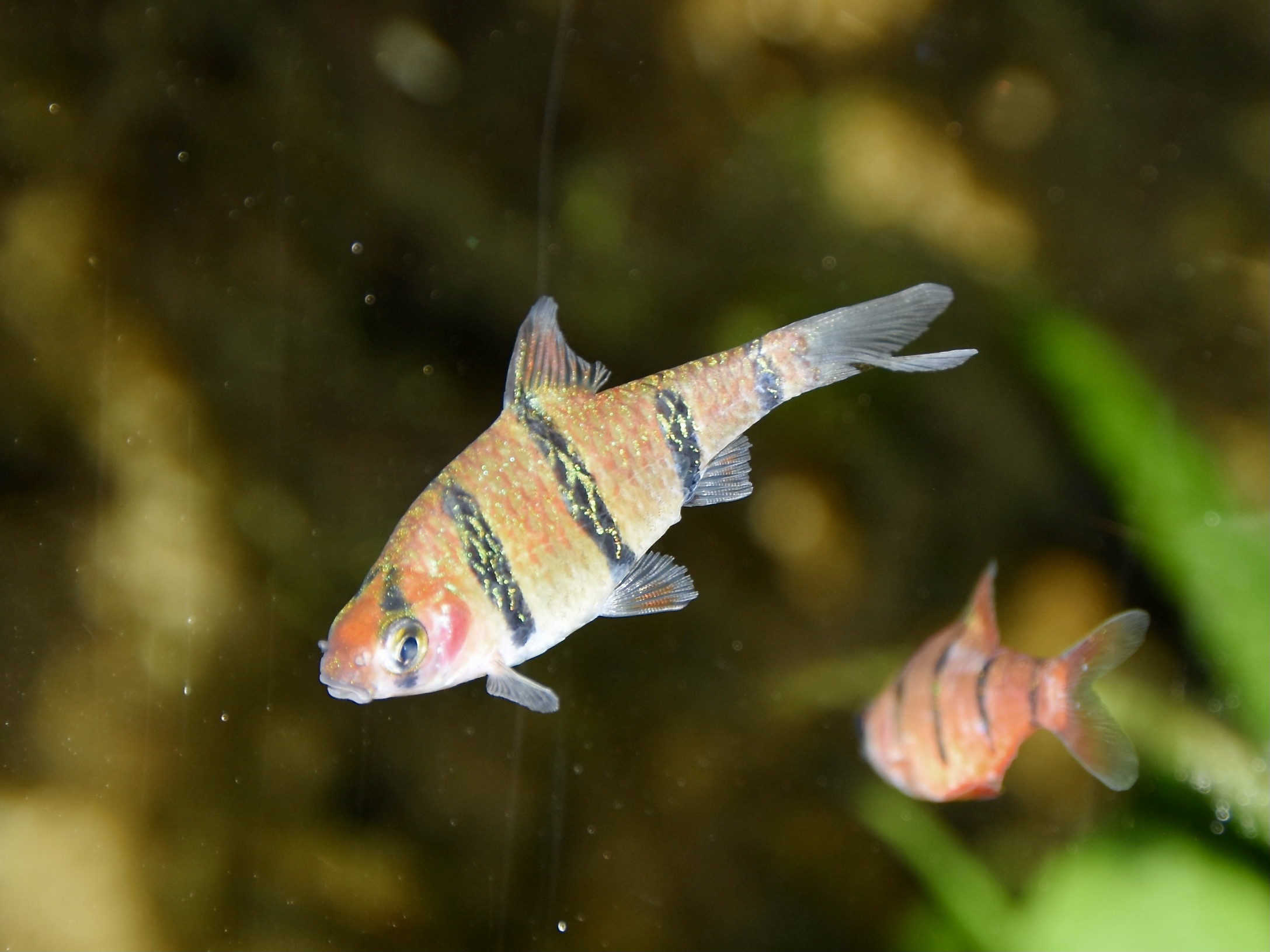
Body small, up to 5.5 cm. Base coloration golden-orange to peach-amber. Five bold black vertical bars cross the body; the first runs through the eye. Fins are translucent with a faint orange wash. Males are slimmer and more intensely colored than females, especially during breeding.
Care
Aquarium footprint at least 80 × 30 cm (~72 L). Blackwater biotope decor is ideal: dark substrate, tannin-stained water (Indian almond leaves or peat filtration), driftwood, and sparse planting. Water parameters are critical: temperature 21–26 °C, pH 4.0–7.0 (optimally 5.0–6.5), hardness 1–5 dGH. Keep in groups of 8–10; reduce lighting intensity. Regular water changes are essential.
Feeding
A micropredator in nature, consuming small insects, worms, and crustaceans. In the aquarium it prefers live and frozen foods — Daphnia, Artemia, and bloodworm. Dry foods are accepted reluctantly; regular live food is necessary to maintain color and breeding condition.
Compatibility
A peaceful species suited to a themed blackwater or Southeast Asian aquarium. Good tankmates include other small barbs (D. hexazona), harlequin rasboras, micro rasboras, corydoras, and dwarf gouramis. Do not house with large or territorial fish.
Breeding
Egg-scattering free spawner with no parental care. In mature tanks spontaneous spawning may occur. For controlled breeding, use a dimly lit tank with egg-protection matting or fine-leaved plants; water should be very soft (1–2 dGH) and acidic (pH 5.0–5.5). Eggs hatch in 24–36 h; fry become free-swimming after 3–4 days. First food: infusoria.
Fun facts
The majority of fish sold as 'five-banded barb' are actually the six-banded barb D. hexazona — confirmed by counting the body bars. The peat swamps this species inhabits are among the most acidic aquatic environments on Earth, with pH values sometimes below 4.0. Tannin-stained water in a blackwater setup with driftwood and Catappa leaves visibly intensifies body color and reduces stress in these fish.