
Fish
Tiger Barb
Puntigrus tetrazona
Origin: Endemic to central and southern Sumatra, Indonesia. Inhabits forest streams and small rivers with clear water and sandy to rocky substrates. Naturalized feral populations exist in Australia, the USA, Colombia, Suriname, and Singapore.
Also known as: Sumatra Barb, Partbelt Barb
Fact sheet
- Size
- 7 cm
- Lifespan
- 6 years
- Minimum tank size
- 80 L
- Temperature
- 20–26 °C
- pH
- 6–7.5
- Hardness GH
- 5–15 °dH
- Temperament
- Semi-aggressive
- Social behavior
- Schooling
- Group size
- 6+ individuals
- Swimming zone
- Middle
- Diet
- Omnivore
- Jumps out
- Yes
- Eats plants
- No
Varieties
Overview
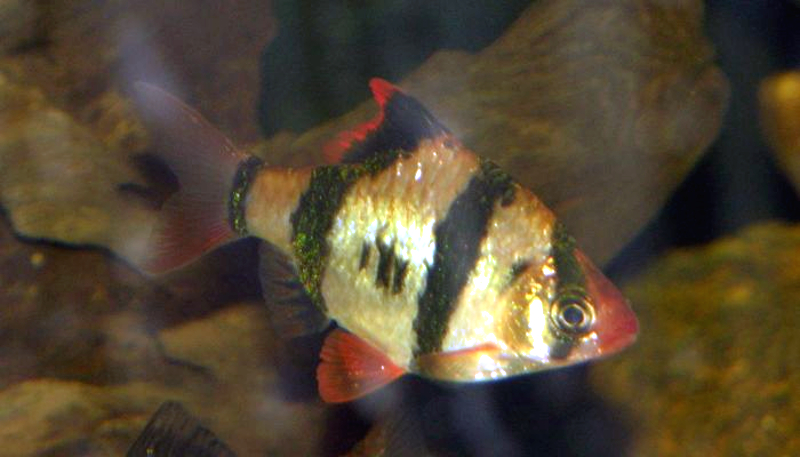
The tiger barb is one of the most widely kept aquarium fish in the world, introduced to the hobby around 1935. An energetic shoaling fish, it is instantly recognizable by its four bold black vertical bars on a golden-orange body and vivid red fins. The species has a well-documented reputation for fin-nipping, but this behavior is greatly reduced when the fish are kept in groups of eight or more, redirecting aggression within the shoal. Tiger barbs are undemanding regarding water quality and diet, making them accessible to beginners. Selective breeding has produced numerous popular color forms.
Appearance
Body deep and compact, reaching 6–7 cm (typically 5–6 cm in the aquarium). Base coloration golden-silver to orange-yellow with four vertical black bars. Snout and lower fins bright red; dorsal fin black with a red border. Females are larger and deeper-bodied; males develop an intensely red snout and throat during breeding.
Care
Minimum 80 L (footprint 80 × 30 cm). Arrange the aquarium with open swimming space, dense perimeter planting, floating plants, and driftwood. Water parameters: temperature 20–26 °C, pH 5.0–8.0 (optimally 6.5–7.0), hardness 1–20 dGH. Keep exclusively in groups of 8–10 or more. A secure lid is mandatory. Moderate filtration and regular water changes are required.
Feeding
Omnivorous. In nature feeds on aquatic invertebrates, insect larvae, and plant debris. In the aquarium it accepts quality flake and granule foods alongside live and frozen bloodworm, Daphnia, and Artemia. Feed small portions 2–3 times daily. Including vegetable-based foods enhances coloration.
Compatibility
Notorious fin-nippers, particularly toward slow-moving fish with long fins (bettas, gouramis, veil-tails). In groups of 8+, aggression stays within the shoal. Good tankmates: danios, rasboras, other barbs, corydoras, and loaches. Avoid large cichlids and territorial species.
Breeding
Egg-scattering free spawner. Condition males and females separately before introducing them to a 40–60 L breeding tank fitted with egg-protection matting and fine-leaved plants. A female scatters 200–500 eggs (up to 1000). Remove parents immediately after spawning to prevent egg predation. Incubation 24–48 h. Fry absorb the yolk sac over 2–3 days, then require infusoria followed by Artemia nauplii.
Fun facts
The tiger barb was one of the first aquarium fish for which multiple color varieties were deliberately bred: green/moss, albino, golden, platinum, and fluorescent (GloFish) forms are now all commercially available. In the wild, tiger barbs form large shoals in moderate currents; replicating this flow in the aquarium significantly reduces stress and aggression. Despite their fin-nipping reputation, tiger barbs kept in adequate numbers coexist successfully with a wide range of peaceful mid-water community species.