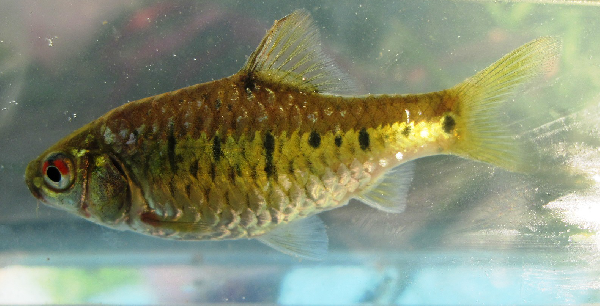
Fish
Schubert's Barb
Puntius semifasciolatus
Origin: The wild species Puntius semifasciolatus originates from the Red River basin in Vietnam, southeastern China, and northern Laos. The golden 'Schuberti' variety is a domestically bred strain developed in the United States during the 1960s.
Also known as: Gold barb (captive form), Green barb (wild form), Chinese barb, Half-banded barb
Fact sheet
- Size
- 7 cm
- Lifespan
- 5 years
- Minimum tank size
- 80 L
- Temperature
- 18–26 °C
- pH
- 6–7.5
- Hardness GH
- 5–15 °dH
- Temperament
- Peaceful
- Social behavior
- Schooling
- Swimming zone
- Middle
- Diet
- Omnivore
- Jumps out
- Yes
- Eats plants
- No
Varieties
Overview
Schubert's barb is one of the most popular aquarium cyprinids, prized for its vivid golden-orange colouration and easy care. The form was developed by hobbyist Thomas Schubert of Camden, New Jersey, in the 1960s through selective breeding from the wild green barb. It was initially misidentified as a separate species before being recognised as a captive strain. The fish is active and forms loose schools, reaching up to 7.5 cm and living four to six years in captivity. It is highly recommended for beginners due to its wide tolerance of water parameters and acceptance of all standard foods. Groups of ten or more are recommended to spread intraspecific aggression across the school.
Appearance
The body is compact and moderately elongated, uniformly golden-yellow to orange with faint dark markings along the lateral line. Males develop vivid red pigmentation on the belly and pelvic fins during breeding condition. Females are notably deeper-bodied and larger than males. Short barbels are present at the corners of the mouth. Fish produced through intensive selective breeding may occasionally exhibit minor fin deformities.
Care
A minimum tank of 90 × 30 cm (approximately 80 L) is needed for a group of ten. Temperature 16–24°C (tolerates brief drops to 14°C), pH 6.0–8.0, hardness 2–20 dGH. Moderate aeration and filtration are required, along with weekly water changes of 25–30%. Plants and shelters are welcome, but a clear open swimming area must be preserved. The species tolerates a broad range of water chemistry and is highly adaptable.
Feeding
An omnivore that readily accepts quality flakes, granules, and live or frozen foods such as bloodworm, daphnia, artemia, and tubifex. Its natural diet consists of small invertebrates, insects, and plant matter. Vegetable supplements such as blanched spinach, courgette, or spirulina-based foods support health and colour. Feed twice daily in small amounts.
Compatibility
An active and mildly aggressive species that should not be kept with long-finned fish such as bettas or veiltail goldfish, as it may nip fins. It thrives alongside other medium-sized cyprinids, tetras, rainbowfish, and corydoras catfish. Keeping a large shoal (ten or more) reduces individual aggression and produces more natural behaviour.
Breeding
Spawning typically occurs at first light in the morning. Condition the pair separately for one to two weeks on live foods. Use a spawning tank of at least 50 L with fine-leaved plants or a mesh screen. A female may produce 100–400 adhesive eggs; remove adults immediately after spawning to prevent egg predation. Eggs hatch in 24–48 hours, with fry becoming free-swimming on days three to five. First foods are infusoria and baby brine shrimp; the fry grow rapidly.
Fun facts
The Schuberti form was created by an amateur aquarist, not a scientist: the fish is named after Thomas Schubert of New Jersey, USA, who developed it in the 1960s. The wild ancestor — the green barb — is far rarer in the trade than its golden descendant, despite being the original species. The golden colouration is not a genetic mutation in the biological sense, but the product of decades of selective breeding for a specific pigmentation phenotype.