Fish
Gold Barb
Barbodes semifasciolatus var.
Origin: Southeast Asia: the Malay Peninsula, Sumatra, and Borneo. Inhabits lowland rivers and streams with slow current, rich vegetation, and slightly acidic water chemistry.
Also known as: Gold-finned barb, Sachsi barb, Puntius sachsii
Fact sheet
- Size
- 7 cm
- Lifespan
- 5 years
- Minimum tank size
- 80 L
- Temperature
- 18–25 °C
- pH
- 6–7.5
- Hardness GH
- 5–15 °dH
- Temperament
- Peaceful
- Social behavior
- Schooling
- Swimming zone
- Middle
- Diet
- Omnivore
- Jumps out
- Yes
- Eats plants
- No
Varieties
Overview
The gold barb (Pethia sachsii) is a small, brightly coloured cyprinid distinguished by its attractive golden-yellow colouration and characteristic dark spots. It is sometimes confused with the Schuberti aquarium strain, but is a biologically independent species with its own natural range and ecology. The fish reaches 5–7 cm in length and lives five to seven years with proper care. Undemanding in husbandry, it is well suited to community aquaria and beginner hobbyists alike. Active and social, it thrives in groups of six or more. The golden colouration is most vivid in males during the spawning season.
Appearance
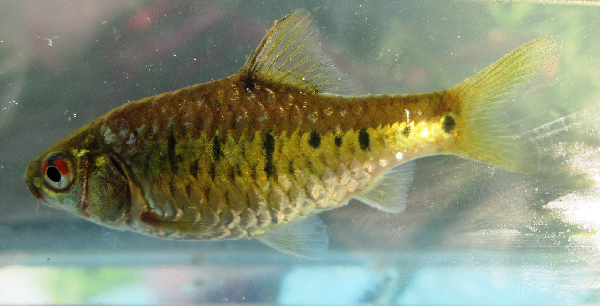
The body is compact and moderately elongated, uniformly golden-yellow to bright yellow. A characteristic diagnostic feature is a rounded black spot at the base of the dorsal fin, with a secondary spot on the caudal peduncle. Fins are yellowish to orange; males are more vividly coloured with intensified belly hues during spawning. Females are noticeably deeper-bodied and larger.
Care
A tank of 60–80 L is sufficient for a group of six to eight. Temperature 22–26°C, pH 6.0–7.5, hardness 5–15 dGH. The species appreciates densely planted areas with open swimming zones. Moderate filtration and weekly water changes of 25–30% are required. A fine sandy or small-gravel substrate approximates natural conditions. A lid is advisable although the species rarely jumps.
Feeding
An omnivore accepting dry flakes, granules, and live or frozen foods such as bloodworm, daphnia, artemia, and tubifex. Vegetable components — blanched spinach, algae, spirulina — help maintain the vivid golden colouration. Feed in moderation twice daily; overfeeding leads to obesity and water quality decline.
Compatibility
A peaceful schooling species that coexists well with most similarly sized fish. Suitable companions include tetras, danios, other small barbs, corydoras catfish, and small characins. Solitary individuals become timid; a group is essential for natural behaviour and colouration.
Breeding
An egg-scattering free spawner with no parental care. Condition breeders separately and feed live foods generously before spawning. Use a 40–50 L spawning tank with fine-leaved plants or a mesh screen. A female may produce 100–300 eggs; remove adults immediately. Eggs hatch in 24–48 hours, with fry free-swimming on days three to five, initially eating infusoria then baby brine shrimp. Growth is rapid.
Fun facts
Pethia sachsii is frequently confused with the Schuberti form of the green barb, but it is a biologically distinct species with a different natural range and ecology. The male's golden colouration reaches peak intensity during the spawning season under optimal water conditions. This small barb has been bred for aquaria in Southeast Asia for generations, though it remains less commonly exported to Europe than the competing Schuberti strain.