Fish
Madagascar Rainbowfish (Bedotia)
Bedotia geayi
Origin: Endemic to the island of Madagascar. Inhabits fast-flowing mountain streams and rivers with clear, well-oxygenated water, primarily in the eastern part of the island.
Also known as: Geay's rainbowfish, Madagascar reed fish, Bedotia
Fact sheet
- Size
- 7 cm
- Lifespan
- 3 years
- Minimum tank size
- 80 L
- Temperature
- 18–24 °C
- pH
- 7–8
- Hardness GH
- 10–20 °dH
- Temperament
- Peaceful
- Social behavior
- Schooling
- Swimming zone
- Top, Middle
- Diet
- Omnivore
- Jumps out
- Yes
- Eats plants
- No
Varieties
Overview
The Madagascar rainbowfish is a unique freshwater species belonging to the family Bedotiidae, which is endemic to Madagascar. It resembles the rainbowfish of Australia and Southeast Asia in ecological role and general appearance, though it is not closely related to them. The fish reaches 12–15 cm and is distinguished by exquisite metallic colouration blending blue and yellowish tones. In the wild it is threatened by deforestation and alterations to Madagascar's river hydrology. Aquarium breeding therefore carries genuine conservation value for maintaining the species' genetic diversity. Clean, highly oxygenated water and social keeping in groups are essential for long-term success.
Appearance
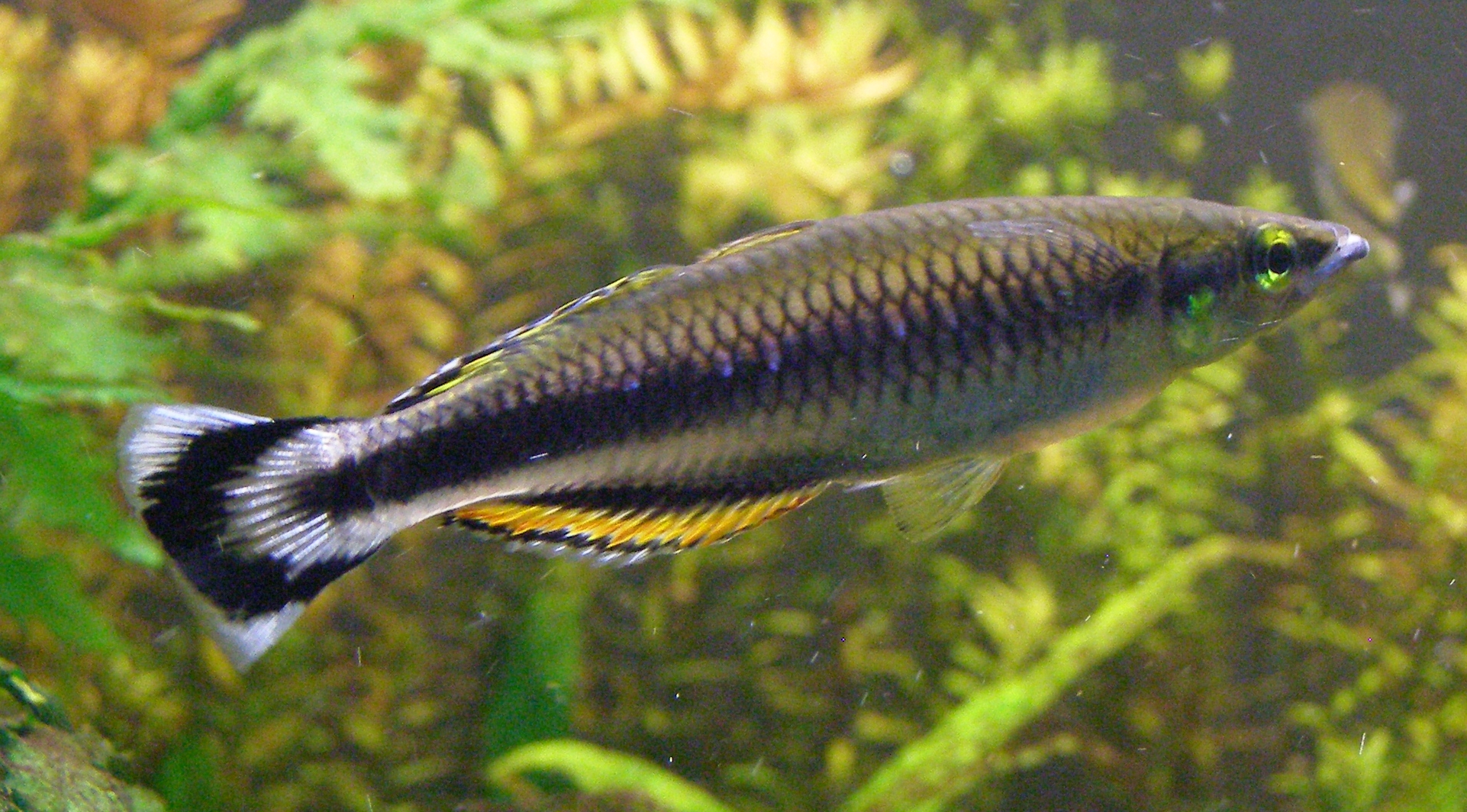
The body is elongated and streamlined with a pointed head and fan-shaped caudal fin. The back is yellowish-brown; the flanks bear characteristic blue or bluish lateral bands with metallic green iridescence. Fins are orange-yellow with black or reddish borders; the tail ranges from whitish to near-black with possible blood-red outer edges. Males are significantly more vividly coloured than females.
Care
A tank of 120–150 cm (200–250 L) is the minimum for a group of six to eight; a 300 L or larger tank is preferred for groups of ten or more. Temperature 20–24°C, pH 7.0–8.0, hardness 10–18 dGH. Water must be crystal clear with high oxygenation and moderate current. Weekly partial water changes of 30–40% are non-negotiable. Dense planting along the sides and back with an open central swimming area is ideal. A secure cover is mandatory as the species is an excellent jumper.
Feeding
An omnivore with a strong preference for protein. Readily consumes bloodworm, artemia, daphnia, and small insects; also accepts quality flakes and pellets formulated for rainbowfish. Live and frozen foods help maintain vivid colouration and stimulate spawning behaviour. Feed two to three times daily in small portions.
Compatibility
A peaceful schooling species that coexists best with other similarly sized tranquil fish. Compatibility with other rainbowfish, larger tetras, peaceful cichlids, and catfish is good. Best kept away from very slow-moving or tiny species. Males engage in mild competitive displays within the shoal without causing injury.
Breeding
Daily spawning takes place among fine-leaved plants, with each egg individually attached by a short thread. Incubation lasts six to seven days. Parents do not actively guard or predate on eggs, but separating spawners increases yield. Newly hatched larvae consume infusoria and paramecia initially, then progress to artemia nauplii. Juveniles grow relatively slowly compared to other egg-scattering species.
Fun facts
Bedotia are Madagascan endemics: no member of the family Bedotiidae is found anywhere else on Earth. Despite superficial similarities to Australian and New Guinean rainbowfish, Bedotia belong to an independently evolved lineage — a textbook example of convergent evolution. Captive breeding of Bedotia has genuine conservation value, as many wild populations are under pressure from the destruction of Madagascar's forested river catchments.