Fish
Pike Livebearer
Belonesox belizanus
Origin: Central America, ranging from southern Mexico (Veracruz) through Belize, Guatemala, and Honduras. Inhabits shallow lakes, swamps, river backwaters, and densely vegetated shorelines, typically near the water surface.
Also known as: Pike killifish, Pike topminnow, Top minnow
Fact sheet
- Size
- 20 cm
- Lifespan
- 5 years
- Minimum tank size
- 200 L
- Temperature
- 25–30 °C
- pH
- 7–8.5
- Hardness GH
- 10–25 °dH
- Temperament
- Predator
- Social behavior
- In pairs
- Swimming zone
- Top, Middle
- Diet
- Carnivore
- Jumps out
- Yes
- Eats plants
- No
Varieties
Overview
The pike livebearer is the sole member of its genus and one of the very few dedicated piscivores among the livebearing family Poeciliidae. Its elongated body, projecting lower jaw, and ambush hunting style give it a striking resemblance to a pike — hence its common name. Females are dramatically larger than males, reaching 22–23 cm while males rarely exceed 10 cm. The species tolerates a wide salinity range from fresh to near-marine, making it highly euryhaline. Its husbandry demands experience: the fish requires live fish prey and is aggressive towards anything it can swallow. Recommended only for experienced aquarists.
Appearance
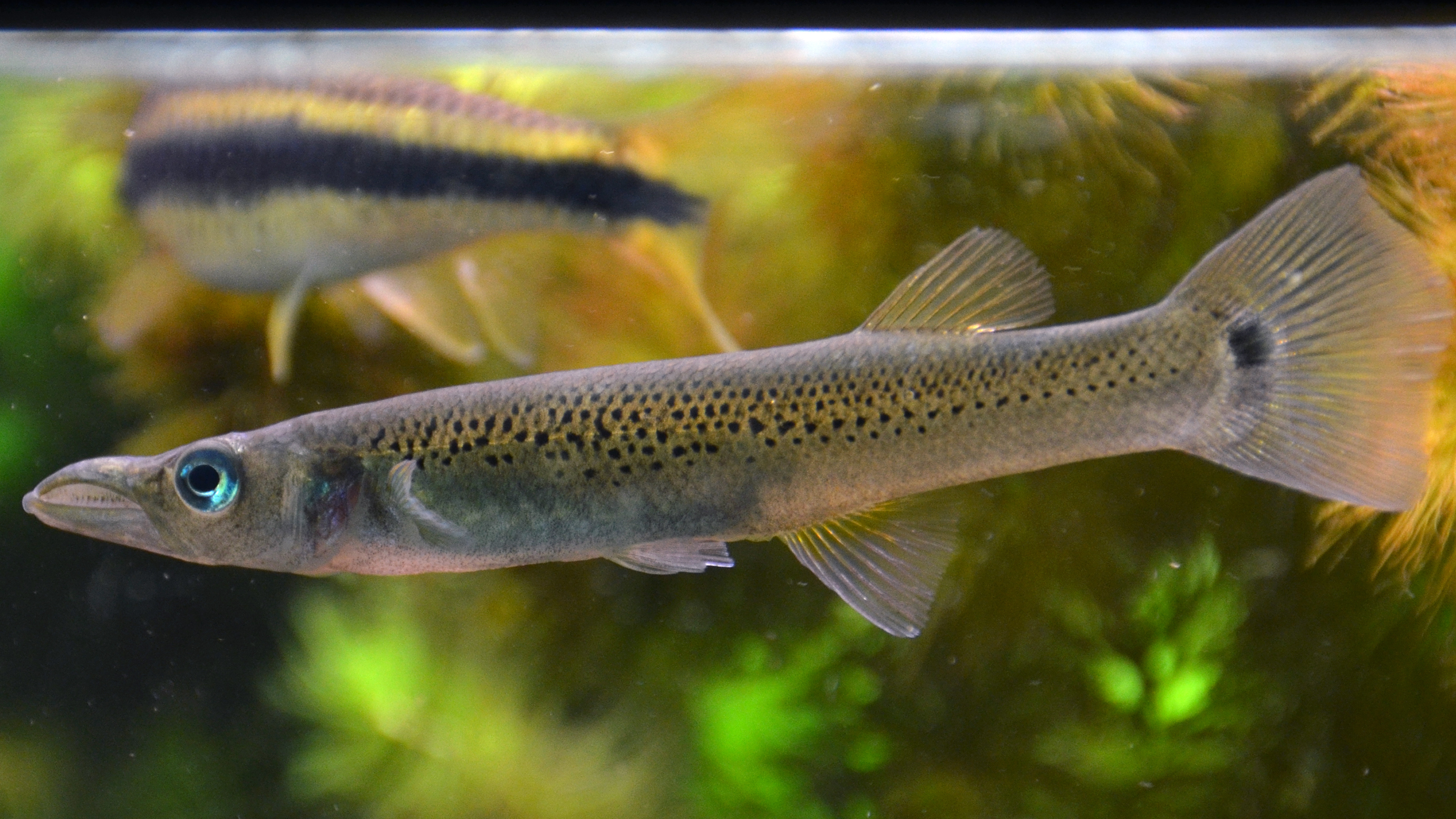
The body is strongly elongated and nearly cylindrical, with a flat dorsal profile and a distinctly projecting lower jaw adapted for surface ambush predation. The back is light brown to olive, flanks slightly darker with small dark spots often forming a broken lateral line. A prominent dark spot marks the caudal fin base. Females are much larger and deeper-bodied than males; males possess a modified gonopodium for internal fertilisation.
Care
A minimum 150 L tank (approximately 100 cm long) is needed for a pair. Temperature 25–30°C, pH 7.5–8.0, hardness 10–26 dGH; a 1–1.5% salt addition is recommended. Dense plant cover provides essential refuge and acts as a physical barrier between individuals. The fish remains near the surface, so filtration should not generate strong surface turbulence. A tightly fitting cover is mandatory. Lifespan five to ten years.
Feeding
An obligate piscivore whose natural diet consists almost exclusively of live fish — guppy fry, swordtail fry, and platy fry are commonly used. Transition to frozen fish pieces or other non-living foods is possible but requires patience and gradual weaning. Tubifex and invertebrate-only diets are generally refused. Feed once every one to two days.
Compatibility
Species tank only, or kept exclusively with fish larger than the pike livebearer. Any fish that fits in its mouth will be eaten immediately. Males can fight with one another; females may attack males after parturition. Entirely unsuitable for a community aquarium.
Breeding
An internal-fertilising livebearer. Gestation lasts 30–50 days, after which the female delivers up to 100–120 large, well-developed fry of 1–2 cm. Fry are immediately capable of predatory behaviour and cannibalism among siblings and from the mother is a real risk. Separate fry immediately and feed live cyclops and artemia nauplii, gradually graduating to small live fish.
Fun facts
The pike livebearer is the only livebearing cyprinodontiform specialising almost exclusively on fish prey: invertebrates hold little interest even for hungry individuals. Its euryhalinity is exceptional: the species tolerates freshwater, brackish water, and near-marine conditions — a trait that has made it an established invasive species in Hawaii, Florida, and Israel. Fry are born as fully formed micro-predators and begin hunting artemia nauplii within hours of birth.