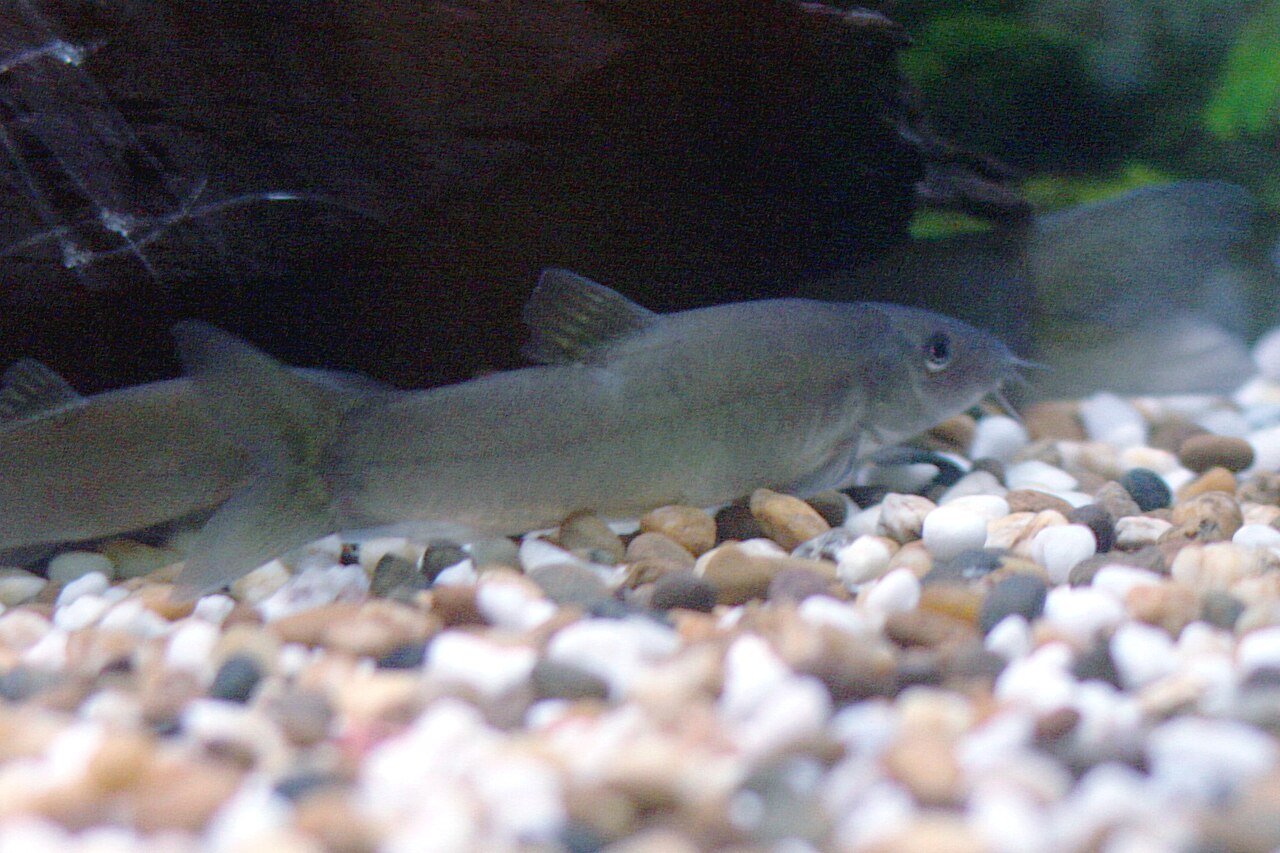
Variety of Sun Loach (Botia eos)
Yasuhikotakia lecontei
Syncrossus eos
Origin: Southeast Asia — Mekong system: Laos, Cambodia, Thailand
Also known as: Botia eos, Yasuhikotakia eos, Dawn loach
Fact sheet
- Size
- 15 cm
- Lifespan
- 10 years
- Minimum tank size
- 200 L
- Temperature
- 23–30 °C
- pH
- 6–7.5
- Hardness GH
- 5–15 °dH
- Temperament
- Semi-aggressive
- Social behavior
- Schooling
- Swimming zone
- Bottom
- Diet
- Omnivore
- Jumps out
- No
- Eats plants
- No
Overview
A rare species from the lower Mekong basin. Similar in appearance to Y. eos but with a paler colouration. Extremely rarely seen in the aquarium trade.
Appearance
Shared with the species: Sun Loach (Botia eos)
Adults reach up to 11 cm. The body is elongated and torpedo-shaped with a yellowish-brown base colouration and metallic sheen. Juveniles display dark vertical bars on the flanks that often partially merge in adults. A large dark blotch marks the caudal peduncle. The dorsal fin has 10–11 branched rays — a diagnostic character separating this species from close relatives. The inferior mouth bears characteristic barbels.
Care
Shared with the species: Sun Loach (Botia eos)
A minimum tank footprint of 120 × 30 cm (approximately 110 litres) is needed for a group of 5–6 fish; 150 × 40 cm is preferable. Substrate should be fine sand with smooth cobbles, mixed gravel, and driftwood on top. Strong water movement and aeration are mandatory. Water parameters: temperature 23–28 °C, pH 6.0–7.5, hardness 2–12 dGH. A tight-fitting lid is essential. Weekly water changes of 30–50% of tank volume should be performed. The species is sensitive to deteriorating water quality and must never be introduced to biologically immature aquaria.
Feeding
Shared with the species: Sun Loach (Botia eos)
Readily accepts a wide range of foods including quality sinking pellets, catfish tablets, frozen bloodworm, Artemia, Mysis shrimp, and daphnia. Larger adults eagerly take chopped prawns and mussels. An effective snail controller in the aquarium. Vegetable supplements (blanched cucumber, courgette, spinach) are beneficial. Feed twice daily.
Compatibility
Shared with the species: Sun Loach (Botia eos)
An aggressive species unsuitable for general community tanks with delicate fish. Best maintained in a species-only setup or alongside other robust, combative loach species. Not recommended with small fish, long-finned forms, or timid species. Fish establish a firm hierarchy within the group, so abundant hiding places for subordinate individuals are critical.
Breeding
Shared with the species: Sun Loach (Botia eos)
No aquarium spawnings have been documented. In nature fish are believed to migrate to flooded plains during the rainy season to spawn. Commercial breeding employs hormonal stimulation. Breeding in the home aquarium is considered impractical without specialist facilities and hormonal intervention.
Fun facts
Shared with the species: Sun Loach (Botia eos)
The diagnostic character of this species is the presence of 10–11 branched dorsal-fin rays, distinguishing it from similar-looking Yasuhikotakia species. Sun Loaches produce audible clicking sounds during feeding and social interactions within the group, a behaviour typical of botiid loaches.